

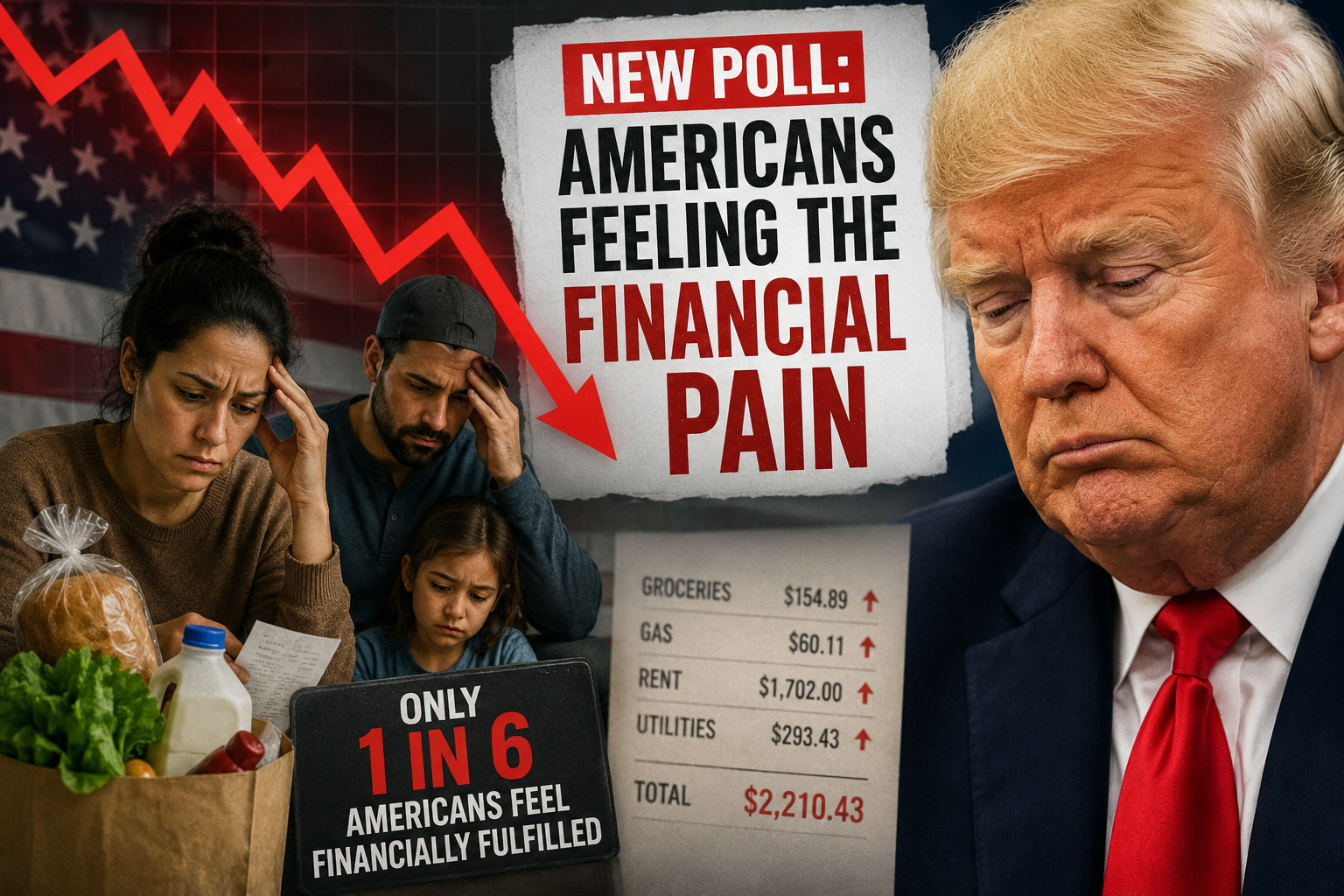
President Donald Trump is facing a new political headache as a fresh survey suggests millions of Americans are still not feeling the economic comeback he keeps trying to sell.
A new Edward Jones and Gallup survey found that only one in six Americans say they feel financially fulfilled, meaning their money allows them to live the life they actually want. Roughly one-third of U.S. adults say they are financially stressed, while just over half say they feel conflicted about their financial situation.
That is a grim snapshot for a president who has repeatedly insisted that Americans are thriving under his leadership.
The numbers arrive at a dangerous moment for Trump and Republicans, who are heading into a high-stakes midterm season with affordability still dominating kitchen-table conversations across the country. While the White House continues to project confidence, the survey paints a very different picture: a nation where many families are still anxious, stretched thin, and unconvinced that the economy is working for them.
The divide is especially clear by age and income. Americans 65 and older were more likely to say they feel financially fulfilled, while wealthier Americans reported significantly higher levels of satisfaction. For middle-class and lower-income families, however, the picture appears far more strained.
That matters politically.
According to Brookings, inflation, stagnant wages, and rising everyday costs continue to hit middle- and lower-income Americans hard, with Black and Latino communities facing particular pressure. Those are the same groups both parties are aggressively trying to reach before the next election cycle. Some voters who shifted toward Trump in 2024 because of economic frustration may now be asking whether his promises have actually improved their lives.
For Democrats, the poll offers a potential opening. Trump’s political brand has long been built around the idea that he is a businessman who can deliver prosperity. But if voters still feel squeezed at the grocery store, at the gas pump, and in their monthly bills, that message could be a tough sell.
Other polling has shown similar warning signs for the White House. A majority of Americans, 57 percent, believe the country is heading in the wrong direction. Meanwhile, a net 76 percent describe current economic conditions as either fair or poor.
That is not exactly the image of a booming economy.
The disconnect has become one of Trump’s most persistent political problems. In his State of the Union address, he declared that Americans were “thriving.” But many voters appear to be looking at their bank accounts and reaching a very different conclusion.
Trump also drew criticism in mid-May when he said he does not “think about Americans’ financial situation” while negotiating with Iran. For a president already struggling to convince people that he understands their economic pain, the remark gave critics a ready-made attack line.
The broader issue is affordability. Even though Trump inherited what many considered a strong economy, rising costs remain a major burden for many households. Americans continue to worry about rent, food prices, energy bills, childcare, insurance, and whether their wages can keep up.
Some critics argue that Trump’s own policies and foreign policy moves have made those pressures worse. Inflation reportedly reached 3.8 percent in April, outpacing wage growth for the first time since May 2023.
That is a major problem for any president trying to run on economic strength.
For now, the White House is trying to project optimism. But the polling suggests voters may not be buying it. And if Americans continue to feel financially trapped, Republicans could enter the midterms facing one of the most dangerous political forces in the country: angry voters who feel like Washington is telling them the economy is great while their own lives say otherwise.
The White House has been contacted for comment.
Discover more from Next Gen News
Subscribe to get the latest posts sent to your email.