

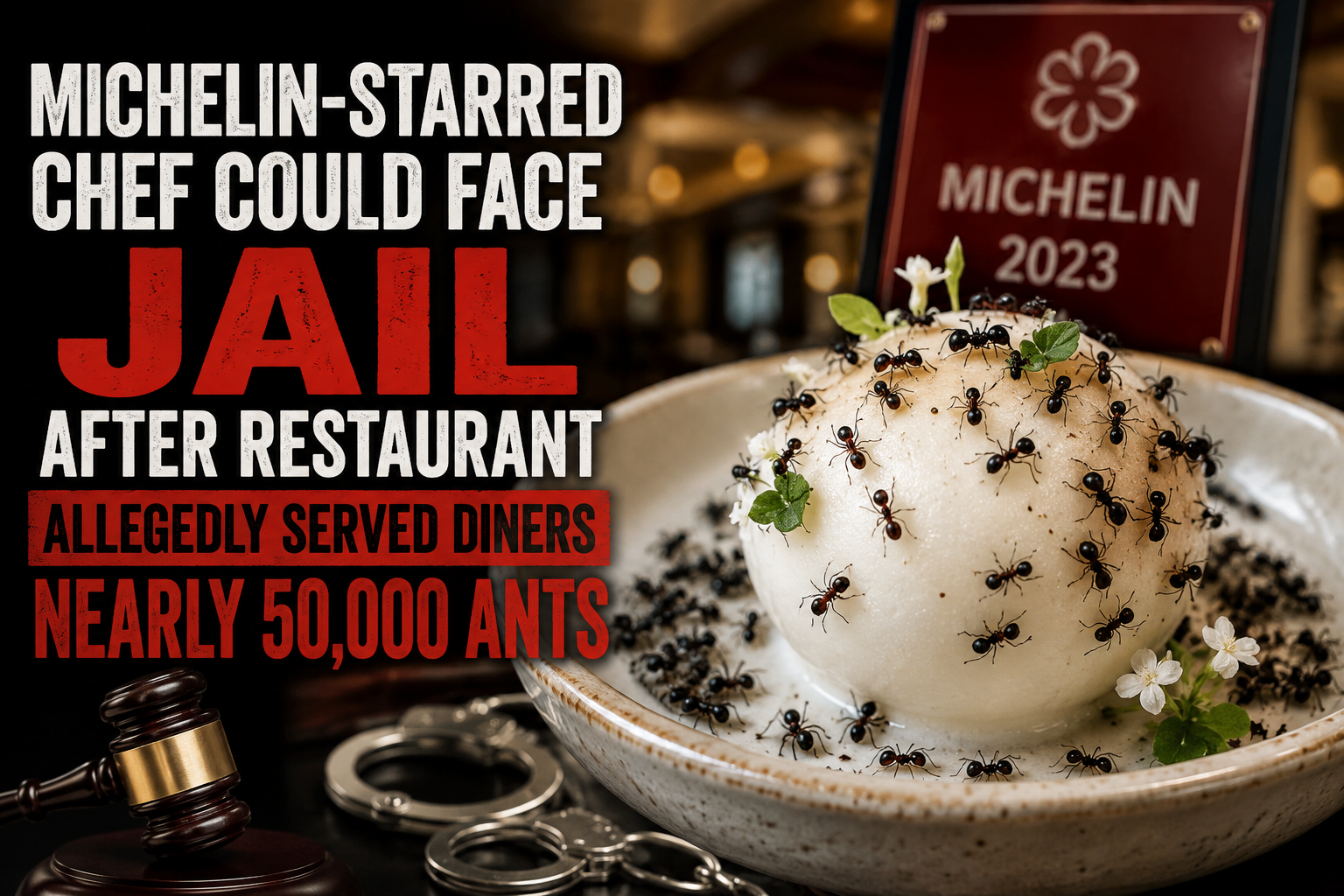
A Michelin-starred restaurant in South Korea is now at the center of a bizarre food scandal after prosecutors accused the upscale Seoul eatery of serving diners thousands of ants as a sorbet topping.
The restaurant’s owner, who has not been publicly identified in court documents, is facing up to one year behind bars and a fine of roughly $13,510 after allegedly using ants that were not approved for human consumption under South Korea’s Food Sanitation Act.
While edible insects have become a trendy talking point in the global food world, South Korean law only allows certain insect species to be served as food. Ants are not on that list.
According to the BBC, the country currently permits 10 insect species for human consumption, including grasshoppers, mealworms, silkworm pupae, locusts and two-spotted crickets. Those species are evaluated under health and nutrition standards. Ants, however, are not legally approved.
Authorities reportedly began looking into the restaurant after customers posted about the unusual ant-topped desserts on social media and in online reviews. Those posts eventually caught the attention of South Korea’s Ministry of Food and Drug Safety, which discovered the alleged violation.
Prosecutors claim the restaurant imported dried ants and used roughly 49,000 of them in dishes dating back to 2021.
The most alarming accusation is not just that the ants were unapproved. Prosecutors also allege the ants contained heavy metal levels up to 55 times higher than the maximum limit allowed for other edible insects.
The restaurant owner has acknowledged serving ants, but defense attorneys are pushing back on the prosecution’s numbers, according to The Chosun Daily.
The defense argued that ants were not forced on every diner but were offered as an optional garnish for sorbet. Diners could reportedly choose ants or other toppings, including fermented vinegar and edible flowers. Attorneys said only about 60% of customers chose the ants.
Still, prosecutors say the restaurant crossed a serious legal line by serving a non-approved insect to paying customers.
The case has drawn international attention not only because of the Michelin-starred setting, but because it lands right in the middle of a growing debate over edible insects, sustainability and what belongs on a dinner plate.
Around the world, insect-based foods are being marketed as a more sustainable protein source. The edible insect market is expected to grow sharply in the coming years, with Fortune Business Insights estimating it could rise from $1.73 billion in 2025 to $13.23 billion by 2034.
Some insect-based products are already available in the United States. Chirps Chips, for example, are tortilla-style chips made with cricket flour. Other companies sell cricket protein powders and snack bars, while Jiminy’s makes grain-free dog treats using crickets and grubs.
Researchers have also found that some consumers may be more open to eating insect-based foods than expected. A small study from the University of Beira Interior in Portugal found that people exposed to insect-based foods showed more curiosity and receptiveness than many might assume.
Ashley Gearhardt, Ph.D., a psychology professor at the University of Michigan, told Fox News Digital that it is “exciting to see that consumers may be open to new abundant sources of nutrition.”
But the South Korean case shows the other side of the trend. Even as chefs and food companies experiment with alternative proteins, regulators are still deciding where to draw the line between culinary innovation and public health risk.
For now, the chef’s unusual sorbet topping could carry very real consequences.
A verdict is expected in September.
Discover more from Next Gen News
Subscribe to get the latest posts sent to your email.
 What's Up Today Editorial Team