

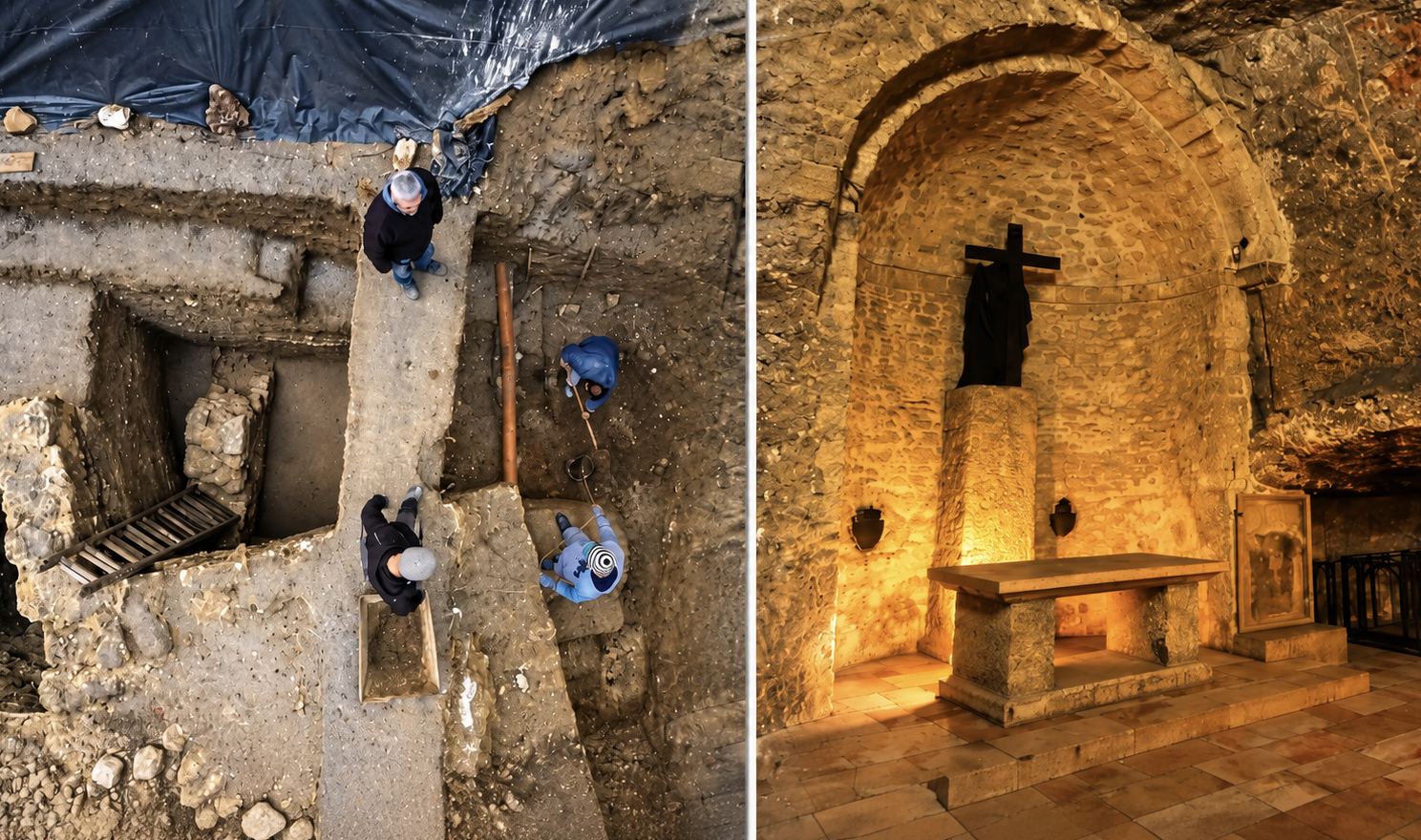
New archaeological discoveries beneath one of Christianity’s holiest sites are offering fresh support for a centuries-old tradition about where Jesus Christ was buried.
Researchers working beneath Jerusalem’s Church of the Holy Sepulchre have uncovered evidence of an ancient quarry, burial areas and cultivated land that existed before the massive church complex was built.
The discoveries are significant because the landscape appears to resemble key details found in the Gospel accounts of Jesus’ crucifixion and burial.
But there is an important distinction: archaeologists have not found physical evidence proving that Jesus himself was buried there.
Instead, the excavation is strengthening the historical case that the Church of the Holy Sepulchre stands on an ancient burial landscape that fits what is known about Jerusalem during the time of Jesus.
Ancient Landscape Hidden Beneath Famous Church
The excavation is being led by Francesca Romana Stasolla, a professor of Christian and medieval archaeology at Sapienza University of Rome.
The work is part of the Hagia Polis Project, a large archaeological investigation being carried out alongside restoration work inside the Church of the Holy Sepulchre.
Sapienza University confirmed in September 2026 that researchers have now spent more than four years studying the church and its underground remains.
The university’s published research describes the area as originally containing a quarry that was later reused for agriculture and burials before the site was transformed into a monumental Christian sanctuary during the reign of Roman Emperor Constantine in the fourth century. Iris
That sequence is especially intriguing because the New Testament describes Jesus as being buried in a rock-cut tomb near the place where he was crucified.
According to the Gospel of John, there was also a garden near the crucifixion site.
Archaeological analysis has now found evidence that cultivated areas existed in the vicinity centuries before Constantine’s church was constructed.
Researchers have identified traces associated with agricultural use, including evidence of vegetation consistent with an area that was not yet densely built over.
That does not prove the biblical account, but it gives archaeologists a clearer picture of what this part of Jerusalem may have looked like around the Roman period.
A Quarry Became a Burial Ground
One of the most important findings involves the ancient quarry beneath the church.
The latest academic report from the Sapienza team says the quarry on Jerusalem’s Gareb Hill went through several phases of stone extraction before parts of it were reused for agricultural and funerary purposes. Iris
Rock-cut tombs in former quarries were not unusual around ancient Jerusalem.
That makes the discovery important because the traditional tomb of Jesus inside the Holy Sepulchre sits within exactly that kind of environment.
The church’s famous Edicule, the small shrine standing beneath the Rotunda, surrounds a limestone burial chamber traditionally identified as Jesus’ tomb.
The location has been revered by Christians for roughly 1,700 years.
What Archaeologists Can Actually Say
The new findings have generated dramatic headlines suggesting archaeologists have finally discovered Jesus’ tomb.
That goes further than the evidence currently allows.
Researchers have not uncovered remains, inscriptions, artifacts or DNA that could identify a burial chamber as belonging specifically to Jesus of Nazareth.
What the excavation does show is that the traditional site existed within a landscape containing burials and agricultural activity before the church was built.
That matters because those characteristics are broadly compatible with the ancient descriptions surrounding Jesus’ burial.
Stasolla’s project is focused on reconstructing the history of the entire location rather than attempting to scientifically prove a particular religious event.
Sapienza describes the investigation as a multidisciplinary effort involving archaeologists, historians, geologists, paleobotanists, chemists and other specialists studying the site from the Iron Age through the modern era. Ricerc@Sapienza
Why Christians Believe This Is Jesus’ Tomb
Tradition surrounding the site reaches back to the earliest centuries of Christianity.
According to historical accounts, Emperor Constantine authorized construction of a Christian sanctuary in Jerusalem during the fourth century after the location was identified with Jesus’ crucifixion and burial.
A Roman temple had previously occupied part of the area.
Constantine’s builders removed earlier structures and created a monumental church around the revered tomb.
Archaeological work has since documented multiple architectural phases beneath the present complex, including portions of the early Christian church and later structures. Iris
The Church of the Holy Sepulchre was repeatedly damaged, destroyed, rebuilt and altered over the centuries.
Much of the structure visitors see today reflects later rebuilding and restoration.
Despite those upheavals, however, the central location traditionally associated with the tomb remained the focal point of the church.
Scientists Previously Opened the Tomb
Researchers received another rare opportunity to investigate the shrine in 2016 when conservation work allowed experts to temporarily remove the marble covering over the burial area.
Beneath it, they documented the surviving limestone surface of the original rock-cut burial structure.
That discovery showed that at least part of the underlying tomb had survived despite centuries of reconstruction above it.
The more recent excavations are much broader.
Instead of examining only the tomb shrine, researchers are studying the surrounding ground beneath the church to determine how the entire landscape developed.
The new evidence suggests that before Christianity’s most famous sanctuary rose there, the location had gone through several dramatically different lives.
It began as a stone quarry, portions were later cultivated, tombs were carved into the rock, and eventually Constantine’s builders transformed the landscape into an enormous religious complex. Iris
The Garden Detail Has Drawn Particular Attention
One of the most discussed discoveries concerns evidence of ancient vegetation.
The Gospel of John describes a garden near the place of crucifixion and says a new tomb was located there.
Researchers cannot determine that a particular ancient garden was the garden mentioned in the Gospel.
But evidence that the surrounding landscape included cultivated areas makes that description archaeologically plausible.
A July 2026 account published by L’Osservatore Romano also discussed the relationship between the excavated landscape and the ancient tradition of a garden and tomb near Calvary. Osservatore Romano
That is a much more defensible conclusion than saying archaeologists have proven they found the exact burial place of Jesus.
An Extraordinary Site Even Without Definitive Proof
The archaeology is significant regardless of whether researchers can ever establish that a particular tomb belonged to Jesus.
The excavation increasingly shows that the Church of the Holy Sepulchre was constructed over a genuine ancient burial landscape rather than an arbitrary location selected centuries later.
That gives historians important evidence when evaluating how early Christian memory of the crucifixion and burial developed.
Stasolla’s research describes the project as an attempt to understand how the location evolved from an ancient quarry and burial area into the monumental center of Christian worship that exists today. Iris
For believers, the findings may reinforce a tradition passed down for nearly two millennia.
For archaeologists, the discovery is more carefully framed.
They have not scientifically identified the tomb of Jesus.
What they have uncovered is something still remarkable: physical evidence showing that the landscape beneath Christianity’s most famous tomb shrine looks increasingly consistent with the type of place described in ancient accounts of Jesus’ burial. Iris
Discover more from Next Gen News
Subscribe to get the latest posts sent to your email.
Can’t find the tomb of a Jesus/Mohammad that never existed… religions are just excuses to have wars…