

Donald Trump’s latest Easter message did not inspire prayer, hope, or even a hint of grace. Instead, it unleashed a wave of outrage from Christian leaders and believers who say the president’s foul-mouthed social media tirade about Iran crossed a moral line they can no longer ignore.
On Easter Sunday, while millions of Christians across the world gathered in churches to reflect on the Resurrection, Trump took to Truth Social with a message that stunned even some of his longtime religious supporters. In a profanity-laced post about the Strait of Hormuz, he threatened devastation and invoked religious language in a way many believers found jarring, offensive, and deeply sacrilegious.
The result was immediate. Pastors, Catholic leaders, former allies, and Christian activists began publicly distancing themselves from Trump, arguing that his language and behavior bore little resemblance to the faith he so often claims as his own.
For many, it was not just the substance of the message that caused alarm. It was the timing. Easter is the holiest day on the Christian calendar, centered on renewal, sacrifice, mercy, and redemption. Trump’s message, filled with violent rhetoric and swaggering threats, landed like a blunt-force collision between political rage and sacred tradition.
Doug Pagitt, a pastor from South Minneapolis, said the post felt like a direct insult to Christians marking one of the most meaningful days of the year. He said the combination of war talk, profanity, and careless religious references made it clear that Trump had little regard for what many believers hold sacred.
Pagitt also said he has watched more Christians recoil from Trump in recent weeks, especially as the Iran conflict has increasingly been wrapped in religious language by the administration. To him, the idea of presenting military escalation under a banner of faith is not just offensive. It is spiritually corrosive.
That concern has only grown as Trump and Defense Secretary Pete Hegseth have repeatedly framed the confrontation with Iran in overtly Christian terms. The administration described the rescue of a downed American airman as an “Easter miracle,” while Hegseth has openly invoked scripture in defense of crushing military force. In one Pentagon worship event, he quoted Psalm 18 while speaking about pursuing enemies until they were consumed, language critics say dangerously blends faith with vengeance.
For religious leaders already uneasy about Trump’s public embrace of Christianity, the Easter episode only reinforced a deeper skepticism. Caleb Campbell, pastor of Desert Springs Bible Church in Phoenix, said Trump’s faith has long appeared performative rather than rooted in any recognizable Christian ethic. In his view, the president’s words are little more than religious branding attached to political power.
Critics also point to Trump’s long history of conduct that clashes with the moral image many of his supporters have tried to build around him. Allegations involving Stormy Daniels and Karen McDougal, both of which Trump has denied, as well as the 2023 civil finding that he sexually abused writer E. Jean Carroll, have only deepened doubts about whether his public displays of piety are genuine or politically convenient.
That tension has been present for years. Back in 2015, Trump famously dodged a question about his favorite Bible verse, saying only that the Bible was “very personal” to him. At the time, many questioned whether he could name a passage at all. Still, after surviving the July 13, 2024 assassination attempt in Pennsylvania, Trump began speaking more openly about divine purpose, saying he had been spared by “the grace of Almighty God.”
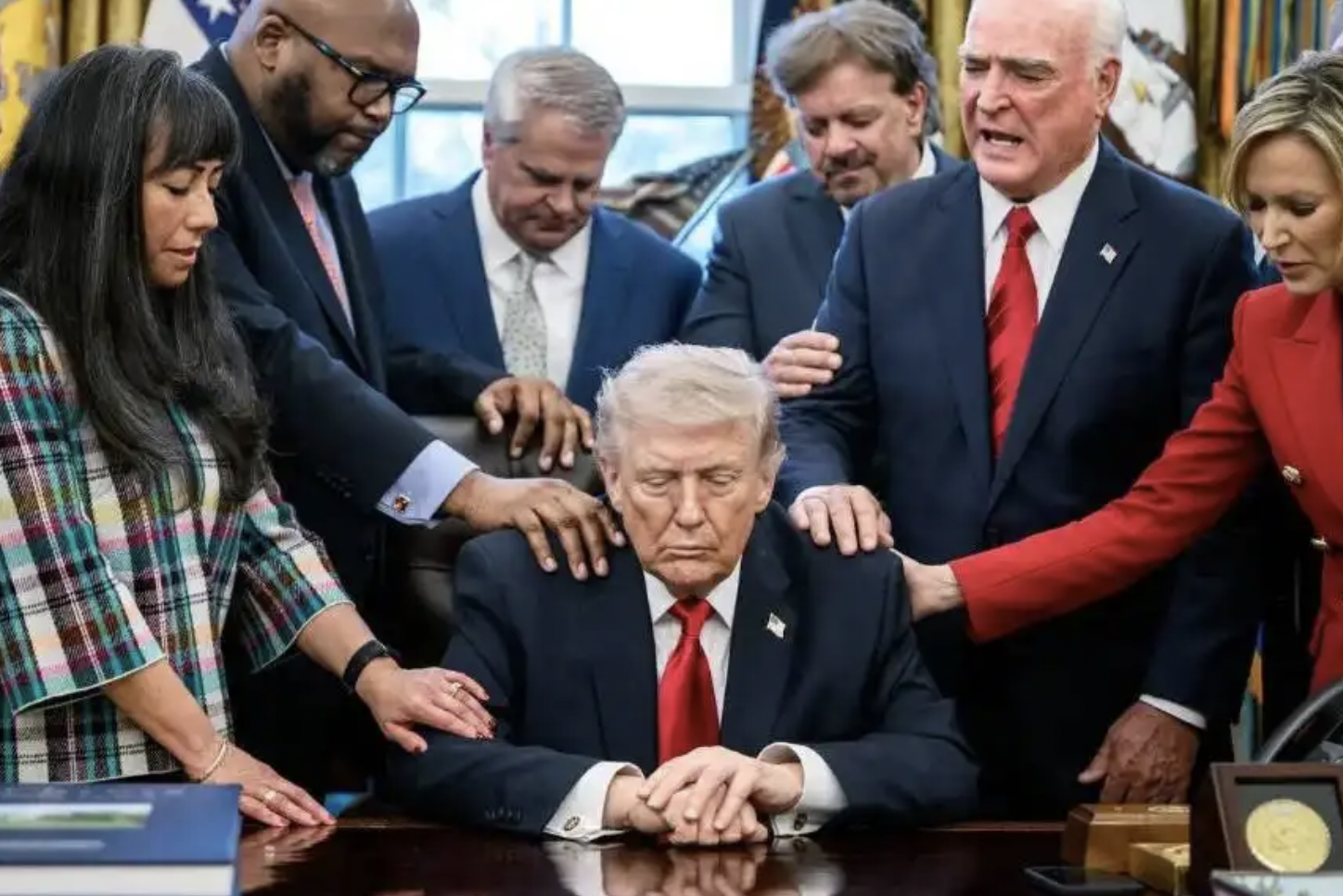
That message resonated with much of the Christian right. Evangelical and Protestant voters were instrumental in helping return Trump to the White House, and public prayer became a staple of his campaign trail. Images of religious leaders laying hands on him in churches and at rallies spread widely online, reinforcing the idea that Trump had become a political vessel for conservative Christianity.
But now, some of the same voices that once elevated him are beginning to sound alarm bells.
Marjorie Taylor Greene, once one of Trump’s fiercest defenders, wrote on Easter Sunday that the president was not a Christian and that his words and actions should not be defended by Christians. Tucker Carlson, another close ally, went even further, calling Trump’s comments a “mockery of Christianity” and describing them as evil. Trump responded by lashing out at Carlson, calling him “stupid” and a “broken man.”
Even some of Trump’s religious surrogates have drawn criticism for how far they have gone in trying to sanctify him. Paula White Cain, one of his longtime spiritual advisers, recently compared Trump’s legal troubles and assassination attempt to the suffering of Jesus, telling him onstage that he had been betrayed, falsely accused, and nearly lost his life in a pattern similar to Christ’s. To many Christians, the comparison was not just inappropriate. It was offensive.
Catholic figures have also begun breaking ranks. Joseph Strickland, the former bishop of Tyler, Texas, and a historically supportive Trump voice, condemned the president’s Easter remarks as careless, irreverent, and theologically confused. He said the issue should be confronted not as a matter of politics, but as a matter of truth.
Catholics for Catholics, a group that has often backed Trump, also signaled discomfort, posting that threats to wipe out an entire civilization should compel believers to pause and pray for peace. The Pope likewise weighed in, criticizing rhetoric that targeted “all the people” of Iran and calling it truly unacceptable.
That broader moral discomfort may prove politically significant. According to NBC exit polling, 63 percent of voters identifying as Protestant or other Christian backed Trump in the 2025 election, up from 60 percent in 2020. Christians have been the bedrock of Trump’s coalition for years, and no Republican understands the symbolic power of faith better than he does.
But what happens when the symbolism stops working?
In Phoenix, where pastor Caleb Campbell ministers just minutes away from the former stronghold of Turning Point USA, he says he has watched a form of political Christianity take root that is more about spectacle than spiritual formation. Mega-events, celebrity-style preachers, giant screens, and social media soundbites have created an environment where quoting scripture can become a shortcut to credibility, even when the message itself runs against the teachings of Jesus.
That, Campbell argues, is why many believers have accepted Trump for so long. They have been conditioned to trust anyone who speaks in biblical language and confirms their worldview, even when the substance is hollow.
Now, that illusion may be cracking.
For a growing number of Christians, Trump’s Easter outburst was not just another crude post in a long stream of online chaos. It was a revealing moment, one that exposed the widening gap between the language of faith and the politics of domination.
The question heading into the 2026 midterms is no longer whether Trump can still wrap himself in the imagery of Christianity. It is whether enough American Christians are finally willing to admit that the costume no longer fits.
Discover more from Next Gen News
Subscribe to get the latest posts sent to your email.
Oh st
F any evil Christians or any other evil religics that aren’t on the side of USA/MAGA/Trump !!!
They can move back to their beloved Middle East where they will likely be murdered by other evil religics…