

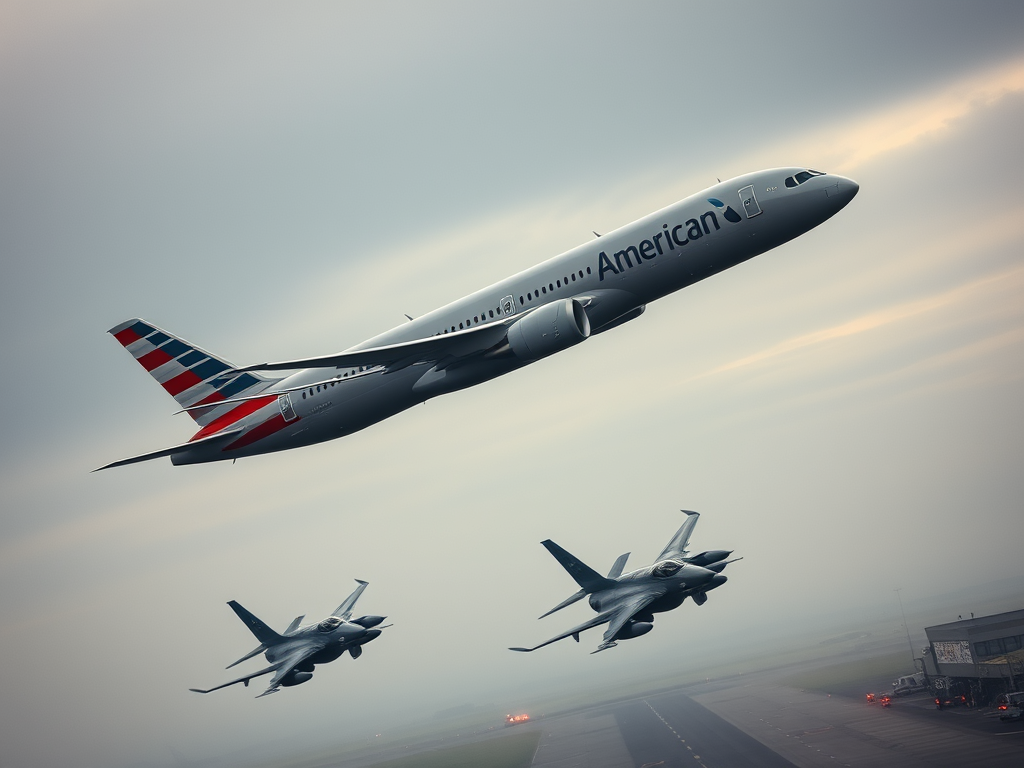
A routine American Airlines flight from New York’s JFK to Delhi turned into a dramatic international incident Sunday after a mid-air bomb threat forced the aircraft to make an emergency diversion to Rome—escorted by fighter jets.
Flight 292, a Boeing 787-9 Dreamliner, was cruising over Turkmenistan when the crew received an urgent security alert. According to American Airlines, the flight crew made a swift decision to reroute out of an “abundance of caution.” However, sources within the airline industry suggest the threat was credible enough to warrant immediate action.
“We don’t take these things lightly,” a senior aviation security official told us under condition of anonymity. “A threat at 35,000 feet over international airspace requires rapid coordination between multiple governments. This was a high-stakes situation.”
Military Escort Over Europe
As the aircraft turned back toward Europe, Italian authorities scrambled two Eurofighter Typhoon jets to intercept and shadow the plane until it landed safely at Rome’s Fiumicino Airport at approximately 11:15 a.m. ET.
Witnesses at the airport reported tense moments as emergency services swarmed the tarmac. “It was clear something serious was going on,” said Marco DeLuca, an airport worker who saw the plane land. “The fighter jets were circling, and security teams rushed in as soon as it touched down.”
Passengers were held on board as bomb squads and security personnel conducted thorough sweeps of the aircraft and luggage. “We were scared out of our minds,” one passenger, Anjali Verma, told reporters. “No one told us anything for hours. We just saw the jets and knew something was wrong.”
Airline’s Response and a Troubling Pattern
American Airlines released a carefully worded statement emphasizing their commitment to safety. “Security is our top priority. We appreciate our passengers’ patience as we work with authorities to ensure everyone’s safety,” it read.
This marks the second major bomb scare for the airline this month. Earlier in February, a flight in Texas was delayed for hours after a passenger created a Wi-Fi hotspot named “There is a bomb on the flight.” That incident, though ultimately a false alarm, highlighted the growing concerns over air travel security.
A Bigger Picture: The State of Air Travel Security
With tensions high globally, aviation experts warn that airlines remain prime targets for disruptions. “Incidents like this underscore how fragile air security remains,” said Dr. Rachel Epstein, an aviation risk analyst. “Threats—real or hoaxes—can cause massive disruptions, panic, and international consequences.”
While officials have yet to confirm the exact nature of the bomb threat on Flight 292, the ordeal raises fresh concerns about gaps in security and the increasing frequency of in-flight scares.
“At the end of the day, passengers are left rattled, airlines are left scrambling, and governments are left wondering if they did enough to prevent the next one,” Dr. Epstein added.
For now, the passengers of Flight 292 are safe, but the questions about air security remain very much in the air.
Discover more from Next Gen News
Subscribe to get the latest posts sent to your email.
How much effort are they going to put into locating the source of the warning? If they locate that person, will there be any punishment levied, such as terrorist activity? Will the airline also sue them for the costs they incurred?
How was the bomb threat incurred?
I’m sure rerouting an airplane in mid flight isn’t cheap; so yes, costs were incurred.