

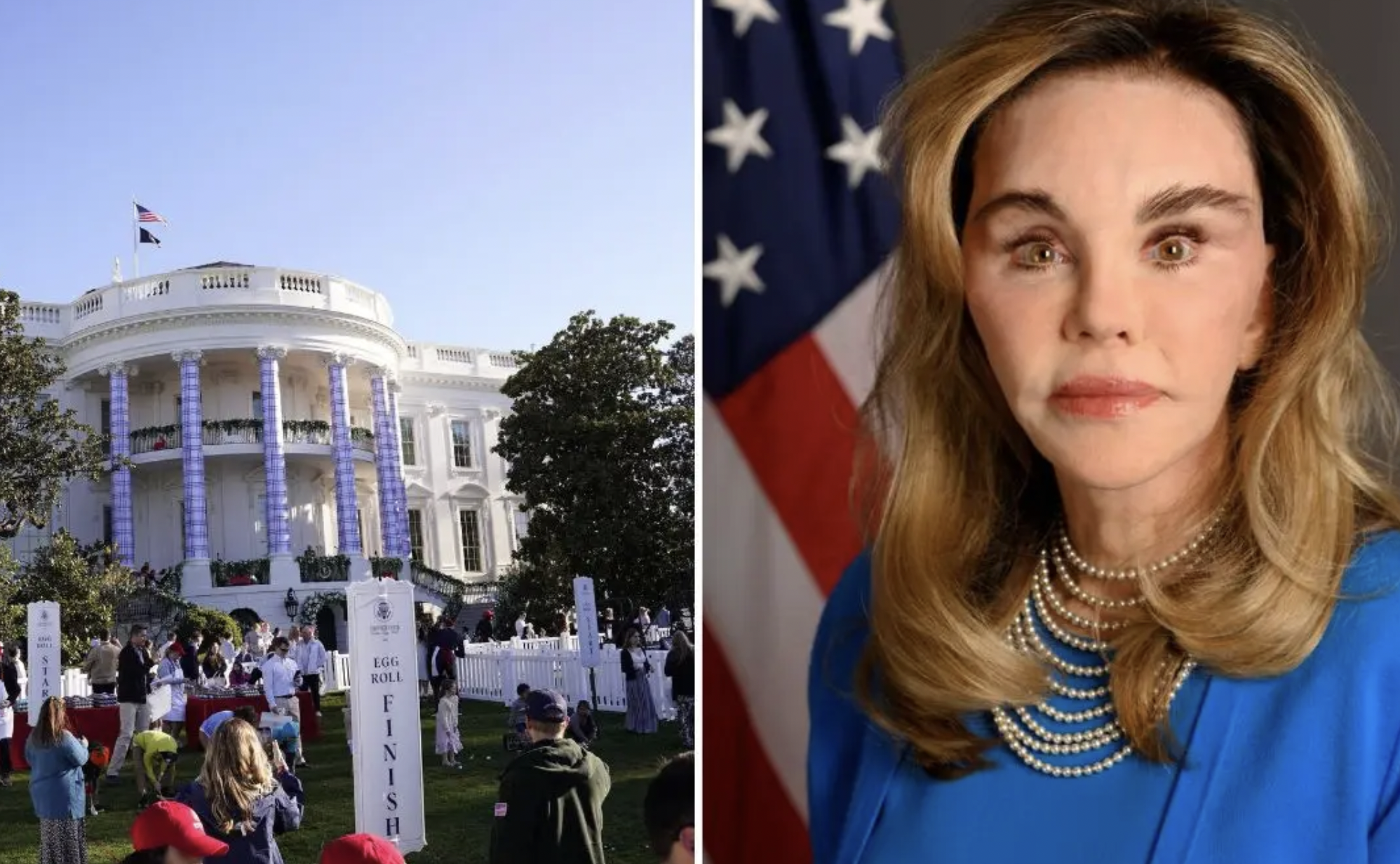
President Donald Trump’s newly confirmed ambassador tasked with fighting human trafficking is attracting unexpected attention after her official government portrait went viral, triggering an online controversy that has quickly expanded beyond her appearance.
Barbera Thornhill, a former interior design executive and philanthropist, is now leading the State Department’s Office to Monitor and Combat Trafficking in Persons, one of the federal government’s most important offices in the global fight against human exploitation.
But her arrival has sparked questions about her professional experience, political donations and the difficult challenges facing the department she has been appointed to lead.
The controversy intensified October 13 when Assistant Secretary of State Riley Barnes welcomed Thornhill in a social media announcement that included her official portrait.
Instead of focusing entirely on the new ambassador’s responsibilities, numerous users began commenting on her appearance.
Some compared her photograph to images of philanthropist Susan Dell, while others speculated about cosmetic procedures or digital editing.
There is no verified evidence supporting those claims, and Thornhill has not publicly addressed the personal commentary.
The online reaction has also drawn attention to a more consequential question: What qualifications does Thornhill bring to a position responsible for helping combat human trafficking around the world?
Thornhill was confirmed by the U.S. Senate on August 7 in a 51-47 vote as part of a larger group of Trump administration nominees.
Her responsibilities include overseeing international anti-trafficking initiatives, coordinating diplomatic efforts and helping produce the State Department’s annual Trafficking in Persons Report.
The report evaluates how governments around the world are addressing human trafficking and can influence diplomatic relationships, foreign assistance and U.S. policy.
Before joining the administration, Thornhill built her career largely outside government.
She previously served as president of Impact Design, a Los Angeles-based interior design business, and participated in philanthropic and cultural organizations, including the Getty Research Institute Council and the Library Foundation of Los Angeles.
She has also been involved in charitable efforts supporting vulnerable communities.
Her relationship with Trump dates back to his first presidency.
In September 2019, Trump announced his intention to nominate Thornhill as U.S. ambassador to Singapore.
However, that nomination never received Senate confirmation and was withdrawn after President Joe Biden took office in 2021.
Now, Thornhill has secured a different diplomatic appointment, but one involving an especially sensitive area of international human rights policy.
Protect All Children from Trafficking, a nonprofit advocacy organization known as PACT, acknowledged her philanthropic background while raising concerns about her lack of extensive federal anti-trafficking experience.
In a statement issued during the confirmation process, the organization welcomed the administration’s decision to fill the long-vacant leadership position but emphasized that the office requires specialized knowledge and experience.
PACT noted that Thornhill had participated in charitable work involving vulnerable children but had not demonstrated significant experience developing or overseeing federal anti-trafficking policy.
The organization also expressed concern that her Senate confirmation hearing did not sufficiently explore how she would address the challenges facing the department.
Those challenges include substantial staffing reductions.
According to PACT, the Office to Monitor and Combat Trafficking in Persons lost approximately 70% of its personnel during restructuring in 2025.
The team responsible for producing the annual Trafficking in Persons Report reportedly shrank from 31 employees to just nine.
The reductions have raised questions about whether the department has enough experienced staff to investigate global trafficking trends, evaluate foreign governments and support victims effectively.
During her confirmation process, Thornhill defended the administration’s restructuring efforts, arguing that personnel changes did not necessarily indicate a reduced commitment to combating trafficking.
She has also emphasized the importance of involving survivors in developing policies intended to prevent exploitation and hold traffickers accountable.
The controversy over her qualifications has been accompanied by scrutiny of her political contributions.
Federal records cited in congressional materials show that Thornhill donated $98,527 to the Trump-Vance Inaugural Committee in December 2024.
She also contributed $44,300 to the Republican National Committee’s Team 100 program in June 2025.
Those donations were disclosed through political finance records and do not establish that her appointment was improperly influenced.
However, they have become part of the public discussion surrounding her selection for a major diplomatic position.
For advocates working to combat human trafficking, the priority is whether Thornhill can effectively lead the office at a time when trafficking networks continue exploiting vulnerable people around the world.
Human trafficking can involve forced labor, commercial sexual exploitation and other forms of coercion.
Victims may be adults or children, and trafficking can occur both across international borders and within individual countries.
The State Department’s annual report is among the most influential international assessments of how governments respond to those crimes.
Countries are evaluated on their efforts to prevent trafficking, protect victims and prosecute offenders.
The 2026 report was released October 8, shortly before Thornhill’s public welcome announcement.
That means her first major challenge will not be immediately producing the annual report but overseeing the department’s work following its publication and preparing for the next reporting cycle.
As the administration’s new ambassador-at-large, Thornhill will also be responsible for working with foreign governments, advocacy groups and survivors to strengthen anti-trafficking efforts.
Her supporters point to her philanthropic background and management experience as potential assets in the role.
Critics argue that the position requires specialized policy knowledge, particularly after the department’s significant loss of experienced personnel.
For now, the debate surrounding Thornhill has moved well beyond the viral photograph that initially attracted public attention.
The larger question is how effectively the administration’s new appointee can lead one of America’s most important international human rights initiatives.
And with the State Department facing questions about staffing, expertise and the future of its anti-trafficking programs, Thornhill’s performance in the months ahead is likely to receive close scrutiny.
Discover more from Next Gen News
Subscribe to get the latest posts sent to your email.