

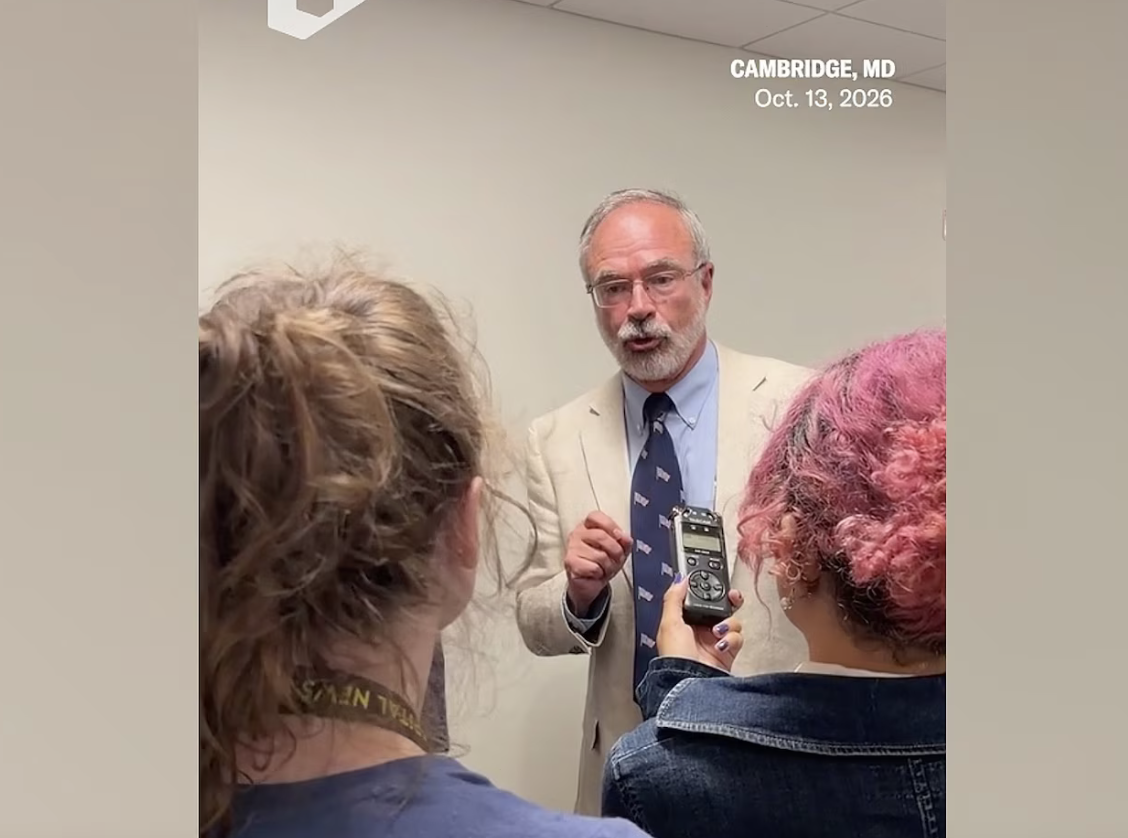
Republican Congressman Andy Harris is facing growing criticism after threatening a journalist with possible criminal prosecution for recording him during a press gathering, sparking a heated confrontation over press freedom and government accountability.
The Maryland lawmaker, who is seeking another term in Congress, repeatedly demanded that reporter Cat Murphy stop filming him following a contentious debate with Democratic challenger Dan Schwartz on Tuesday, October 13.
But Murphy refused to back down, pointing out that several other journalists were openly recording the same conversation.
The confrontation, captured on video by a Baltimore Banner photojournalist, quickly spread across social media and raised questions about whether Harris misunderstood Maryland’s recording laws.
Republican Rep. Andy Harris incorrectly told a reporter they were breaking the law as the reporter and others recorded an exchange with him last night. Harris had just wrapped up a debate with Democratic challenger Dan Schwartz. https://t.co/J0pWnt2lki
— The Baltimore Banner (@BaltimoreBanner) October 14, 2026
“You do not have my permission to record,” Harris told Murphy. “If you record, we will refer you to prosecutors.”
Murphy, a journalist with the University of Maryland’s Capital News Service, challenged the congressman’s demand.
“Everyone in here is recording,” she responded. “Why am I not allowed to?”
Harris insisted that Maryland’s two-party consent law prohibited her from filming without his approval.
However, legal experts say his interpretation does not apply in the same way to a public exchange with journalists.
The confrontation took place in Cambridge, Maryland, following a debate organized by the League of Women Voters.
Harris, a physician who has represented Maryland’s 1st Congressional District since 2011, had already experienced a tense evening.
During the debate, he clashed with an audience member who laughed as he discussed rising diesel prices and blamed Democratic policies.
“You’re rude,” Harris told the woman, pointing toward her from the stage.
The atmosphere became even more heated when Harris met with reporters afterward.
Murphy was attempting to question him about U.S. military involvement in Iran, a significant issue facing Congress and the Trump administration.
Rather than answering her question, Harris objected to her recording the conversation.
The congressman repeatedly invoked Maryland’s Wiretapping and Electronic Surveillance Act, which generally requires the consent of all parties before recording private conversations.
But Murphy maintained that the exchange was taking place in a public setting where multiple news organizations were recording.
Another journalist intervened, reminding Harris that he was speaking at a public press gathering.
The congressman continued arguing that he had the right to deny Murphy permission to record him.
When the reporter attempted to return to her question about Iran, Harris escalated the confrontation.
“Take her camera,” he demanded, before calling for a police officer.
He accused Murphy of violating state law and insisted that authorities needed to intervene.
The video shows Harris looking for law enforcement assistance as journalists continued questioning his interpretation of the statute.
At one point, another reporter asked whether Harris was an attorney.
“I’m a legislator,” Harris responded, adding that he understood the law.
But legal specialists who reviewed the confrontation reached a different conclusion.
Joyce Smithey, managing partner of the Maryland-based Smithey Law Group, told ABC News that Harris appeared to be misapplying the state’s recording statute.
Maryland’s all-party consent law protects certain communications when participants have a reasonable expectation of privacy.
It does not automatically prohibit journalists from recording public officials during open media gatherings.
Smithey explained that a congressman voluntarily speaking with reporters ordinarily would not have a reasonable expectation that his comments were private, particularly when other journalists were openly recording.
She also noted that refusing permission to one reporter does not necessarily transform an otherwise public exchange into a confidential conversation.
That interpretation is consistent with longstanding Maryland legal guidance distinguishing private communications from statements knowingly made in public.
Lucy Dalglish, a media-law expert at the University of Maryland, also questioned Harris’s interpretation.
Speaking to Delmarva Public Media, Dalglish said she had never encountered the state’s consent law being invoked in that manner during a press conference.
The legal controversy has brought renewed attention to the First Amendment and the importance of journalists being able to question elected officials without facing threats of prosecution.
While lawmakers can refuse to answer questions or end interviews, threatening criminal consequences for ordinary reporting raises a different set of concerns.
Murphy is a credentialed journalist who has covered government and political affairs through Capital News Service.
She told ABC News that the debate had not required special press registration, and she was participating alongside other reporters who were also documenting Harris’s remarks.
The confrontation became especially unusual because Harris appeared to single out Murphy while allowing other journalists to continue recording.
At least eight reporters were present during the exchange, according to ABC News.
Eventually, Harris ended the discussion and left the room without answering Murphy’s questions about Iran.
Before departing, he blamed the reporter for preventing other journalists from receiving answers.
“She’s ruining all your chances to get an answer about anything,” Harris complained.
He then told the other reporters to thank Murphy for the interruption.
The incident has since attracted criticism from press freedom advocates and political figures who argue that elected representatives should expect scrutiny, especially when discussing matters involving national security and military operations.
Democratic Congressman Jamie Raskin, also of Maryland, criticized Harris’s treatment of the journalist, joining those questioning the attempt to restrict recording at a public media availability.
The controversy comes just weeks before the November 3 midterm elections, when Harris will face Schwartz in a contest for Maryland’s 1st Congressional District.
Harris is a prominent member of the House Freedom Caucus and a longtime ally of President Donald Trump.
His conservative district has historically favored Republican candidates, although the congressional race has drawn increasing attention during a turbulent election season.
The exchange also comes as Congress faces questions over America’s military involvement overseas, including operations involving Iran.
Murphy’s unanswered question concerned comments Harris had made during the debate about how those operations were proceeding.
Instead of providing further clarification, the congressman’s confrontation with the press became the evening’s most widely discussed moment.
As of Wednesday, October 14, Harris had not publicly provided a detailed explanation for his conduct, and ABC News reported that his office had not responded to a request for comment.
There was no public indication that Murphy had been charged with a crime.
The video has nevertheless sparked a broader debate about the responsibilities of public officials when facing uncomfortable questions.
Journalists routinely record interviews, news conferences and political events so that the public can hear what elected representatives say.
And while Maryland law protects private conversations from unauthorized recording, legal experts say the circumstances surrounding Harris’s confrontation were fundamentally different.
For Murphy, the exchange became an unexpected test of her ability to carry out that responsibility.
For Harris, it turned a routine post-debate media appearance into a controversy over the very laws he insisted he understood.
And with the midterm elections approaching, the incident has placed an uncomfortable spotlight on how the congressman responds when journalists ask questions he would rathe
Discover more from Next Gen News
Subscribe to get the latest posts sent to your email.