

President Donald Trump’s controversial $400 million White House “ballroom” is turning out to be far more than a lavish place for state dinners and political pageantry.
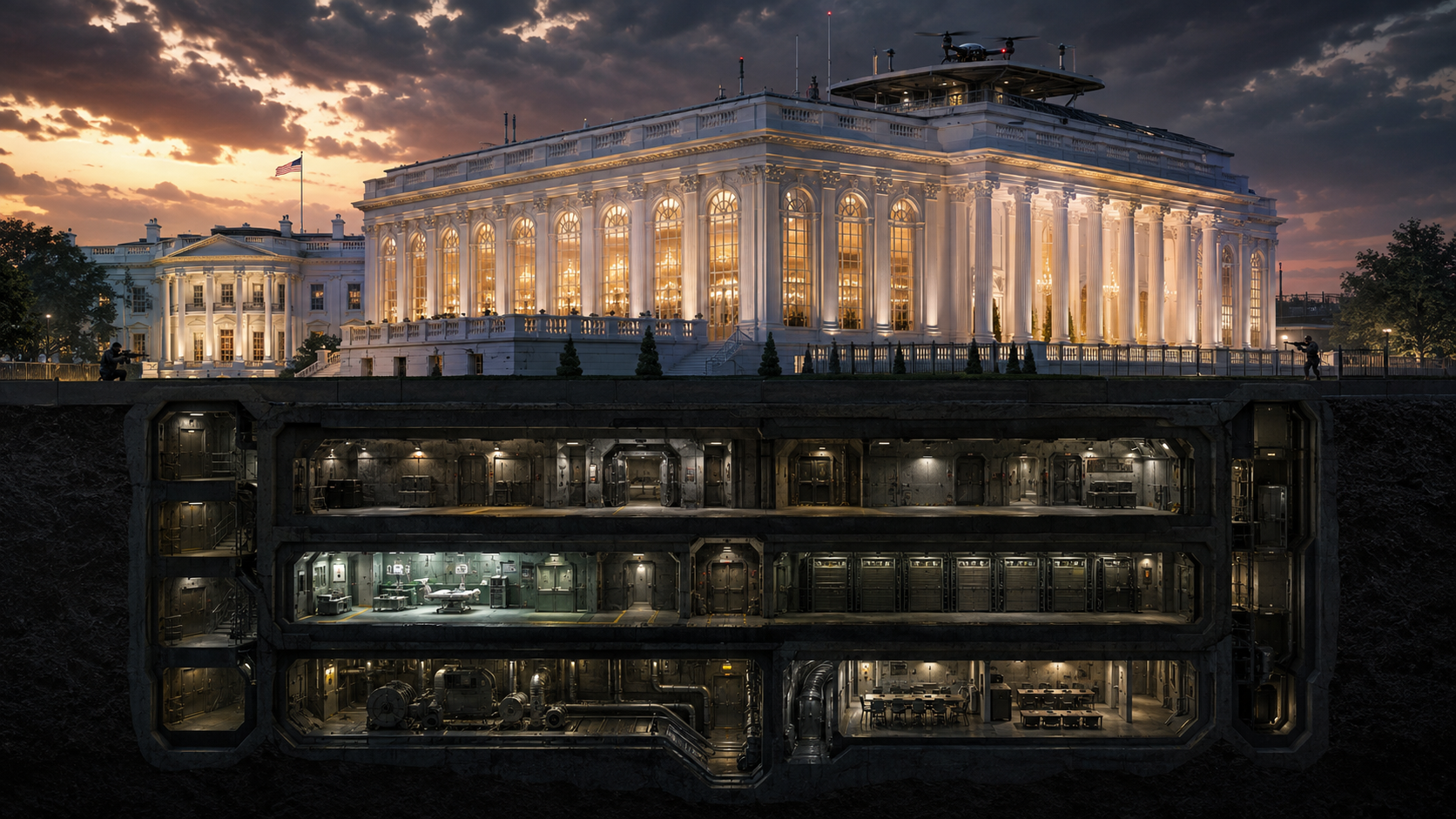
New details buried in the Trump administration’s emergency Supreme Court filing reveal the sprawling East Wing project is being designed as a heavily fortified military complex capable of protecting the president during everything from drone attacks to a potential nuclear strike.
The government’s own filing describes the project as a “highly integrated military complex” that combines Trump’s massive ballroom with an extraordinary array of national security facilities.
And much of it will be hidden underground.
According to the court documents, the structure plunges five stories beneath the White House grounds and is being constructed with hardened concrete, steel and rebar. Missile-resistant columns and beams, drone-resistant roofs and ceilings, and bullet-, ballistic- and blast-resistant glass are all part of the design.
The project also includes bomb shelters, sophisticated medical facilities, classified military infrastructure, military-grade ventilation and heavily protected partitions separating different sections of the complex.
Perhaps most strikingly, the plans call for sniper positions and a rooftop drone port intended to help defend the White House and surrounding area against aerial threats.
That is a dramatic evolution for a project Trump originally unveiled publicly as a grand new ballroom.
The administration now argues the ballroom cannot simply be separated from the military infrastructure underneath it because the entire building was designed as a single security system.
The filing says the materials used throughout the structure are intended to withstand bombs, rockets and missiles — and even the effects of a nuclear blast. Officials describe the overall complex as essentially a massive presidential “safe room” designed to preserve continuity of government during a catastrophic attack.
The revelations are emerging as Trump battles in court to keep construction moving despite judges raising serious questions about whether his administration had the authority to carry out such a sweeping transformation of the White House without specific approval from Congress.
A federal appeals court ruled 2-1 that aboveground construction should be halted, finding the administration lacked congressional authorization for the project. The ruling has temporarily been put on hold while Trump asks the Supreme Court to intervene.
Trump’s Justice Department insists that stopping now would be dangerous.
According to the administration, roughly 250 workers have been putting in 20-hour days, seven days a week, and the entire project is already about 65 percent complete.
The concrete-and-steel superstructure now stretches five stories underground and rises roughly 70 feet above ground, covering nearly 50,000 square feet at its current stage of construction. Government officials claim the project has already passed the point where major design changes can realistically be made.
The administration warns that abruptly halting construction could leave an enormous unfinished structure sitting beside the White House, creating both structural problems and new security headaches for the Secret Service.
Trump announced the East Wing overhaul in July 2025, and construction began that October. The original East Wing was demolished to make way for the dramatically larger replacement, a move that immediately sparked objections from historic preservation groups.
The administration says the ballroom portion of the development is being paid for with approximately $400 million in private donations from Trump and wealthy individuals and corporations, insisting taxpayer money is not required for that portion of the project.
But critics have argued that the much broader White House redevelopment — particularly its security infrastructure — raises questions about government spending, congressional oversight and just how far a president can go in remaking one of America’s most historic public buildings without lawmakers signing off.
Those questions are now headed straight toward the Supreme Court.
Trump’s lawyers are asking the justices to block the injunction before it is scheduled to take effect Aug. 21, arguing that the courts are interfering with presidential security and that the sprawling complex is simply too far along to stop safely.
For all the talk of chandeliers, state dinners and grand celebrations, the administration’s own filing makes one thing increasingly clear: Trump’s new “ballroom” is being built to function just as much like a bunker as a banquet hall.
Discover more from Next Gen News
Subscribe to get the latest posts sent to your email.
Democrats exposed the classified Military Secrets of the new BallRoom!
Another stupid article by stupid people and another far left judge interfering! So what if there is being built a huge “safe room” under the ball room? So what if it has hardened glass and beams, so what if it has sniper nets and a drone proof roof! Idiots! Of course it should have all of those things! Common sense would tell you that the US is responsible for all the world leaders gathered in that ballroom! BTW did Roosevelt or Kennedy need congressional permission to alter the White House? No they didn’t! Why just because they aren’t DJT?? Another example of TDS!