

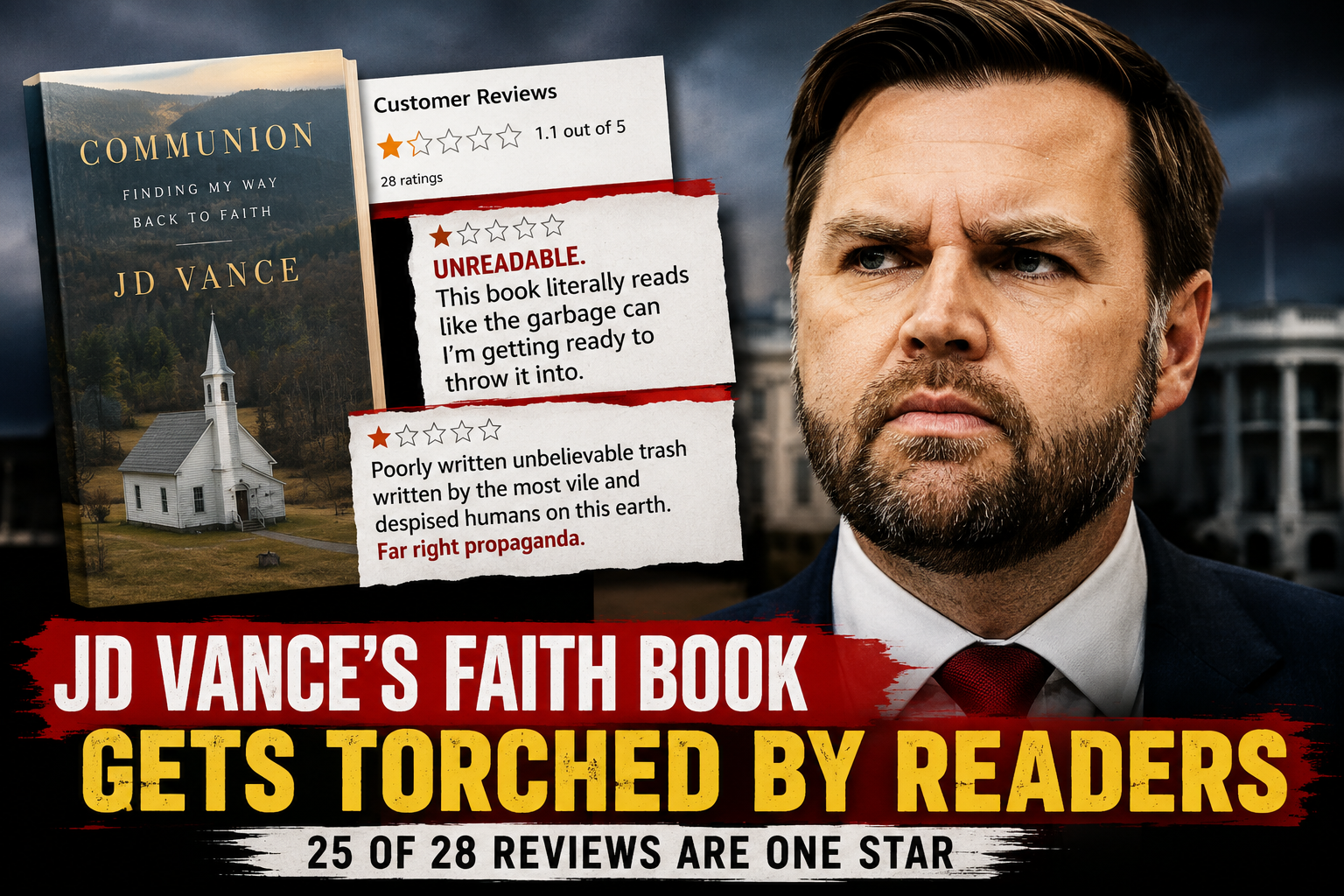
Vice President JD Vance’s new book about his journey back to faith is already facing a brutal reception online, with readers flooding Barnes & Noble’s website with scathing one-star reviews and accusations that the memoir rings hollow.
The book, Communion: Finding My Way Back to Faith, was released Tuesday and centers on Vance’s path from the Christianity of his childhood, through atheism, and ultimately to his conversion to Catholicism in 2019.
But within days of publication, the book was being hammered by reviewers. On Barnes & Noble’s website, 25 out of 28 reviews gave the book just one star, with critics calling it everything from “unreadable” to political propaganda dressed up as a religious memoir.
One reviewer, identified as Kelly P., did not hold back.
“This book literally reads like the garbage can I’m getting ready to throw it into,” the reviewer wrote. “There’s no way JD actually wrote this. I also find it comical that the Pope doesn’t even recognize him as a Catholic lol 0-10 would recommend!”
Another reviewer, Evelyn B., blasted the book as “poorly written” and accused Vance of using Catholicism to soften his image at a time when critics say his politics clash sharply with the faith he claims to champion.
His new book follows Vance’s blockbuster 2016 memoir Hillbilly Elegy, which turned him into a national figure long before he became Donald Trump’s vice president. But Communion appears to be landing in a very different political climate, with Vance now one of the most polarizing figures in American politics.
The backlash is not just about the writing.
Vance’s public embrace of Catholicism has long drawn scrutiny, especially from critics who argue that his hardline immigration views and “America First” politics are difficult to square with the Catholic Church’s teachings on migrants, the poor and human dignity.
The controversy even reached the book’s cover before it was released. Communion features an image of Mt. Zion United Methodist Church in Elk Creek, Virginia, rather than a Catholic church, prompting questions about the religious framing of a memoir built around Vance’s conversion to Catholicism.
That tension has followed Vance into the reviews.
One reviewer, Karen S., wrote that Vance’s “take on faith and religion is at odds with his behavior and speech in his everyday life,” adding that she was glad she used a public library rather than buying the book.
Jack Schlossberg, the grandson of President John F. Kennedy and a Democratic congressional candidate in Manhattan, previously mocked the book by writing, “As Jesus famously said: ‘Deport thy neighbor.’”
That line captured the broader criticism from Vance’s opponents, who argue that his faith-centered messaging is undercut by the Trump administration’s immigration agenda.
Last year, Pope Francis appeared to push back on an argument Vance had made using ordo amoris, a medieval Catholic concept about the proper ordering of love and duties. Vance had invoked the idea to defend an “America First” approach to immigration, arguing that people owe greater obligations to their family, community and nation before those outside their borders.
In a February letter, Pope Francis warned against treating Christian love as a ranking system that places some people above others. He instead pointed to the parable of the Good Samaritan, emphasizing a love that is open to all “without exception.”
For Vance’s critics, that moment became a powerful symbol of the gap between his religious rhetoric and his political record.
Still, the book has received some praise. One Barnes & Noble reviewer, Alyssa M., gave Communion five stars and wrote that although she is not Catholic, she enjoyed the book’s message and found it to be a quick read.
Vance has said faith deeply shapes how he thinks about family, politics and public service.
“When you really believe something, it ought to influence how you think about the way that you do your job, the way that you spend time with your wife and your children,” Vance said last year during an interview with New York Times columnist Ross Douthat. “It just kind of necessarily informs how I live my life.”
But as Communion hits shelves, the reaction shows just how difficult it may be for Vance to separate his personal faith story from the political firestorm surrounding him.
For supporters, the book is a sincere account of spiritual transformation.
For critics, it is another example of a powerful politician trying to wrap a hard-edged agenda in the language of faith.
Either way, JD Vance’s new memoir has already sparked the kind of controversy that may send curious readers straight to the reviews before they ever reach the first page.
Discover more from Next Gen News
Subscribe to get the latest posts sent to your email.
 What's Up Today Editorial Team
I’m Irish Catholic and haven’t read Vance’s book. Looks like this criticism is coming from the loons on the left aka godless communist Democrats who can easily be characterized as anti-God, anti-America, anti-American, anti-everything that can save our nation.
Everyone should be anti-religions as they fuel all the unneeded wars including the one remaining one in Ukraine…
J D Vance is an educated person so his book is likely above the reading level of most Democrats…
This the usual behaviors displayed by the Hate Filled Marxist Democratic Anarchist losers!!!
Well some dems cant read, too busy changing their childs sex. Sent from my iPhoneOn Jun 19, 2026,