

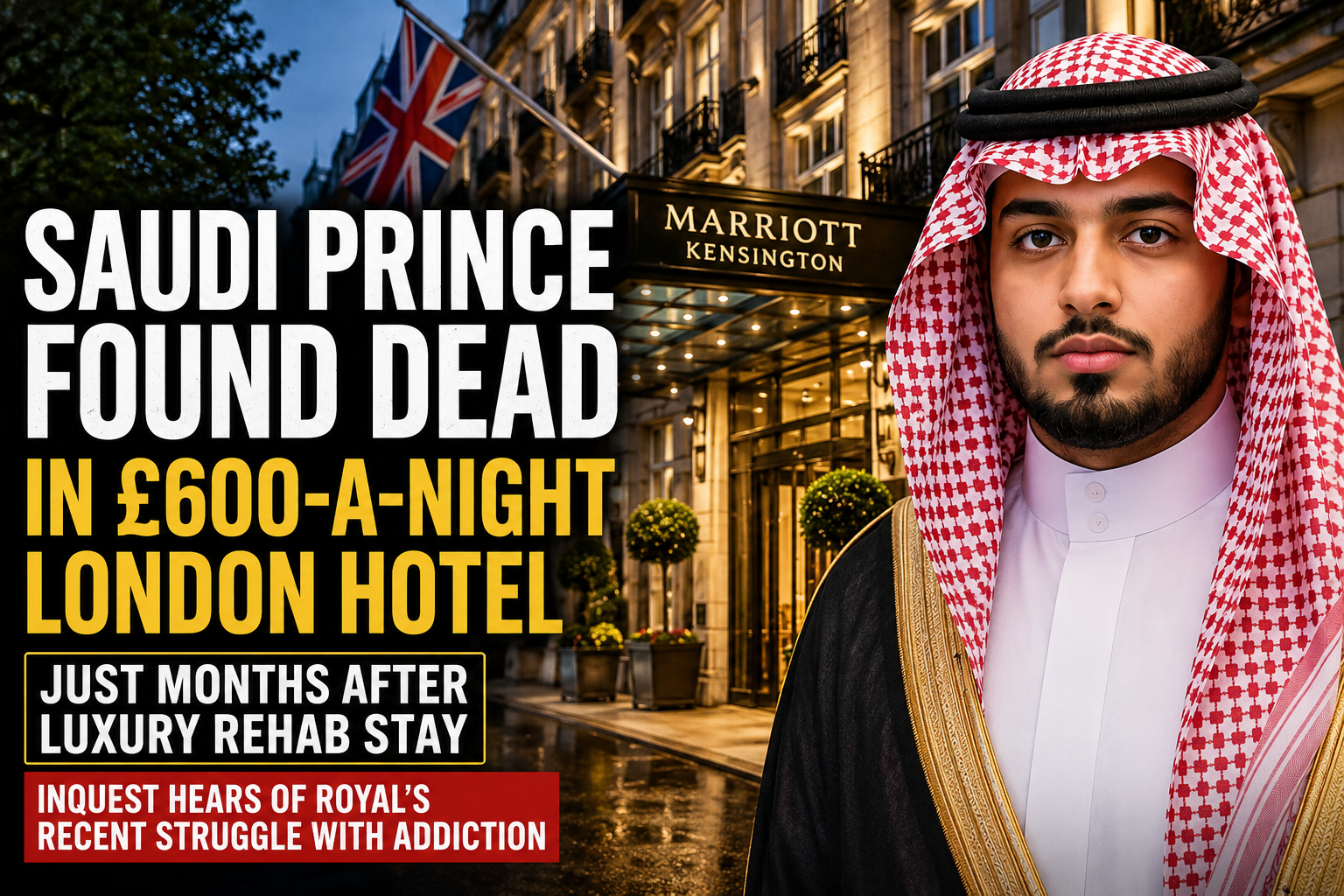
A young Saudi prince was found dead on the bathroom floor of a luxury London hotel room after taking a dangerous mix of alcohol and drugs just months after completing high-end addiction treatment, an inquest has heard.
Prince Abdullah bin Fahad bin Abdullah bin Abdulaziz bin Jalawi al Saud, 29, was discovered fully clothed inside his £600-a-night room at the Marriott Hotel in Kensington on November 25 last year.
The shocking discovery came after the prince had checked into the upscale west London hotel for what was supposed to be a week-long stay. But by the next day, staff were calling security and paramedics after a cleaner entered his locked fifth-floor room and found him collapsed on the bathroom floor.
Despite efforts to save him, Prince Abdullah was pronounced dead at the scene.
A post-mortem examination later found the young royal had suffered a cardiac arrest after ingesting a toxic combination of alcohol, the party drug GHB, and several other substances. Assistant Coroner Jean Harkin ruled his death a tragic misadventure, saying there was no evidence the prince intended to take his own life.
Inner West London Coroner’s Court heard Prince Abdullah arrived at the Marriott Hotel on November 19. The last confirmed sighting of him came on CCTV the night before his death, when he left the hotel to smoke a cigarette before returning alone.
The following day, a cleaner entered the room and made the grim discovery.
Toxicology tests revealed the prince had a blood alcohol level of 222mg per 100ml of blood, nearly three times England’s legal drink-drive limit of 80mg. The inquest heard that level alone fell within a range that could potentially cause a coma.
But alcohol was not the only substance found in his system.
Tests also detected potentially fatal levels of Gamma-hydroxybutyrate, better known as GHB, a drug often associated with nightlife and party scenes. Cannabis was also found, along with alprazolam, the anti-anxiety medication commonly known as Xanax, at a recreational dose. Other anti-anxiety medications were present at therapeutic levels.
The court heard Prince Abdullah had struggled with alcohol misuse and Xanax before his death.
Just months earlier, in August, he had been admitted to the Priory Clinic in Roehampton, southwest London, where residential treatment can cost up to £35,000 a week. During his stay, he underwent detoxification from alcohol, benzodiazepines, and the anti-anxiety drug pregabalin.
Consultant psychiatrist Dr. Victoria Chamorro said in a statement that the prince had “engaged well” during treatment and that his detox had “proceeded without physical side effects.”
“He was supportive and kind to his peers, making friends,” she said.
Dr. Chamorro also said Prince Abdullah had symptoms of low mood and anxiety when he arrived at the clinic, but staff did not believe he was at risk of suicide when he was discharged.
“When he was discharged he was considered not to be at risk of suicide,” she said. “He was discharged with a friend but then failed to attend scheduled Zoom appointments. Nevertheless there was no concern for him. He engaged well and completed his treatment.”
After leaving the Priory, the prince continued treatment at the private Rainford Hall clinic in St Helens, Merseyside, where stays can cost around £7,000 a week.
The inquest heard he had also been diagnosed with an upper respiratory tract infection before recovering and leaving that clinic on October 14.
A post-mortem examination found Prince Abdullah had no underlying acute or chronic illnesses. His official cause of death was given as multi-drug ingestion.
Coroner Harkin said there was nothing to suggest the prince had intended to end his life. She noted that staff at both treatment centers had raised no suicide concerns, he had not expressed suicidal thoughts to anyone, and no note was found in the hotel room.
She also said CCTV showed no evidence that anyone else entered his room before his death.
Recording a conclusion of death by misadventure, Harkin offered condolences to the royal’s family.
“I would like to offer my sincere condolences to the family of Abdullah,” she said.
The inquest paints a heartbreaking picture of a young royal who had recently sought treatment for addiction, appeared to complete his detox successfully, and then died alone in a locked luxury hotel room after a fatal combination of substances.
Discover more from Next Gen News
Subscribe to get the latest posts sent to your email.
So Saudi Arabia has a close connection to Democrats…