

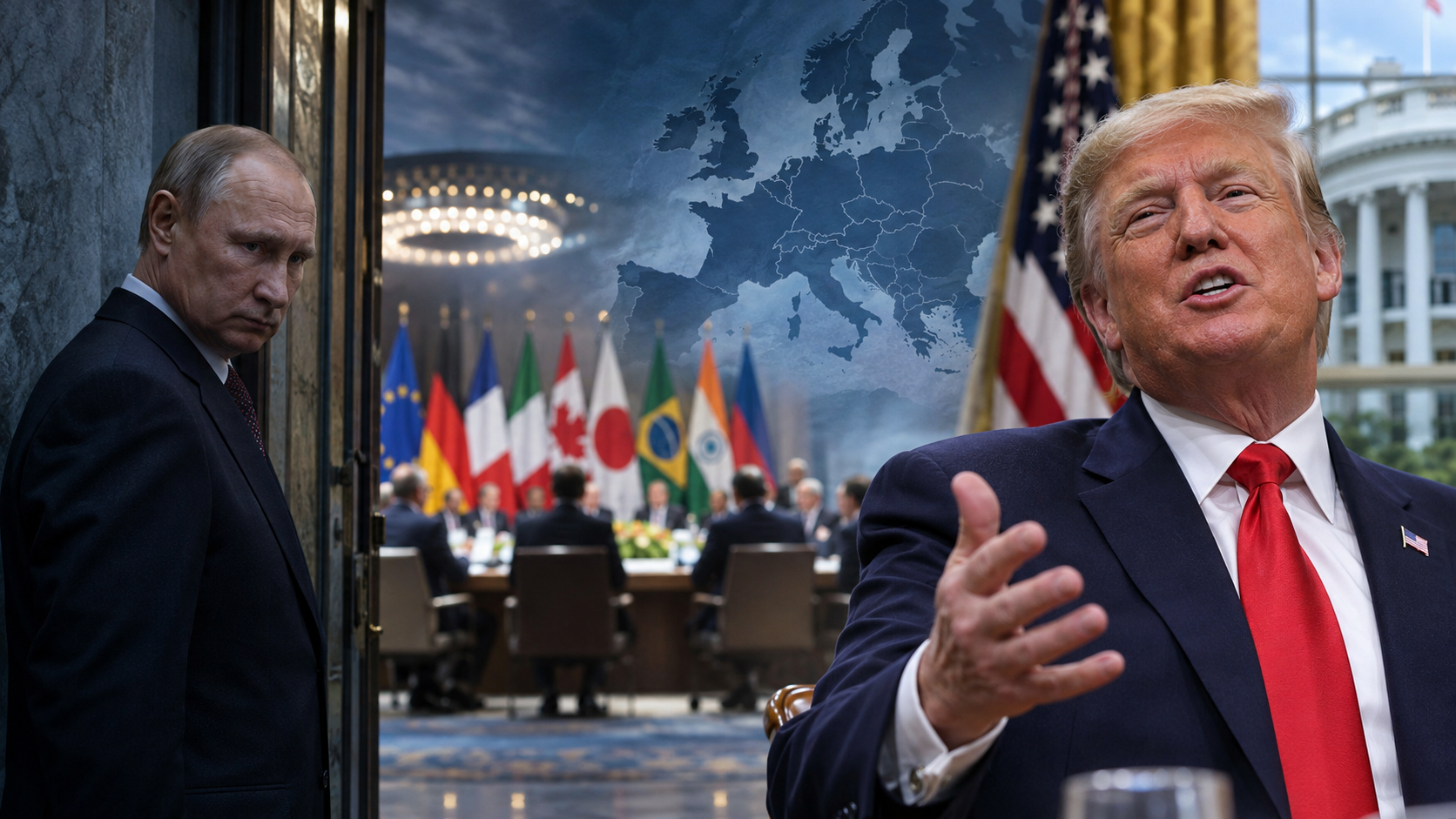
Russian President Vladimir Putin is facing a cold shoulder from one of America’s closest allies just as President Donald Trump suggests a sweeping agreement with Moscow could be within reach — potentially reshaping the future of Ukraine and security across Europe.
British Prime Minister Andy Burnham has declared that Putin will not attend the 2027 G20 summit in Manchester, drawing a sharp contrast with the Trump administration’s decision to invite the Russian leader to this December’s gathering in Miami.
The diplomatic split comes at a sensitive moment in the war in Ukraine, with Trump pursuing direct negotiations with Moscow while questions mount over whether Kyiv and its European allies will have a meaningful say in any agreement that affects their security.
Burnham delivered his message during a November 5 interview with The Economist. Asked whether Putin would be invited to next year’s summit, the British leader gave a one-word answer: “No.”
He explained that sanctions imposed on senior Russian officials following Moscow’s 2022 invasion of Ukraine remain an obstacle to Putin’s attendance. Although Russia is still a G20 member and Britain cannot simply remove it from the organization, Burnham made clear that Putin would not be welcomed at the Manchester gathering.
The position puts London at odds with Washington, where Secretary of State Marco Rubio confirmed in September that Putin had been invited to the December 2026 summit. The invitation would offer the Russian president an opportunity to meet Trump and other world leaders despite the continuing war.
The contrast became even more striking Thursday when Trump revealed he had privately met with Kirill Dmitriev, Putin’s special envoy, at the White House.
Rather than disclose the details of their conversation, Trump made an extraordinary prediction about the possibility of a deal extending far beyond Ukraine.
“It’s going to be a big agreement, and it’s going to involve more than Ukraine,” Trump told reporters. “I could even say it might involve all of Europe.”
He described the potential arrangement as a “big, beautiful agreement” and predicted that everyone would be pleased with the outcome.
But the president offered no concrete terms, timetable or explanation of what European countries might be asked to accept. There was also no announcement of a finalized agreement.
Perhaps the most politically sensitive detail was Trump’s acknowledgment that he met privately with Putin’s representative but did not hold a corresponding meeting with the Ukrainian officials who were also visiting the White House.
That distinction has raised concerns about whether Washington could pursue a broader understanding with Moscow without giving Ukraine an equal voice in decisions involving its territory and security.
For Ukrainian leaders, the stakes extend well beyond ending the fighting. Any lasting settlement would have to confront questions about Russian-occupied territory, security guarantees and the possibility of renewed aggression.
The latest diplomatic activity followed an unusual White House event organized by First Lady Melania Trump, who brought Russian and Ukrainian representatives together to discuss a humanitarian ceasefire in Oleshky, a Russian-occupied city in southern Ukraine’s Kherson region.
The temporary arrangement was designed to allow food, water and medicine into the devastated community while providing safer evacuation routes for civilians. Melania later reported that the operation had helped nearly 800 people leave the area.
The first lady described extensive discussions with representatives from both countries, including arrangements for transportation, medical care and safe passage. Dmitriev publicly thanked her on Putin’s behalf and said the Russian president had personally directed officials to help implement the local ceasefire.
Although the humanitarian breakthrough offered a rare example of cooperation, it did not resolve the wider conflict. The limited agreement concerned one city, not a nationwide halt to hostilities.
The diplomatic push is now expected to shift to Abu Dhabi, where Russian, Ukrainian and American representatives are scheduled to hold talks November 10 and 11. U.S. special envoy Steve Witkoff and Trump’s son-in-law Jared Kushner are expected to participate.
Kushner also held discussions with Ukrainian, NATO and European representatives in Brussels on November 5, focusing on possible security guarantees and a broader European security framework.
Those negotiations could prove critical as Trump pursues an agreement that he says might involve much of Europe. Yet the president’s optimistic predictions have not been accompanied by publicly disclosed commitments from either Moscow or Kyiv.
For now, the contrast is unmistakable: Trump is opening diplomatic doors to Putin while Britain insists that the Russian leader remains unwelcome at one of the world’s most prominent international gatherings.
And with the next round of peace talks approaching, the central question remains whether Trump’s promised breakthrough can deliver a lasting peace without compromising Ukraine’s sovereignty or Europe’s security.
For additional context, Putin has also faced an International Criminal Court arrest warrant since March 2023 over alleged war crimes involving Ukrainian children. The warrant is separate from the British sanctions cited by Burnham.
Discover more from Next Gen News
Subscribe to get the latest posts sent to your email.
 What's Up Today Editorial Team
Both Christians Trump and Putin are sick of THE JEW in Ukraine !!!