

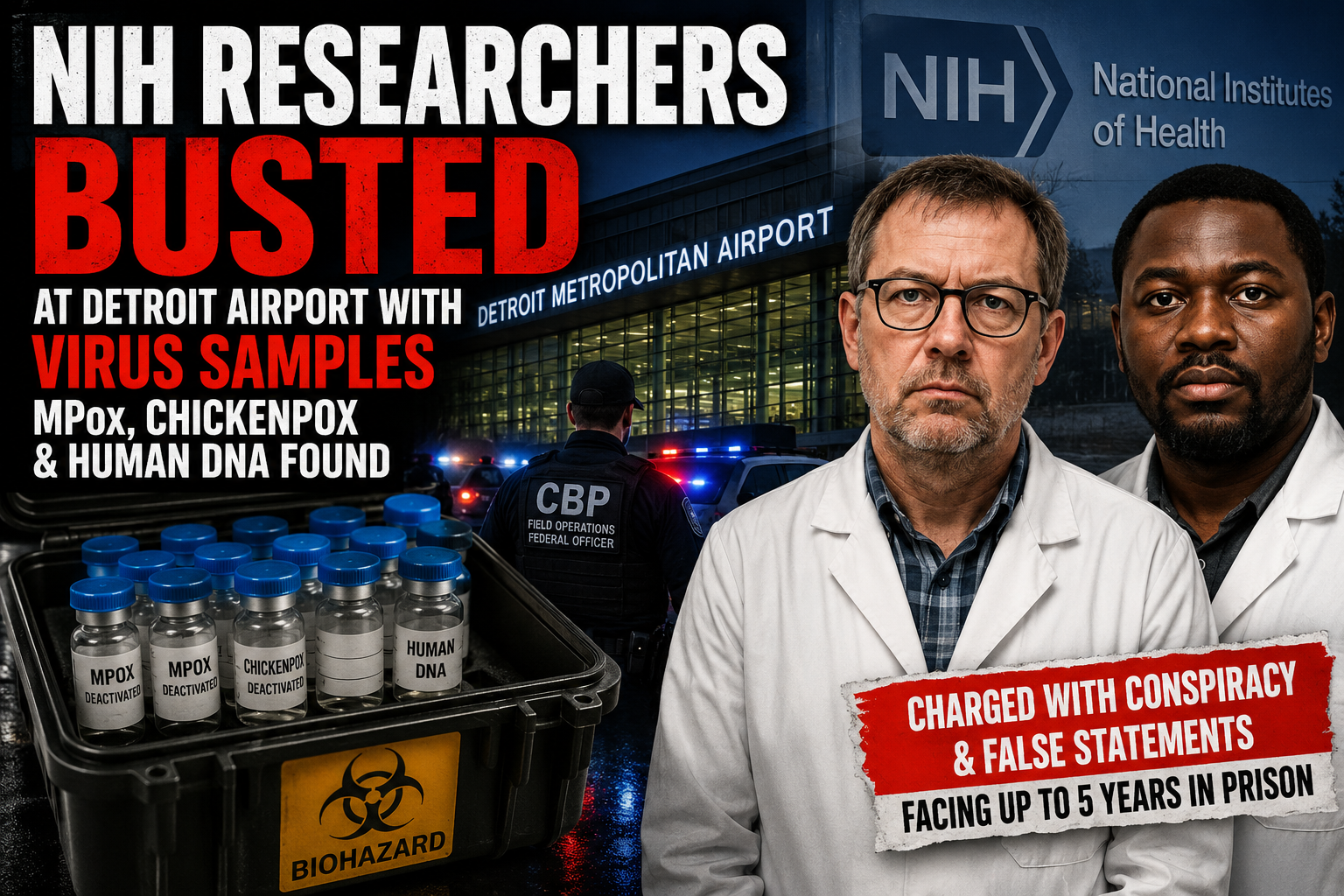
Two researchers tied to one of America’s most important federal science agencies are now facing criminal charges after authorities say they tried to bring vials of dangerous biological material into the country through a U.S. airport without telling the truth about what they were carrying.
Federal prosecutors say Vincent Munster, 53, and Claude Kwe, 38, were stopped at Detroit Metropolitan Airport after arriving on a flight from Brazzaville, Republic of Congo, where an mpox outbreak is currently underway.
What Customs and Border Protection officers allegedly found inside a black plastic case stunned investigators.
According to U.S. Attorney Jerome F. Gorgon Jr., the case contained 113 vials, including samples connected to mpox, chickenpox and human DNA. Authorities said 20 of the vials were tested, and 17 allegedly contained deactivated mpox, the virus formerly known as monkeypox.
Munster, a Dutch citizen, and Kwe, a citizen of Cameroon, both work for the National Institutes of Health at Rocky Mountain Laboratory in Hamilton, Montana. The lab is known for research involving infectious diseases, including emerging viral pathogens and how those viruses can jump from animals to humans.
That background is exactly what makes the case so alarming.
These were not random travelers carrying suspicious items they did not understand. Prosecutors say both men work in NIH’s Virus Ecology Section, where researchers study some of the world’s most serious infectious threats.
Federal officials said the pair were asked by CBP officers what was inside the black case. Instead of allegedly disclosing the biological samples, they reportedly claimed it contained diagnostics and testing equipment.
But a closer inspection by CBP and the FBI allegedly revealed the vials.
The two researchers have now been charged with conspiracy and making false statements to federal law enforcement.
The case is likely to raise serious questions about oversight, lab safety, international disease research and the handling of biological materials at a time when public trust in health institutions remains fragile after the COVID-19 pandemic.
For Democrats and public health advocates who have long defended federal science agencies from political attacks, the charges present a deeply uncomfortable moment. The NIH plays a central role in lifesaving medical research, but this case could fuel calls for stronger safeguards, clearer accountability and tougher rules around the transport of infectious materials.
At the same time, the allegations are not proof of guilt. Munster and Kwe are presumed innocent unless convicted in court.
If found guilty, the two researchers could face up to five years in prison.
Discover more from Next Gen News
Subscribe to get the latest posts sent to your email.