

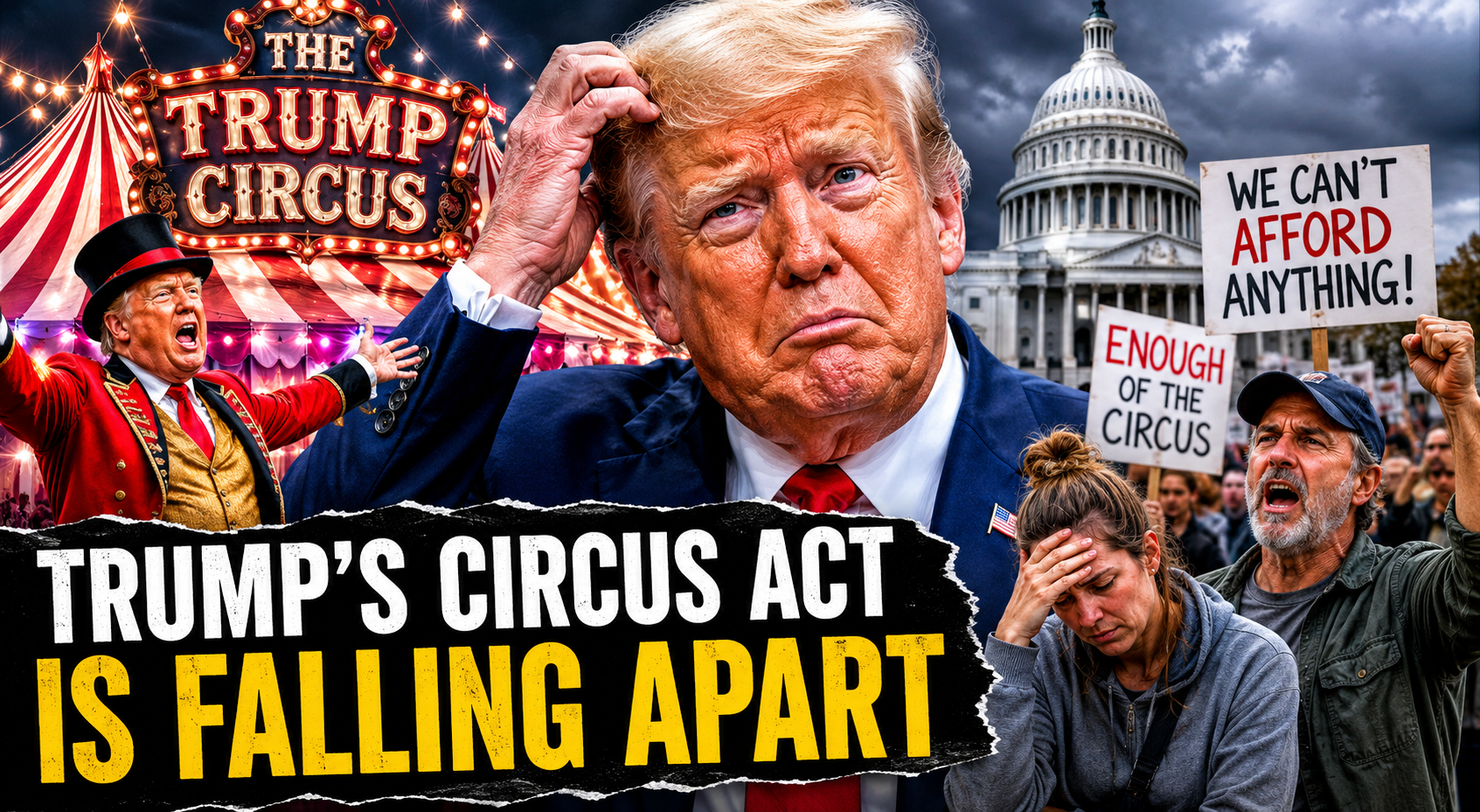
For years, Donald Trump turned American politics into a nonstop spectacle.
The insults. The rallies. The social media explosions. The made-for-TV drama. The constant promise that he alone could smash through Washington’s broken system and deliver something bigger, louder, and more exciting than ordinary politics.
But now, one prominent writer says the act may finally be wearing thin.
Journalist and author Kurt Andersen, who has spent years studying the fantasy-driven forces behind Trump’s rise, argued on The Daily Beast Podcast that the president’s entertainment-first political brand is starting to collapse under the weight of real-world problems.
“This guy is entertaining,” Andersen told host Joanna Coles, describing one of the key reasons Trump has remained so politically durable. For many voters, especially younger ones drawn to his anti-establishment style, Trump was never just another politician. He was a chaos agent. A performer. A man who promised to shake up a system millions of Americans already distrusted.
But Andersen suggested that Trump’s biggest strength may now be turning into a liability.
The show is still loud. The drama is still constant. The posts are still bizarre. But the payoff, critics argue, is getting harder to see.
One glaring example is Trump’s proposed $1.8 billion “Anti-Weaponization Fund,” a plan designed to compensate people who claim they were politically targeted. The idea was blocked Friday after failing to gain enough support, including from many Republicans who reportedly urged Trump to drop it.
For Andersen, the failed fund is not just another policy defeat. It is a sign that Trump’s grip on the spectacle machine may be weakening.
Even more embarrassing, he argued, is the growing confusion around the Great American State Fair, a massive festival planned for the National Mall from June 25 through July 10 as part of America’s 250th anniversary celebrations. The event has reportedly been thrown into chaos after Trump floated the idea of replacing parts of it with a MAGA-style rally. Reuters reported that multiple performers withdrew amid concerns about the event’s political associations.
The shrinking lineup became so awkward that even conservative commentator Megyn Kelly called the situation a “disaster,” according to The Daily Beast.
Then Trump added another twist.
In a Truth Social post written in the third person, Trump suggested that he should become the main attraction at his own Freedom 250 celebration, describing himself as “the man who gets much larger audiences than Elvis in his prime, and he does so without a guitar.”
The boast may have played well with loyal supporters. But to critics, it looked less like strength and more like a president trying to rescue a floundering event by making it entirely about himself.
The confusion appears to have reached inside the administration as well. Interior Secretary Doug Burgum said on State of the Union that he did not know whether the concert would be canceled and replaced by a Trump-led rally.
That, Andersen said, feeds a damaging perception.
“It feeds the correct view that I think is spreading among more and more and more people that, wow, he’s kind of incompetent, isn’t he?” Andersen said.
For Democrats and Trump critics, the problem is not merely that the president loves a spectacle. It is that the spectacle increasingly seems to be substituting for competent governing at a time when many Americans are worried about the basics.
Prices remain a major source of anxiety. A May Politico survey cited in the original report found that 53 percent of Americans said the cost of living was the worst they could remember, up from 46 percent in November. Meanwhile, Trump’s handling of the economy and the ongoing war with Iran have added to the sense that his promises of quick fixes are colliding with stubborn reality.
Coles pointed to rising prices as one of the issues making Americans nervous.
“Correct,” Andersen replied.
Then he reached for an ancient political phrase that still applies: bread and circuses.
The idea is simple. Leaders can distract people with entertainment, pageantry, and spectacle, but only for so long. The circus works better when people still have the bread.
“Just the circus alone, and giant ballrooms for rich people, and giant tax benefits for rich people, and giant crypto scams for rich people. While I can’t afford meat at the grocery store, that doesn’t go down so well,” Andersen said.
That line cuts to the heart of the political danger facing Trump.
The rallies may still draw cheers. The social media posts may still dominate the news cycle. The loyal base may still enjoy the performance. But for Americans staring down grocery bills, rent hikes, and economic uncertainty, the Trump show may be starting to feel less like entertainment and more like a distraction from problems that remain unsolved.
Trump built his political brand on the idea that he was not like other presidents. He was bigger, flashier, more outrageous, and more willing to break the rules.
Now, according to Andersen, that same act may be exposing its limits.
The circus is still in town.
But more Americans may be asking whether anyone is actually running it.
Discover more from Next Gen News
Subscribe to get the latest posts sent to your email.
Evil WOKE NextGen spreading the nonsense of Andersen!
Democrats are “desperate” because prices are coming back down again! They hate to see that…
Gas prices never got anywhere near as high as under Jokementia Bribery…
I just filled up for $3.59/gallon… and bought eggs for 99 cents a dozen… buying chocolate candy bars for 25 cents/ounce… look around…
You Mrdont know wh
Once a clown always a clown. He’s always been nothing but a fraud and a conman. All bs and lies, threats and bluffs.