

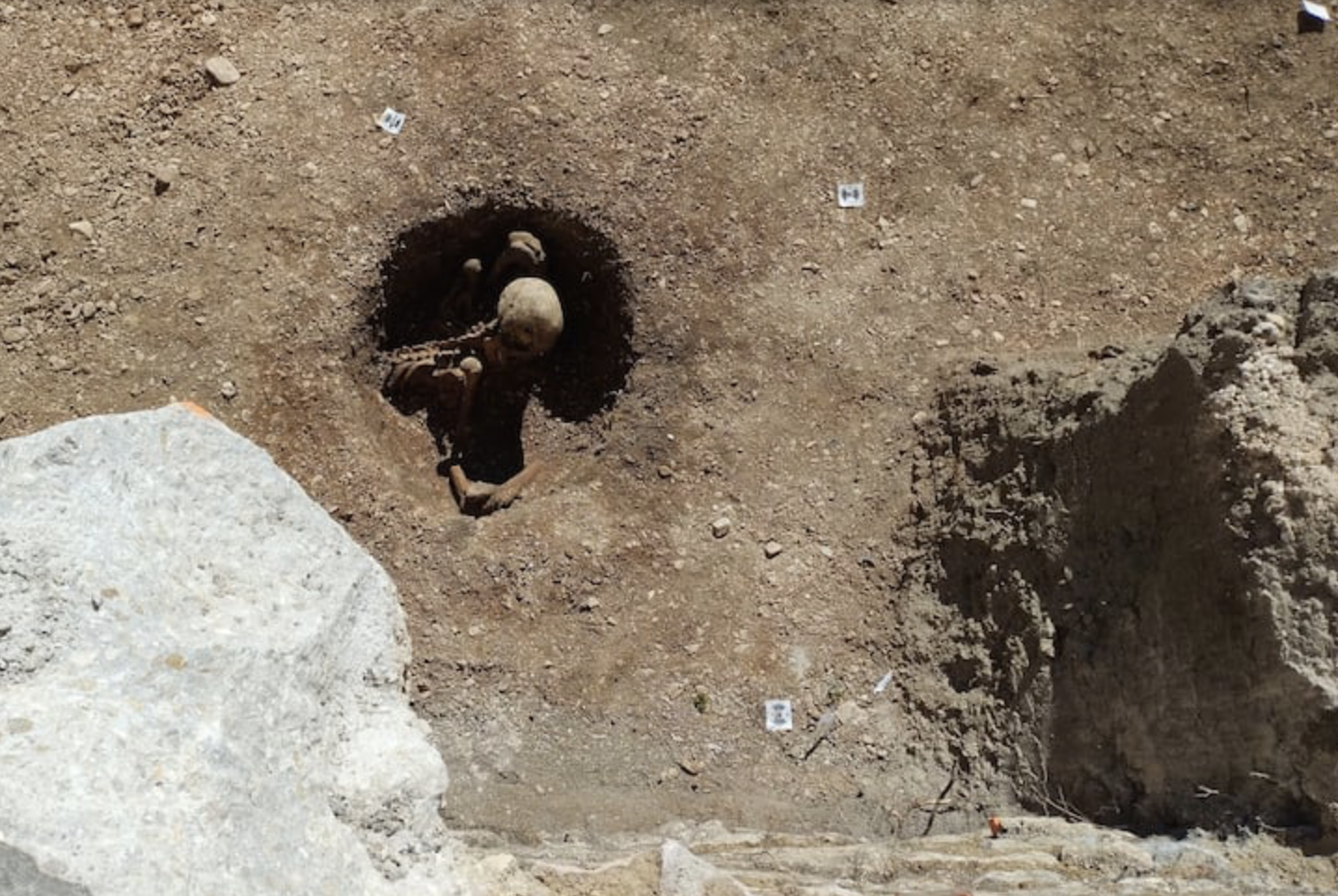
A routine school day in eastern France took a chilling turn when children playing near their school stumbled onto something straight out of a history nightmare — a human skeleton, eerily upright, staring toward the horizon from inside a narrow pit.
The discovery happened beside a primary school in Dijon, a city now at the center of a growing archaeological mystery that has experts scrambling for answers.
But this wasn’t just a one-off shock.
It’s part of a pattern — and possibly something far more disturbing.
Construction crews working near the school had already uncovered unusual remains earlier this month. Then came the latest find: a remarkably well-preserved skeleton positioned in a way that immediately raised red flags.
The body wasn’t lying down like a typical burial.
It was seated.
Its back pressed against the wall of a circular pit. Hands placed neatly in its lap. Head facing west, as if deliberately posed.
“This is not how we expect to find human remains,” said archaeologist Annamaria Latron. “We are used to individuals laid flat, not arranged like this.”
Even more unsettling — this exact position has now been seen multiple times in the same area.
In just the past few weeks, at least five skeletons have been uncovered in identical seated positions, all within close range of each other.
And that’s only the beginning.
Officials say at least 13 additional bodies were discovered nearby last year — bringing the total to nearly 20 in this small pocket of the city.
That concentration is no coincidence.
“Given the number and quality of these finds, we’re looking at a significant ancient settlement,” said researcher Regis Labeaune. “Dijon clearly held importance for this population.”
That population? The Gauls — a mysterious Celtic civilization that dominated much of Western Europe before being conquered by Rome.
The deeper researchers dig, the darker the story gets.
Some of the previously discovered skeletons show clear signs of brutal injuries.
“One individual had two blows to the skull from what appears to be a sharp weapon,” investigators reported.
That has sparked a chilling question:
Were these people executed?
Or worse… buried alive?
Experts admit they don’t have a clear answer.
“We do not have a preferred hypothesis,” Latron said. “There are still too many missing pieces.”
Theories are swirling — and none of them are comforting.
Some experts believe these seated burials could have been a form of punishment, reserved for criminals or outcasts.
Others suspect ritual sacrifice — possibly tied to agricultural cycles or spiritual beliefs.
Animal remains found at the site add weight to that theory. Dozens of dogs, sheep, and pigs were discovered nearby, believed to have been used in ceremonial practices.
There’s also a more strategic — and chilling — possibility.
“These burials could have been meant as a warning,” one researcher suggested. “A way to intimidate enemies or send a message.”
Despite the eerie setup, the bodies themselves offer clues about everyday life — and hardship.
All of the skeletons appear to be male, standing between about 5’3” and 6 feet tall. Their bones show signs of heavy physical labor, especially in the legs.
“They were likely very active individuals,” Latron explained. “Their skeletons suggest intense daily strain.”
Their teeth, surprisingly well-preserved, hint at a diet free from processed sugar — a stark contrast to modern life.
But one detail stands out most:
None of them were buried with valuables.
No jewelry. No weapons. No personal items.
Just bodies — carefully positioned, deliberately arranged, and left behind.
Over the past three decades, Dijon has quietly become one of the most important sites in the world for studying these rare “seated burials.”
Out of roughly 75 known examples worldwide, more than a quarter have been found in this single city.
And yet, the biggest question remains unanswered:
Why?
“This is what makes archaeology both fascinating and frustrating,” Latron admitted. “We’re missing key layers of evidence that could explain everything.”
Until those answers surface, the skeletons of Dijon will continue to unsettle — frozen in time, seated in silence, and guarding secrets from more than 2,000 years ago.
Discover more from Next Gen News
Subscribe to get the latest posts sent to your email.