

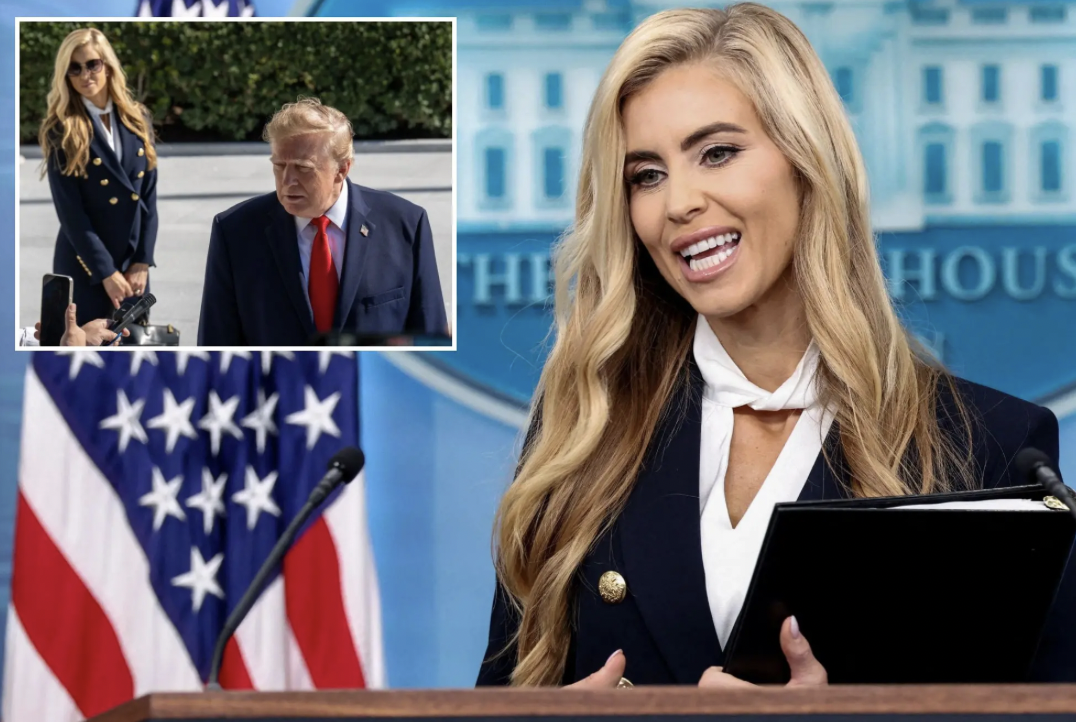
President Donald Trump’s newest White House press secretary is already out of a job after just five days, following a rocky debut, uncomfortable television interviews and growing questions about her professional credentials.
Katie Zacharia, who officially started Monday, October 12, is leaving the high-profile position following a turbulent first week that saw her struggle to defend her performance and face scrutiny over claims about her legal background.
Her abrupt departure became public Friday, October 16, shortly after Trump openly questioned whether she should remain in the role.
The president, speaking to reporters as he prepared to travel to a campaign rally in Georgia, suggested the pressure had become too much for his newly appointed spokeswoman.
He also blamed the media for what he described as unfair treatment.
“Katie’s been treated very badly by the media. Very, very badly, very unfairly,” Trump said.
The president explained that he had spoken privately with Zacharia about whether she wanted to continue in the demanding position.
According to Trump, he told her she did not need to put herself through the intense scrutiny that comes with representing his administration.
A senior administration official subsequently confirmed that Zacharia was leaving the job, bringing one of the shortest White House press secretary tenures in modern history to an abrupt end.
The announcement marked a stunning reversal for a woman Trump had enthusiastically selected just one week earlier.
Zacharia, 41, a California native and conservative political commentator, was appointed to succeed Karoline Leavitt, who left the administration in August.
Before joining the White House, she had worked as a communications adviser for Trump Media & Technology Group, the company behind Truth Social, and appeared frequently on conservative television programs.
But the transition from political commentator to the president’s chief spokesperson proved difficult almost immediately.
Zacharia’s first formal White House briefing on Tuesday lasted approximately 14 minutes.
During that appearance, she took only a handful of questions before ending the session, an unusually short introduction for someone beginning one of the most closely watched communications jobs in Washington.
The briefing attracted widespread criticism over her apparent nervousness and limited engagement with reporters.
An awkward verbal mix-up also drew attention when Zacharia referred to the president while apparently intending to mention her husband.
Although the White House initially praised her debut, the public reaction quickly grew more negative.
Questions about Zacharia’s legal credentials soon complicated matters further.
Trump had introduced her as an attorney, and Zacharia had previously been described as a lawyer during television appearances.
She graduated from Pepperdine University’s law school in 2011, but reporting subsequently established that she had not passed a state bar examination or obtained a license to practice law in the United States.
During a Thursday appearance on Fox News, Zacharia acknowledged that she failed the California bar exam and never retook it.
She defended her background by discussing legal work she said she had performed overseas and guidance she claimed to have received about describing herself as a lawyer.
The distinction became a significant issue because holding a law degree does not automatically make someone a licensed attorney.
In the United States, lawyers generally must satisfy state licensing requirements, including admission to the bar, before practicing law.
The controversy raised questions about how the White House had evaluated Zacharia’s qualifications before appointing her to such a visible position.
By Thursday evening, she was defending herself on Fox News’ Hannity, a program typically sympathetic to the Trump administration.
Host Sean Hannity questioned her brief debut and the controversy surrounding her professional background.
Zacharia said she had been given little time to prepare for her initial briefing and had tried to do her best under difficult circumstances.
She explained that she had been on the job for less than eight hours when she first appeared before the White House press corps.
The following morning, another uncomfortable appearance on Fox & Friends placed additional attention on her future.
Trump acknowledged the television interviews Friday, saying even friendly conservative media personalities had been unusually tough on his new spokeswoman.
He specifically mentioned Hannity and the hosts of Fox & Friends.
The president described Zacharia as a nice person who had been subjected to more criticism than she deserved.
But rather than offering a firm public defense of her continuation in the job, Trump revealed he had encouraged her to reconsider.
When reporters asked whether he intended to keep Zacharia as press secretary, the president declined to make a commitment.
“I don’t know, we’ll see,” Trump said.
He added that he wanted her to decide whether the position was right for her.
The uncertainty did not last long.
Within minutes, reports emerged that Zacharia was transitioning out of the role.
The development was particularly notable because the White House press secretary is responsible for communicating the president’s positions, answering questions about administration policies and responding to major national and international developments.
The job routinely involves aggressive questioning from reporters, unpredictable breaking news and the challenge of defending controversial presidential decisions.
Zacharia’s rapid exit raises fresh questions about the administration’s selection process and its ability to maintain consistent public communications.
It also comes less than three weeks before the November 3 midterm elections, when the White House faces heightened scrutiny over the economy, foreign policy and the political future of Trump’s agenda.
The unusual circumstances of her departure drew comparisons with Anthony Scaramucci, whose tenure as White House communications director lasted just 10 days during Trump’s first administration in 2017.
Zacharia’s time as press secretary was even shorter.
Trump, however, indicated that she could remain connected to his administration in another capacity.
He said he would like to keep her involved in some form, potentially in a position that would expose her to less public pressure.
No specific new position had been announced as of Friday afternoon.
The White House also had not immediately named a permanent replacement.
For Zacharia, the experience represented a dramatic rise and fall.
Only days earlier, she had been introduced as a trusted Trump supporter ready to serve as one of the administration’s most prominent public representatives.
By Friday, after just one official briefing and several difficult media appearances, her tenure was already over.
The episode leaves the White House searching for another spokesperson at a politically sensitive moment, while renewing scrutiny of how the administration selects people for some of its most demanding jobs.
Discover more from Next Gen News
Subscribe to get the latest posts sent to your email.