

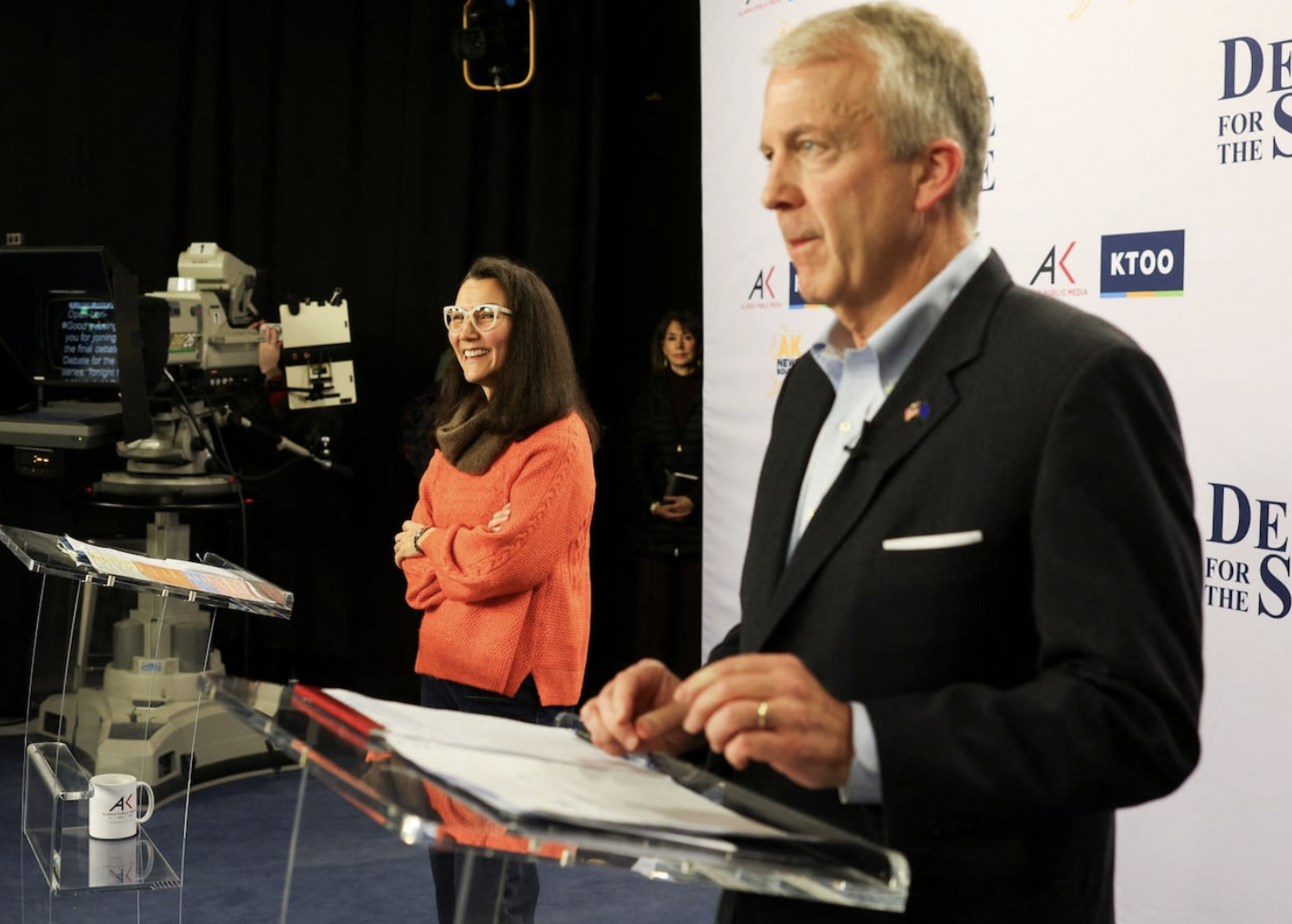
A heated Senate debate in Alaska took an unexpected turn Thursday night when Republican Sen. Dan Sullivan questioned whether his Democratic challenger had received questions in advance, only to be immediately corrected by the moderator.
The awkward exchange unfolded during an October 15 debate in Anchorage, where Sullivan faced former Democratic Rep. Mary Peltola in one of the country’s closely watched Senate races.
What began as a discussion about Alaska’s soaring cost of living quickly escalated into a confrontation over whether Peltola had an unfair advantage.
But the Democrat had a pointed response to Sullivan’s accusation.
She was simply prepared.
The moment came as the candidates discussed the financial pressures facing Alaska families, including rising grocery bills, expensive fuel and some of the highest household energy costs in the country.
Sullivan, 61, acknowledged that affordability had become a serious problem but blamed policies enacted under former President Joe Biden for driving up inflation and energy prices.
Peltola, 53, challenged that explanation, arguing that decisions made during President Donald Trump’s current administration were also contributing to the financial strain.
“Everyone regardless of income is being crippled by these prices,” Peltola said.
She described hearing from rural Alaskans whose monthly electricity bills had reached approximately $1,500, even before accounting for heating costs.
The former congresswoman also criticized Sullivan’s support for the administration’s military campaign against Iran, arguing that the conflict had contributed to higher fuel prices and increased costs for ordinary families.
Sullivan defended the administration’s energy policies and maintained that expanding American oil and gas production was essential to lowering expenses.
Then came the exchange that quickly attracted attention online.
After listening to Peltola’s response, Sullivan turned toward the moderators and questioned whether the candidates had been given advance access to the debate questions.
“We weren’t supposed to get these questions beforehand, were we?” he asked.
Moderator Lori Townsend immediately rejected the suggestion.
“Neither one of you got questions beforehand, absolutely not,” Townsend responded.
Sullivan explained that he had noticed Peltola appearing to read prepared answers from her notes.
The senator’s implication was clear: He was questioning how his opponent could have such a detailed response ready for a question she supposedly had not seen.
Peltola, however, offered a much simpler explanation.
“Prepared,” she replied.
She then thanked Sullivan for what she treated as an unintended compliment.
The moment stood out in an already tense debate that featured repeated disagreements over energy policy, the federal government and the candidates’ competing records.
Although both candidates had notes at their lecterns, Sullivan’s suggestion that Peltola received the questions ahead of time was not supported by the moderators.
There is no verified evidence that either candidate was given advance access to the questions.
The debate was organized by Alaska Public Media in partnership with Alaska’s News Source and KTOO, with moderators limiting most responses to 90 seconds.
Beyond the memorable exchange, the candidates presented sharply different views on several major issues.
Sullivan emphasized his support for domestic energy production, arguing that Alaska’s vast oil and natural gas resources could help strengthen the economy and reduce dependence on foreign energy.
Peltola also expressed support for responsible energy development but argued that Alaska needs federal representatives willing to challenge their own party when national policies hurt local residents.
The Democrat has sought to distinguish herself from national party leadership by emphasizing her work on Alaska-specific issues, including fisheries, energy development and rural infrastructure.
She previously represented Alaska in the U.S. House and became the first Alaska Native woman elected to Congress.
During her time in office, Peltola supported the Willow oil development project, an issue that sometimes placed her at odds with environmental activists and fellow Democrats.
That record has become an important part of her campaign as she attempts to appeal to voters in a state that has traditionally supported Republicans in presidential elections.
Sullivan, meanwhile, is seeking another six-year term after serving in the Senate since 2015.
A former Alaska attorney general and Marine Corps officer, he has received Trump’s endorsement and has campaigned alongside the president.
Earlier this week, Trump traveled to Wasilla to support Sullivan and other Republican candidates ahead of the November 3 midterm elections.
The president praised Sullivan’s performance in Washington and encouraged supporters to help Republicans maintain control of Congress.
But Thursday’s debate highlighted the challenge facing both candidates as they confront voters frustrated by the cost of everyday necessities.
Alaska’s remote communities are particularly vulnerable to high transportation and energy costs.
Many villages depend on imported fuel for electricity and heating, while groceries and other essential supplies often must travel long distances by air or water.
Those geographic realities mean increases in global oil prices can have especially severe consequences for residents.
The debate over the Iran conflict has added another dimension to the issue.
Peltola argued that military decisions supported by Trump and Sullivan had contributed to rising energy costs.
Sullivan countered that stronger domestic production and national security policies were necessary to protect American interests.
The candidates also exchanged criticism over their records in public office, including their positions on government spending and the direction of the country.
At several points, the debate became personal, with the two accusing each other of misleading voters.
The confrontation comes as polling suggests a highly competitive contest.
A New York Times/Siena College survey conducted in late September and early October found Peltola receiving 50% support compared with Sullivan’s 43%.
Other surveys have shown smaller differences, and some have placed Sullivan ahead, underscoring the uncertainty surrounding the race.
Alaska uses a ranked-choice voting system, which adds another consideration because voters can rank candidates in order of preference rather than selecting only one.
The November election could have national consequences as Democrats attempt to regain control of the Senate, where Republicans currently hold a 53-47 majority.
For Peltola, the debate offered an opportunity to challenge the incumbent on economic issues while emphasizing her experience representing Alaskans in Congress.
For Sullivan, it was a chance to defend his record and argue that Republican policies are better suited to the state’s economic and security needs.
But one of the night’s most memorable moments had little to do with either candidate’s policy proposals.
Instead, it came when Sullivan questioned whether his opponent had seen the questions in advance and Peltola responded that she had simply arrived ready to debate.
With Election Day approaching, Alaska voters will have the final say on which candidate made the stronger case for representing their state in Washington.
Discover more from Next Gen News
Subscribe to get the latest posts sent to your email.