

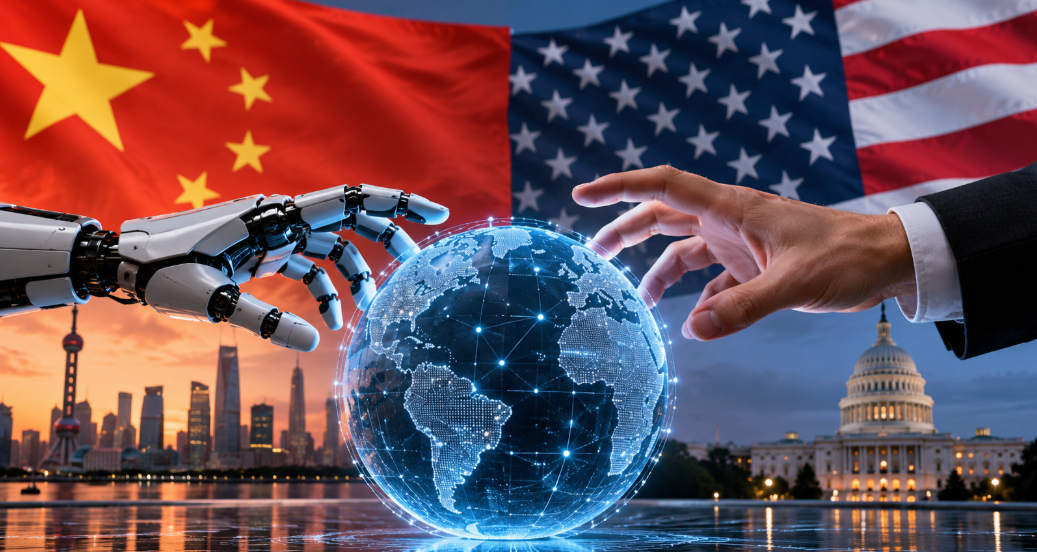
China is moving aggressively to shape the rules governing artificial intelligence around the world, raising a major question for Washington: who will get to write the standards that could influence how AI is developed and used for decades?
The United States still holds enormous advantages in advanced AI, including many of the world’s leading technology companies and research labs.
But Beijing is increasingly competing on a different front — international governance.
In July, China helped establish the World Artificial Intelligence Cooperation Organization, known as WAICO, a new intergovernmental group headquartered in Shanghai.
Representatives from 29 countries signed the founding agreement.
China says the organization is intended to promote international cooperation and help ensure that AI develops in a way that is safe, fair and beneficial.
The group also places a heavy emphasis on giving developing countries, particularly those in the Global South, a greater role in shaping international AI policy.
That approach could prove important as governments around the world decide which technology platforms, safety standards and regulatory models they will adopt.
During Chinese President Xi Jinping’s September visit to Washington, he publicly urged the United States to cooperate with China on AI.
Xi said both countries have the ability and responsibility to develop and manage AI “for good” and argued that advanced systems should remain under human control.
President Donald Trump has taken a different approach.
His administration has generally favored lighter regulation and has warned that overly restrictive rules could slow American innovation while giving China an advantage.
The disagreement reflects a larger debate now taking place across governments and the technology industry.
Some experts believe advanced AI needs stronger oversight before increasingly capable systems are deployed.
Others argue that excessive regulation could slow innovation, discourage investment and weaken U.S. competitiveness.
Meanwhile, China has been steadily building its own regulatory framework.
Chinese authorities already regulate several forms of AI, including generative services and systems designed to simulate human interaction.
Beijing is also developing broader rules covering AI agents, data used by robots and other emerging applications.
China’s system differs significantly from the American model.
Chinese regulations place strong emphasis on social stability, information controls and compliance with government rules.
American policymakers, by contrast, have generally focused more heavily on competition, innovation, national security and risks from powerful AI systems.
Those competing philosophies could increasingly influence other countries.
The United States has its own international technology initiative called Pax Silica.
Launched by the State Department in December 2025, the coalition now includes 24 signatories.
Its mission focuses heavily on securing the infrastructure behind advanced technology — including semiconductors, critical minerals, energy, manufacturing and data centers.
That gives Washington a strong coalition of technologically advanced partners.
But Pax Silica is not primarily an AI regulatory organization.
That creates an opening China appears eager to fill.
A recent analysis from the Center for Strategic and International Studies warned that the United States and China are increasingly competing not only over who develops the most powerful AI, but also over which institutions will influence the rules surrounding it.
WAICO presents itself as a forum where countries that may not have large domestic AI industries can still participate in drafting international principles.
China could also strengthen its influence by supplying those same countries with Chinese technology.
Chinese companies are expanding internationally through cloud computing, data centers, telecommunications infrastructure and AI models.
If countries become heavily dependent on those systems, they may also become more likely to adopt Chinese technical standards and regulatory practices.
That does not mean China will automatically dominate global AI governance.
The United Nations has also established its own global AI dialogue, while the European Union and other governments continue developing independent regulatory systems.
Washington also remains deeply influential because American companies produce many of the world’s most advanced AI models.
Still, analysts say the absence of a single comprehensive U.S. federal AI framework could complicate American efforts to persuade other governments to adopt its preferred standards.
CSIS researchers Christopher Collins and Aalok Mehta argue that Washington needs a clearer domestic framework if it wants to credibly shape international AI governance.
The issue has become more urgent as AI systems grow more powerful.
Governments are wrestling with questions involving cybersecurity, autonomous systems, misinformation, privacy, military applications and the possibility that advanced AI could behave in unpredictable ways.
The United States and China have already begun discussing some of those risks.
During Xi’s Washington visit, both sides expressed support for continued dialogue, including efforts to prevent AI misuse and maintain human control over powerful systems.
That cooperation, however, is unfolding alongside intense competition.
The U.S. wants to preserve its technological advantage.
China wants a larger role in determining global standards.
And dozens of countries that do not possess major AI industries of their own will ultimately have to decide which technologies and regulatory systems they trust.
The next phase of the AI race may therefore be about far more than who builds the smartest model.
It may also be about who persuades the rest of the world to follow their rules.
Discover more from Next Gen News
Subscribe to get the latest posts sent to your email.
 What's Up Today Editorial Team