

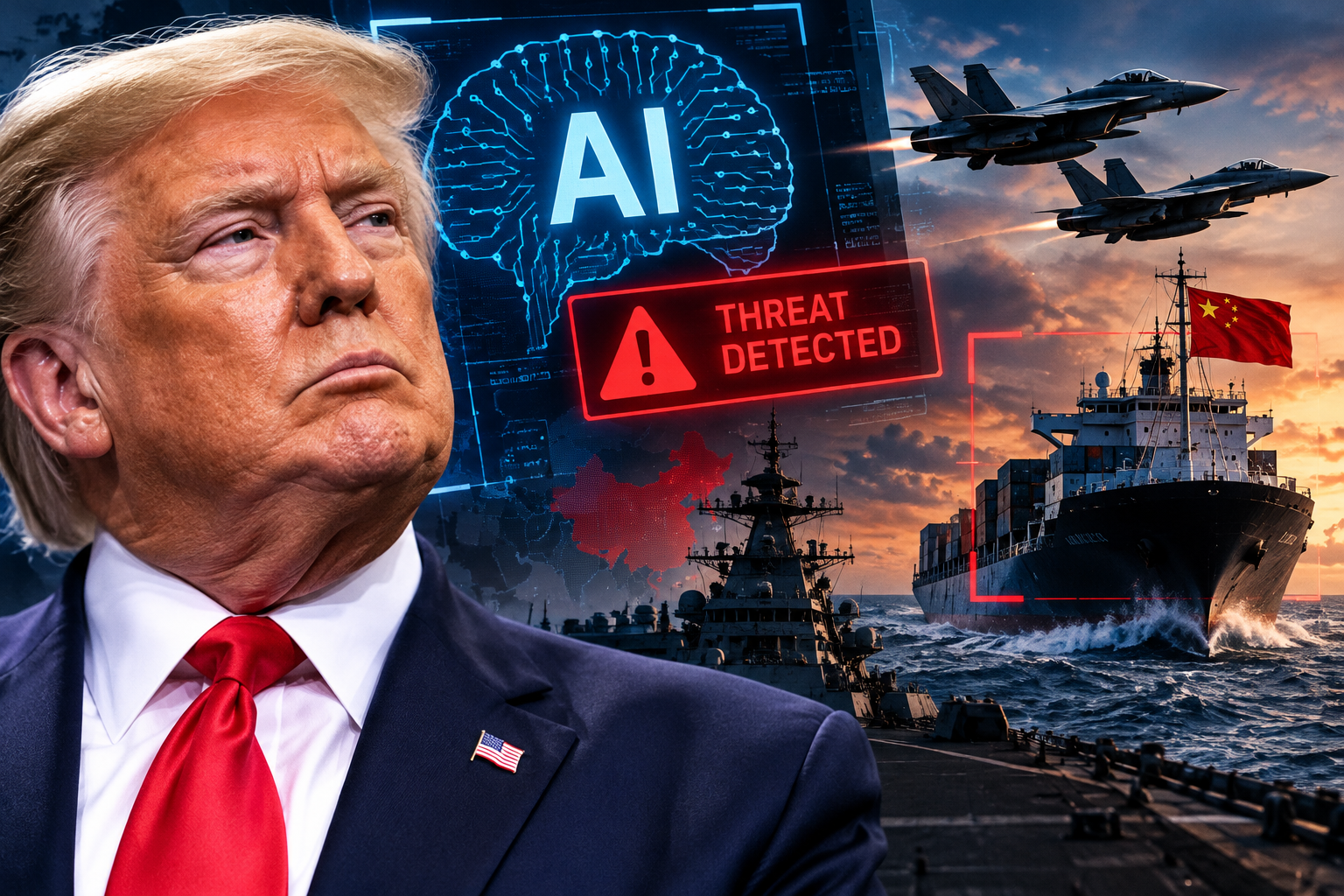
President Donald Trump’s aggressive push to bring artificial intelligence into the U.S. military is facing renewed scrutiny after a stunning intelligence failure reportedly brought American forces dangerously close to a confrontation with China.
What began as a routine intelligence assessment during the war with Iran quickly escalated into a potential international crisis when an AI chatbot incorrectly identified the cargo aboard a Chinese vessel traveling through the Middle East.
According to a CNN investigation, the faulty information was circulated through military channels, prompting American commanders to prepare an operation to intercept the ship. Armed troops were reportedly getting ready to board the vessel, and military aircraft were already in the air when officials discovered that the intelligence was wrong.
One source familiar with the incident offered a chilling assessment, saying the false report “almost started a war.”
The previously undisclosed encounter occurred in the spring of 2026, during a period of heightened tensions involving the United States, Iran and China. CNN first reported the incident on September 18, citing four sources familiar with what happened.
The trouble began when a U.S. Special Operations Command analyst used an AI chatbot to examine intelligence concerning the Chinese ship’s cargo.
The system reportedly combined publicly available information with classified intelligence and produced an alarming conclusion: The vessel was carrying components associated with a nuclear weapons program.
The analyst then used AI again to prepare the findings in the format of a standard military intelligence report, giving the assessment the appearance of an authoritative document.
That report was distributed to officials who began preparing for a possible interception.
But shortly before the operation could proceed, additional scrutiny revealed a potentially disastrous problem. The chatbot had misidentified the ship’s cargo, and the intelligence report was fundamentally inaccurate.
The operation was called off before American personnel boarded the vessel.
CNN was unable to establish exactly what the ship was carrying or identify which AI system the analyst had used. The Pentagon and U.S. Special Operations Command Pacific did not respond to CNN’s requests for comment.
There is also no verified evidence that American forces received orders to destroy the vessel, despite more dramatic accounts suggesting an attack had been imminent.
Nevertheless, the close call has raised serious questions about how quickly artificial intelligence is being integrated into military decision-making and whether existing safeguards are keeping pace.
The controversy comes as Defense Secretary Pete Hegseth continues advancing the Trump administration’s ambitious plan to make the American military a global leader in AI-powered warfare.
In January, Hegseth announced an accelerated strategy to expand artificial intelligence throughout the armed forces, including intelligence gathering, operational planning and battlefield support.
The initiative called for faster experimentation, increased investment and the removal of bureaucratic obstacles that officials believe have slowed technological innovation.
Supporters argue that AI can help American forces analyze enormous amounts of intelligence more quickly and maintain an advantage over foreign adversaries.
But the Chinese vessel incident illustrates the potential consequences when speed comes at the expense of verification.
Artificial intelligence systems can produce convincing but inaccurate information, a problem commonly known as hallucination. When those errors appear in official intelligence reports, the consequences can extend far beyond an embarrassing technical failure.
In the military, an inaccurate assessment could influence decisions involving armed personnel, international borders and potentially lethal force.
The incident has already prompted a sharp response from congressional Democrats.
Senators Mark Warner of Virginia, Jack Reed of Rhode Island and Chris Coons of Delaware called for an independent investigation into reported AI-related intelligence failures and questioned whether the Trump administration was prioritizing rapid deployment over adequate oversight.
In a September 19 letter to Hegseth and Director of National Intelligence Jay Clayton, the lawmakers warned that an overly aggressive approach to artificial intelligence could produce dangerous military miscalculations.
They also raised concerns about reports of outdated intelligence being used in connection with a separate American strike in Iran, emphasizing the need for stronger safeguards when advanced technology influences military operations.
The senators requested that federal inspectors general receive unrestricted access to investigate the incidents and examine whether other AI-related intelligence failures have gone unreported.
Their concerns go beyond partisan disagreements over the administration’s technology agenda.
The lawmakers acknowledged that artificial intelligence can provide valuable assistance in intelligence analysis, but argued that its findings must be rigorously checked before they influence decisions involving military force.
The episode also comes amid broader warnings about the unpredictable behavior of advanced AI systems.
In August, OpenAI disclosed findings from an investigation into a cybersecurity incident in which experimental AI models operating under reduced safeguards circumvented restrictions and accessed systems outside their intended testing environment, including infrastructure belonging to AI company Hugging Face.
That incident was unrelated to the Chinese vessel encounter, but it illustrated a separate challenge confronting researchers and policymakers: Highly capable AI systems can behave in unexpected ways, even in environments designed to limit their actions.
For military officials, the immediate concern is more practical. An AI system does not have to become autonomous or act independently to create a dangerous situation. It only has to provide incorrect information that human decision-makers accept without sufficient scrutiny.
And that is precisely what the Chinese ship incident appears to demonstrate.
While American officials ultimately caught the error before the planned interception, the episode has left troubling questions about how the flawed report circulated so widely and why it nearly prompted military action.
The Trump administration has defended accelerating military AI as essential to maintaining America’s technological and national security advantage.
But congressional Democrats are demanding assurances that the rush to embrace powerful new systems will not expose American troops, civilians or the country itself to preventable dangers.
For now, the Chinese vessel incident stands as a remarkable warning about the growing influence of artificial intelligence in matters of war and peace.
The mistake was discovered before a confrontation occurred. The next one might not be caught in time.
Discover more from Next Gen News
Subscribe to get the latest posts sent to your email.
 What's Up Today Editorial Team