

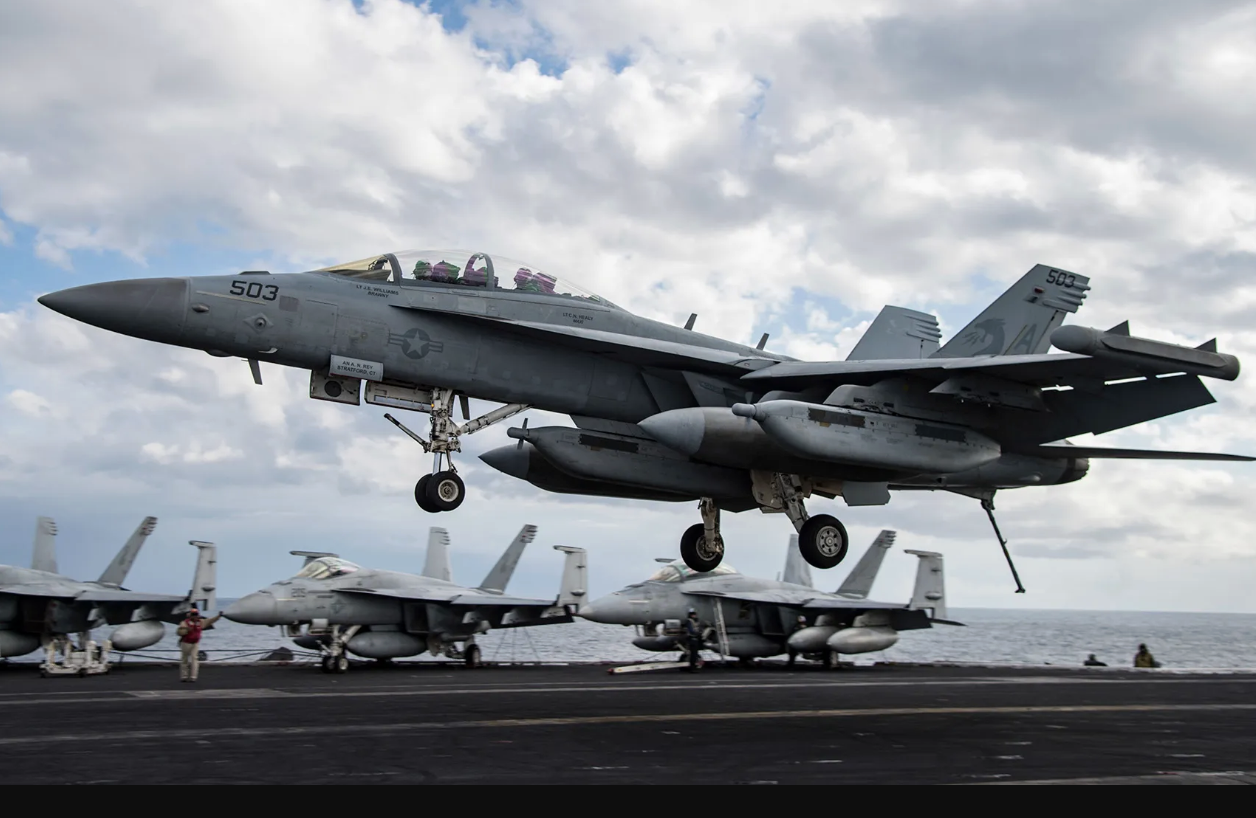
Two U.S. Navy aviators were forced to eject from their aircraft during a frightening landing accident aboard the USS Dwight D. Eisenhower off the Virginia coast, while several sailors on the aircraft carrier were also injured.
The incident unfolded at approximately 6:18 p.m. Monday as an EA-18G Growler was attempting to land on the nuclear-powered carrier during flight operations.
According to an updated Navy account, the aircraft suffered an arresting-gear failure during the landing.
The arresting system is one of the most critical pieces of equipment on an aircraft carrier. Heavy cables stretched across the flight deck are designed to catch a hook on the back of an arriving aircraft and bring the fast-moving jet to a stop in a remarkably short distance.
Something went wrong during Monday’s recovery.
The two aviators aboard the Growler ejected from the aircraft and were quickly recovered by a Navy search-and-rescue crew from Helicopter Sea Combat Squadron 7.
Both aviators survived and were safely returned to the Eisenhower.
Six additional sailors were also injured in connection with the mishap, according to the Associated Press, while the Navy said a total of eight sailors were evaluated by medical personnel following the accident.
One sailor was flown to a hospital in the Norfolk area for treatment of injuries that were described as non-life-threatening.
The two aviators and two sailors who were injured on the flight deck were transported to Naval Medical Center Portsmouth for further evaluation.
The Navy has not publicly disclosed the full extent of their injuries.
The aircraft involved was an EA-18G Growler assigned to the “Zappers” of Electronic Attack Squadron 130 and Carrier Air Wing 3.
The Growler is a specialized electronic-warfare aircraft derived from the Navy’s F/A-18 Super Hornet. Rather than serving only as a conventional fighter, it is designed to detect, disrupt and jam enemy radar and communications systems.
The Navy has not yet released a detailed explanation of exactly why the arresting gear failed or what ultimately happened to the aircraft following the crew’s ejection.
The cause remains under investigation.
The accident is particularly notable because the Eisenhower has only recently returned to more extensive operations following a lengthy period of maintenance, repairs and modernization.
The carrier underwent sea trials earlier this year and was conducting carrier qualification work following its latest repair period when Monday’s accident occurred.
Carrier qualifications require pilots to repeatedly practice the notoriously difficult task of taking off from and landing on a moving aircraft carrier. Even under normal conditions, carrier landings rank among the most demanding operations in military aviation.
A jet approaches the flight deck at high speed while attempting to catch one of the carrier’s arresting wires with a hook mounted beneath the aircraft. If the hook fails to engage properly — or the arresting system itself malfunctions — crews have only seconds to react.
Monday’s accident also comes amid continued scrutiny of military aviation safety following several high-profile Navy aircraft mishaps in recent years.
The USS Dwight D. Eisenhower itself has been in service for nearly half a century.
Commissioned in 1977, the Nimitz-class nuclear-powered aircraft carrier is one of the oldest active carriers in the U.S. Navy. The massive vessel can support thousands of sailors and an entire carrier air wing.
The Eisenhower also completed an unusually demanding deployment to the Middle East in 2024, where its crew conducted operations connected to efforts to protect commercial shipping from attacks by Yemen’s Houthi rebels.
Monday’s accident, however, occurred much closer to home off the Virginia coast.
For now, Navy investigators will be looking closely at the failed arresting system, the aircraft and flight-deck operations to determine precisely what caused the dangerous chain of events.
The Navy said carrier crews regularly train for emergencies during flight operations and credited that preparation with helping personnel respond quickly after the aviators were forced to eject.
Despite the dramatic accident, the most important fact remained unchanged Tuesday: both aviators survived.
Discover more from Next Gen News
Subscribe to get the latest posts sent to your email.