

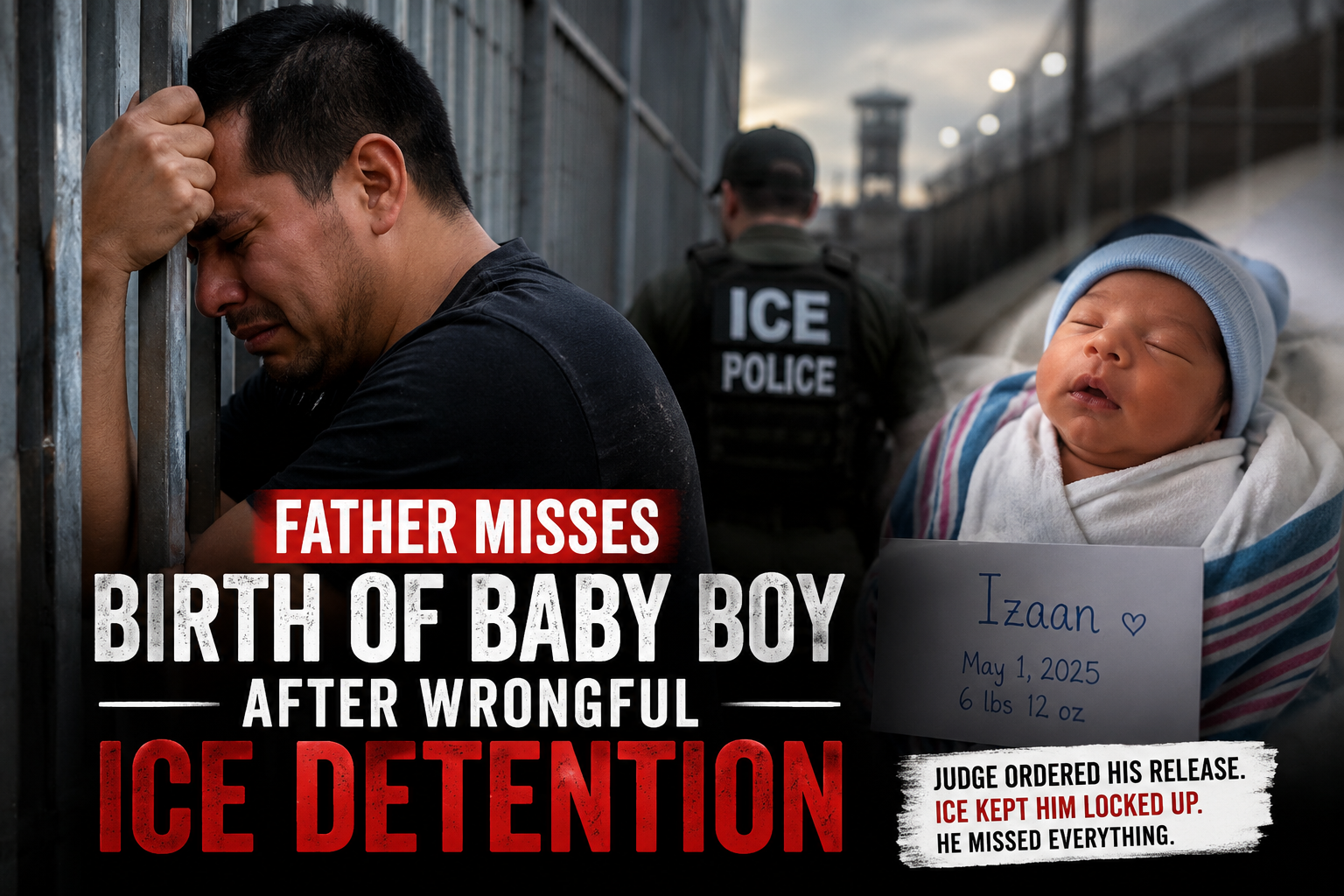
A Guatemalan man missed the birth of his first child after ICE allegedly kept him behind bars for days despite a federal judge ordering his “immediate release,” according to court filings and his family.
Freddy Cortez Lugos, who had been living in the United States on humanitarian parole, was detained by Immigration and Customs Enforcement during what was supposed to be a routine check-in. But according to a federal judge in California, that detention violated his due-process rights.
Then came the moment his family says turned a legal fight into a personal nightmare.
On May 1, U.S. Magistrate Judge Karen E. Scott ruled that ICE had unlawfully re-detained Cortez Lugos and ordered the agency to release him immediately. That same day, his partner went into labor and gave birth to their baby boy, Izaan.
But Cortez Lugos was still in custody.
By the time he was released from the Adelanto Detention Facility in California on the evening of May 4, his son had already entered the world without him there.
Family members say the delay robbed a new father of an irreplaceable moment and turned what should have been one of the happiest days of his life into another flashpoint in America’s bitter immigration battle.
The case is now raising fresh questions about ICE’s power under President Donald Trump’s aggressive deportation agenda, especially as federal judges continue to push back against attempts to detain migrants who had already been released into the community under parole or supervision.
At the heart of the case is a simple but explosive question: if a federal judge orders ICE to release someone immediately, why was Cortez Lugos still locked up days later?
According to the court order, Cortez Lugos had been living in the U.S. on humanitarian parole since 2024. He was enrolled in ICE’s Intensive Supervision Appearance Program, had no criminal record, and, according to the judge’s ruling, was complying with reporting requirements.
ICE detained him on April 14 during a check-in.
The Department of Homeland Security told Newsweek that federal agents arrested Cortez Lugos after he allegedly “committed 12 violations of his ICE check-in requirements.”
But Judge Scott found that ICE had failed to provide the kind of notice and hearing required under constitutional due process protections before taking him back into custody.
In her ruling, Scott said ICE had not explained what had changed that justified re-detaining him after he had spent nearly two years living in the community. The judge also rejected the government’s argument that Cortez Lugos could be held without a hearing as an “arriving alien” subject to mandatory detention.
Even if that label applied, Scott wrote, due process still required ICE to provide written notice and a meaningful opportunity to be heard before putting him back behind bars.
The judge ordered ICE to “immediately release” Cortez Lugos and barred the government from re-detaining him again without written notice and a pre-detention hearing before a neutral decision-maker.
But according to his family, that did not happen right away.
Relatives said they went to the detention facility after the court ruling, order in hand, only to be told by ICE officers that no release order had been received or that no attorney had been assigned to his case.
“I went over … to talk to the ICE officer, and the officer said he had no court order and he had no attorney assigned to Freddy’s case so he couldn’t help me,” Kimberly Barajas, the sister of Cortez Lugos’ partner, told Newsweek. “I had the court order in my hands, and the ICE officer would still not answer all my questions.”
DHS disputed the idea that ICE dragged its feet.
“Cortez-Lugos was ordered released from ICE custody, and he was released as soon as ICE was notified to do so,” a DHS spokesperson told Newsweek.
But for the family, the damage was already done.
Cortez Lugos’ partner, who was nearly eight months pregnant when he was arrested in April, went into labor on the day the judge ordered his release. Family members said doctors attributed complications during labor to stress. She is now recovering, and the baby is healthy, weighing 6 pounds, 12 ounces at birth.
Barajas said Cortez Lugos is a “hard-working man” whose detention was proven unlawful through the habeas petition.
“His detention was unlawful,” she said, adding that if the facility had released him the day the judge signed the order, “Freddy could have been out and made it to his child’s birth.”
For immigrant-rights advocates and critics of Trump’s hardline enforcement push, the case is likely to become another example of what they argue is a system moving too fast, with too little accountability, and with devastating consequences for families caught in the middle.
For Cortez Lugos, the legal victory came too late to give him back the one moment he can never relive: watching his son take his first breath.
Discover more from Next Gen News
Subscribe to get the latest posts sent to your email.
Can’t get a hearing if you don’t show up for the hearings 12 times!