

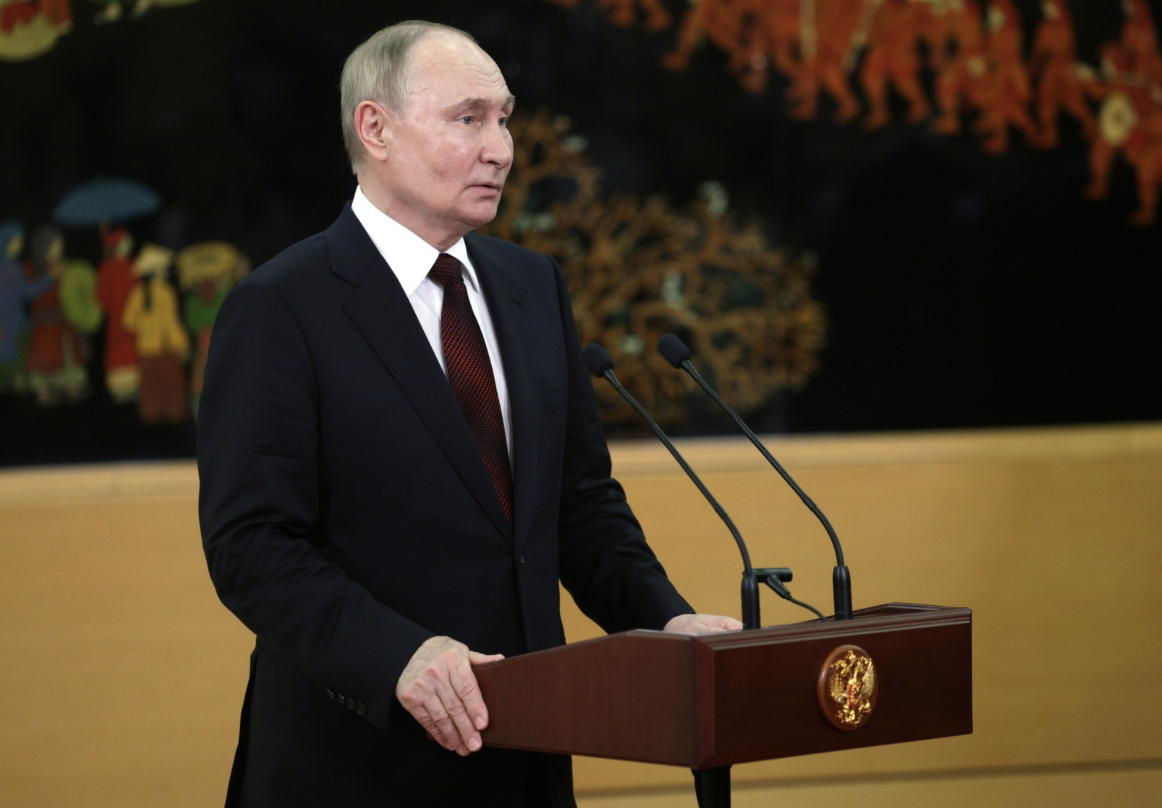
As Moscow goes into lockdown ahead of its May 9 Victory Day parade, the image of Vladimir Putin as the untouchable strongman is looking shakier than ever.
Ukrainian President Volodymyr Zelensky has openly mocked the Kremlin’s anxiety, warning that Russia is so on edge it fears drones “buzzing over Red Square.” That fear is not imaginary. Russia has scaled back this year’s parade, tightened security across Moscow, and even restricted mobile internet service as officials brace for possible Ukrainian strikes during one of the Kremlin’s most symbolic events.
Now comes an even more revealing sign of weakness. A leaked European intelligence report, cited by outlets including the Financial Times’ reporting ecosystem and other regional publications, claims Putin has sharply increased his personal security, reduced travel, limited contact with aides, and spent more time in protected locations because of fears of assassination or even an internal coup. Some details of that leak remain difficult to verify independently, but the broader picture matches what the world can already see: Putin is ruling like a man who knows danger is closing in.
For many Americans watching Russia’s brutal war on Ukraine, that might sound like welcome news. After all, Putin is the architect of the largest land war in Europe since World War II, the man responsible for the bombardment of cities, the kidnapping of children, the crushing of dissent, and years of lies dressed up as patriotism. The instinct to think “good riddance” is understandable.
But there is a darker truth buried underneath that fantasy.
Putin’s death would not automatically mean democracy, peace, or justice. It could mean chaos inside a nuclear-armed state built almost entirely around one man’s power.
That is the real danger.
For 25 years, Putin has hollowed out Russian institutions and replaced them with a system of personal loyalty, fear, corruption, and competing elite factions. He is not just Russia’s president. He is the referee, the enforcer, the patron, and the final decision-maker in a political machine that no longer knows how to function without him. Remove that central figure suddenly, and the result is not a clean transition. It is a violent scramble for power.
Russia has already shown just how fragile that system can be. In June 2023, Wagner boss Yevgeny Prigozhin launched an armed mutiny, seized military sites in Rostov-on-Don, and sent his forces racing toward Moscow before abruptly backing down. Not long after, he died in a plane crash widely viewed as suspicious. Putin survived that challenge, but the episode exposed a glaring truth: loyalty in modern Russia can turn into open rebellion with terrifying speed.
The names now whispered as possible heirs do not inspire confidence. Figures like Aleksey Dyumin, Sergei Kiriyenko, Dmitry Patrushev, or other hardline security insiders may be seen as contenders, while older security heavyweights such as Nikolai Patrushev or FSB chief Alexander Bortnikov could play kingmaker. None of them represent liberal reform. None of them look likely to steer Russia toward accountability or democratic renewal. More likely, they would offer Putinism in a new suit, perhaps even more paranoid and more aggressive than the original.
And there are signs that the internal cracks are already widening. Former Deputy Defense Minister Ruslan Tsalikov, a longtime associate of Sergei Shoigu, was charged with corruption in March 2026, part of a broader purge around the military establishment that has followed Russia’s failures in Ukraine.
At the same time, the war itself has left Russia deeply scarred. Estimates vary, but one late-February 2026 assessment put Russian military casualties at around 1 million killed or wounded, underscoring the staggering human cost of Putin’s invasion.
That kind of trauma does not simply disappear if the man at the top suddenly drops dead.
It lingers in grieving families, in damaged veterans, in an economy warped by war spending, in a propaganda machine that has spent years convincing Russians that the West is out to destroy them. If Putin were suddenly gone, those pressures would not ease overnight. They could explode.
A succession fight inside Russia would not play out like an orderly election in a healthy democracy. It would unfold inside a wartime autocracy packed with intelligence agencies, oligarchs, military commanders, presidential guards, and rival power centers all trying to secure leverage before someone else does. Under Russia’s constitution, Prime Minister Mikhail Mishustin would become acting president if Putin died. But formal titles do not decide real power in modern Russia. Force does.
That means the first question after Putin would not be who has the best vision for peace. It would be who can seize the coercive machinery of the state fastest.
And in a country with thousands of nuclear weapons, that should terrify the entire world.
Yes, there is a best-case scenario. A successor might decide Russia needs sanctions relief, a pause in the war, or a less self-destructive relationship with Europe and the United States. But that would likely come later, if it comes at all. The first phase would almost certainly be a brutal contest for control, with competing factions trying to prove they are strong enough, ruthless enough, and nationalist enough to rule.
That is why the West should not confuse Putin’s downfall with a ready-made solution.
Putin is a war criminal in the eyes of much of the democratic world. He has earned global contempt. But strategy requires more than emotional satisfaction. If he vanished tomorrow, the United States and its allies would still be left dealing with a heavily armed, deeply unstable Russia, possibly under the control of men who learned all the worst lessons from him.
So yes, the collapse of Putin’s rule would end one of the darkest political careers of this century.
But it would not end the machinery he built.
It could unleash it.
For Americans who care about Ukraine, democracy, and preventing an even wider catastrophe, that is the part worth remembering. Putin’s sudden death may feel like justice in the moment. In reality, it could open the door to a far more dangerous crisis, one with armed factions, a wartime state, and nuclear weapons still in play.
Be careful what you wish for.
Because the end of Vladimir Putin might not be the end of the nightmare.
It might be the beginning of something even worse.
Discover more from Next Gen News
Subscribe to get the latest posts sent to your email.
It may bother Vlad Putin… but not the rest of us… that Hitlerite wouldn’t be missed…
Evil WOKE NextGen getting into these dishonest CLICKBAIT HEADLINES !!!
After chasing away most sane readers with their nonsense…