

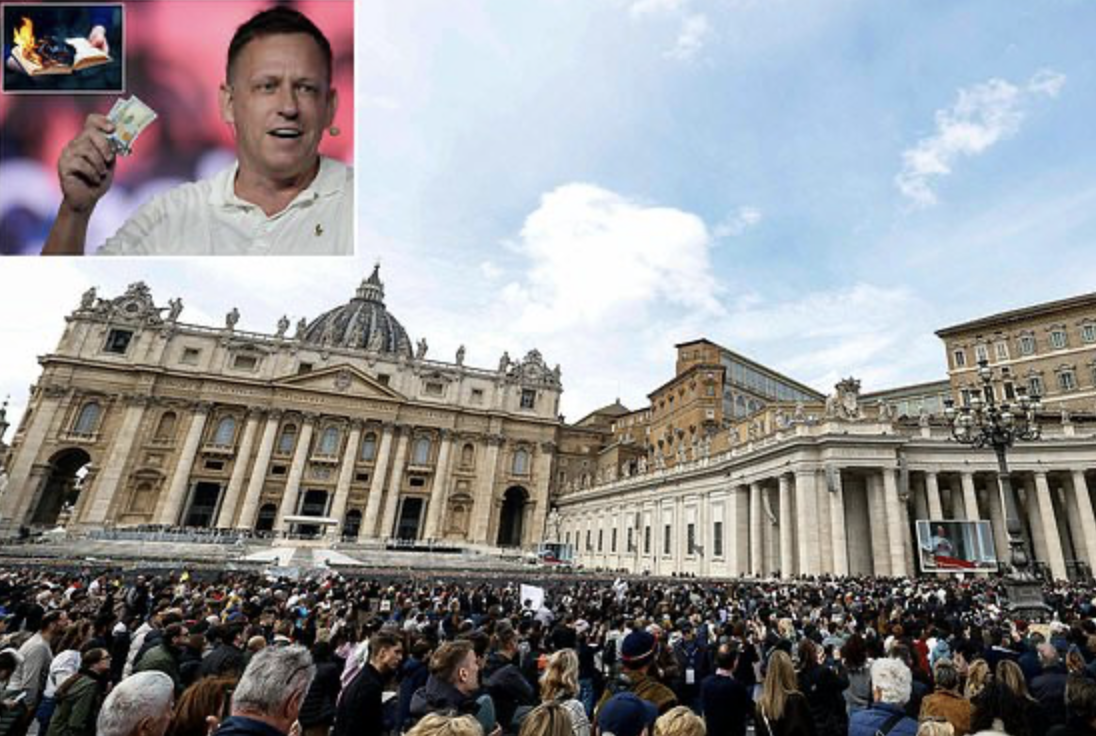
A hush has fallen over a series of high-level meetings unfolding just blocks from the Vatican — and the man behind them is one of America’s most powerful and controversial billionaires.
Peter Thiel, the Silicon Valley heavyweight who co-founded PayPal and built Palantir into a data powerhouse, is quietly hosting an invitation-only conference in Rome centered on a chilling topic: the rise of the Antichrist.
The gathering began Sunday and runs through midweek. Attendees were given strict instructions — no recordings, shifting locations, and tight security. Even in a city used to secrecy, insiders say this event stands out.
“This is not a typical tech conference,” one European attendee reportedly said. “It feels more like a philosophical war room.”
Thiel, 58, has long blended religion, politics, and technology in his worldview. Raised in an evangelical Christian household, he has repeatedly pointed to biblical prophecy as a lens for understanding modern global threats.
In these Rome sessions, sources say he is expanding on a controversial idea: that humanity’s fear of catastrophe could pave the way for a powerful, deceptive global leader — what Christian theology calls the Antichrist.
“The question isn’t just theological,” Thiel wrote in a recent essay. “It’s political, technological, and deeply human. Who would people follow in a moment of global panic?”
According to people familiar with his previous talks, Thiel argues that rising fears — from artificial intelligence to nuclear war and climate collapse — could be exploited by a single figure promising safety.
That leader, he warns, might gain sweeping authority under the banner of preventing disaster.
The Rome lectures have already drawn sharp criticism, particularly from within Catholic circles.
Father Paolo Benanti, a respected Vatican advisor on artificial intelligence, did not mince words.
He described Thiel as a “political theologian of Silicon Valley,” warning that his ideas blur the line between faith and power.
In a recent essay, Benanti wrote that Thiel’s framework challenges “the very foundations of civil coexistence” and represents “a prolonged act of heresy against the liberal consensus.”
Other scholars worry the message could normalize authoritarian thinking under the guise of crisis management.
“The danger,” one Rome-based academic said, “is not theology. It’s the real-world application of these ideas.”
Thiel’s journey from tech disruptor to philosophical provocateur has been years in the making.
After co-founding PayPal in 1998 — alongside a group later dubbed the “PayPal Mafia,” which included Elon Musk and other future tech giants — he turned his focus to investing, defense technology, and political influence.
His company Palantir has since secured major government contracts, including work tied to immigration enforcement and national security.
But behind the boardroom success, Thiel has increasingly turned toward existential questions.
In a previous lecture series in San Francisco, he reportedly cited the biblical Book of Daniel — “knowledge shall be increased” — to argue that rapid technological advancement is fueling modern apocalyptic fears.
He pointed to the atomic bomb as a turning point.
“That was the moment,” he said in notes from the event, “when human innovation became inseparable from the possibility of global destruction.”
Thiel’s central warning is stark.
Modern society, he argues, is obsessed with existential risks — artificial intelligence, bioweapons, nuclear conflict, even population decline. These fears, he says, mirror ancient end-times prophecies.
And they create a dangerous opportunity.
In his view, a future leader could rise by promising peace and stability in a chaotic world — consolidating power while claiming to save humanity.
During a past Q&A session, Thiel reportedly suggested that such a figure would likely be a single individual, not just a system, due to the unprecedented power technology now places in human hands.
“The scale of risk is new,” he said. “And so is the scale of control.”
The choice of Rome has only intensified scrutiny.
Holding these discussions within walking distance of the Vatican — the heart of global Catholicism — is being seen by some as symbolic, even provocative.
Invitations to the event reveal an ambitious intellectual scope. Thiel is reportedly drawing from thinkers ranging from philosopher René Girard to political theorist Carl Schmitt, weaving together theology, science, and geopolitics.
For critics, that combination is exactly what makes the conference so unsettling.
For supporters, it’s a necessary conversation in an unstable world.
One attendee summed up the divide bluntly: “Some people hear ‘Antichrist’ and think religion. Thiel hears it and thinks about the future of global power.”
As the closed-door meetings continue, one thing is clear — whatever is being discussed inside those rooms is about far more than theology.
Discover more from Next Gen News
Subscribe to get the latest posts sent to your email.
Just what we needed… another religious nutcase coming into prominance…
Surprised to just a letter difference between Peter Thiel & Peter Thief??? Is it an accident? David.
>