

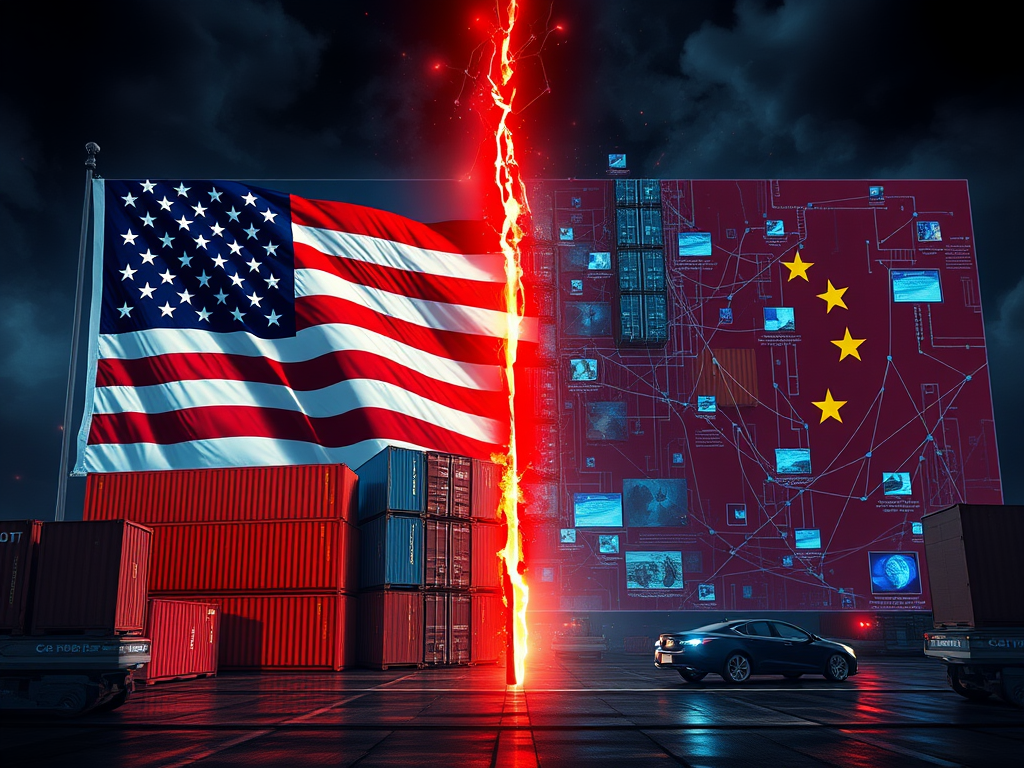
The economic standoff between the United States and China has escalated, with Beijing swiftly retaliating against President Donald Trump’s latest tariffs. As tensions mount, both sides brace for deeper economic consequences.
At the stroke of midnight Tuesday, the U.S. imposed a 10% tariff on all Chinese imports. Within hours, China’s Ministry of Finance hit back, announcing a series of countermeasures. These include a 15% tariff on U.S. coal and liquefied natural gas, alongside a 10% levy on crude oil and farming equipment, effective February 10.
More strikingly, China’s State Administration for Market Regulation (SAMR) launched an antitrust investigation into Google, citing potential monopolistic practices. While Google’s search engine remains blocked in China, its Android operating system dominates the country’s smartphone market. Beijing’s probe signals a broader strategy to curb American tech influence.
“We will safeguard national security and ensure fair competition,” a SAMR spokesperson declared. “No company, foreign or domestic, is above scrutiny.”
In a further move to pressure Washington, China announced restrictions on the export of key minerals essential for high-tech industries. Tungsten, tellurium, ruthenium, and molybdenum—critical in electronics and defense manufacturing—will now be subject to tighter controls.
Additionally, Beijing added two major American firms—biotech giant Illumina and fashion conglomerate PVH Group (parent of Calvin Klein and Tommy Hilfiger)—to its national security blacklist. The move follows allegations that these companies engaged in discriminatory measures against Chinese enterprises. PVH, in particular, has faced scrutiny for distancing itself from Xinjiang cotton, linked to forced labor accusations.
President Trump, doubling down on his stance, linked China’s trade practices to America’s fentanyl crisis.
“China must stop sending us fentanyl,” he asserted Monday. “If they don’t, these tariffs will go even higher.”
His unexpected decision over the weekend to extend tariffs to Canada and Mexico—initially set at 25%—further rattled global markets. However, last-minute negotiations postponed these measures for 30 days. In exchange, Canadian Prime Minister Justin Trudeau and Mexican President Claudia Sheinbaum agreed to enhance border security efforts.
Sheinbaum ordered 10,000 troops to Mexico’s northern border to combat trafficking, while Trudeau unveiled a CA$1.3 billion ($900 million USD) initiative to crack down on smuggling networks. Canada also agreed to designate drug cartels as terrorist organizations and appoint a “fentanyl czar” to oversee enforcement.
With both nations locked in an escalating battle, experts warn that the situation could spiral further.
“China’s response is measured but firm,” said Li Xianhong, a professor of international trade at Peking University. “They’re signaling willingness to negotiate, but also demonstrating they have leverage.”
Oxford Economics analysts echoed similar concerns. “The trade war is still in its early stages,” they noted in a briefing. “Without a resolution, further tariffs and economic damage are inevitable.”
As speculation swirls, the White House confirmed that Trump and Chinese President Xi Jinping are set to hold discussions in the coming days. Whether diplomacy prevails or hostilities deepen remains uncertain.
Discover more from Next Gen News
Subscribe to get the latest posts sent to your email.
Since when do we need China coal and oil. Our country has its own. We can be self sufficient again if people would get off their lazy asses and work together like we did during the world wars. China is not a friend. It it’s taking us down from within and Biden Obama Clinton’s started it