

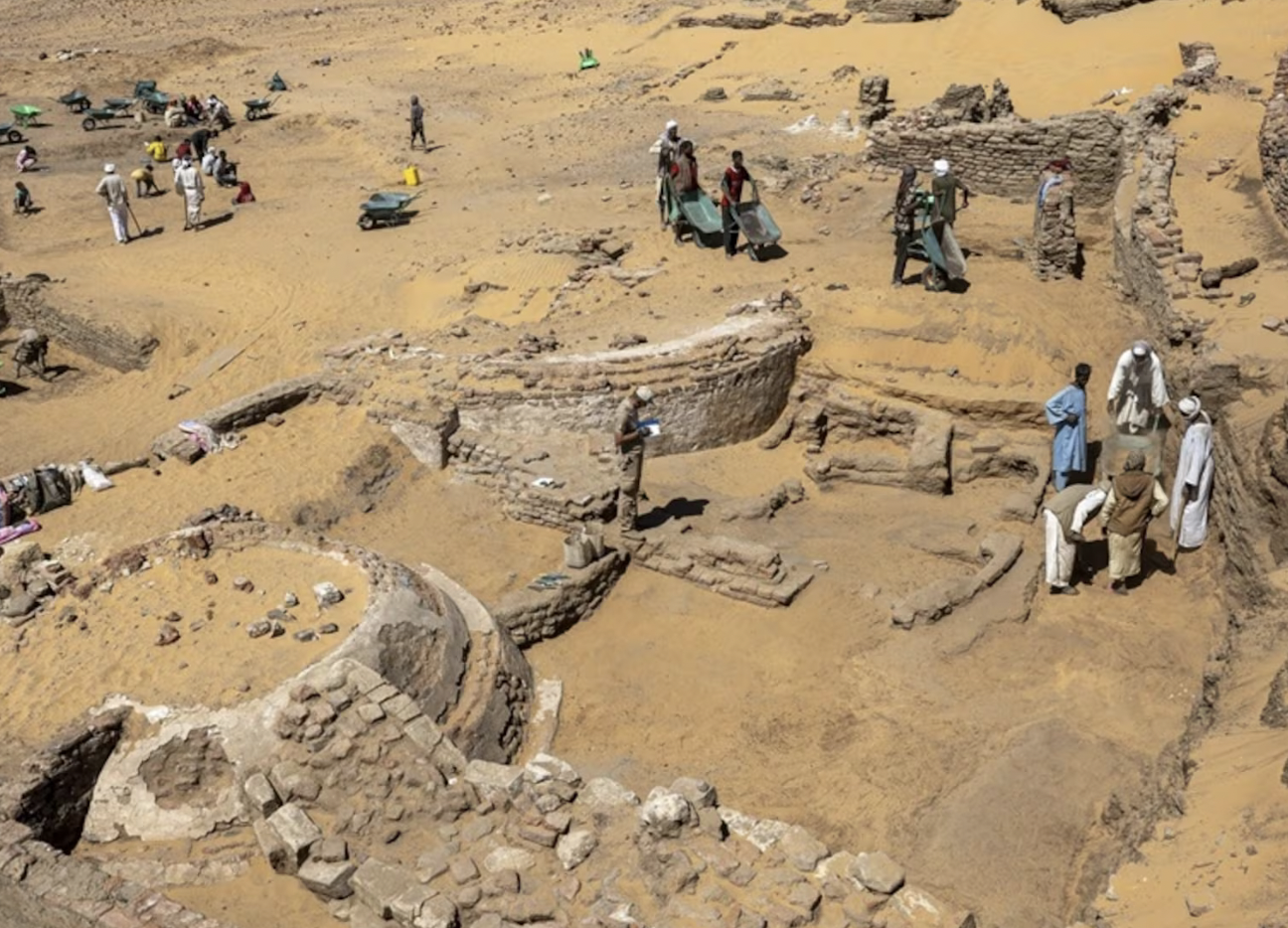
Archaeologists have made a remarkable discovery beneath an ancient African city, uncovering new sections of a massive medieval cathedral believed to be larger than the White House.
The enormous structure, known as the Great Church of Jesus, lies in Old Dongola, Sudan, where a team of Polish and Sudanese researchers has finally reached its original floor after excavating a monumental staircase surrounded by walls standing 36 feet high.
The discovery offers a glimpse into what researchers believe was the largest church in medieval Nubia, a powerful Christian civilization that flourished along the Nile more than 1,000 years ago.
Measuring approximately 154 feet wide and 187 feet long, the cathedral may once have towered nearly 70 feet above the ancient city. Despite its extraordinary size, much of the building remains buried.
“This was a building larger than the famous White House … and we are planning to excavate it!” expedition director Artur Obłuski said.
The cathedral was first identified in 2021, but the latest excavation has revealed just how much of the historic structure remains intact. Researchers have uncovered massive architectural supports and reached the original floor for the first time, providing new clues about the building’s design.
And the cathedral wasn’t the only surprise waiting beneath the ruins.
Archaeologists also discovered another church in an adjoining structure, complete with remnants of elaborate wall paintings and fragments of ancient Greek religious texts. Among the writings was a passage from the biblical Prayer of Hannah, the mother of the prophet Samuel.
The team has recovered enough painted plaster fragments to fill six large shelving units, suggesting the smaller church was once richly decorated.
The discoveries could dramatically change historians’ understanding of Old Dongola, which served as the capital of Makuria, a Christian kingdom that emerged during the sixth century.
For years, researchers believed another church outside the city’s ancient walls had served as its cathedral. The newly uncovered structure now challenges that theory and raises questions about the religious importance of both buildings.
Obłuski believes the Great Church of Jesus may have influenced religious architecture throughout the region, comparing its potential significance to Istanbul’s famous Hagia Sophia.
But excavating the enormous cathedral presents an unusual challenge. Some surviving walls are so tall that researchers must dig to extraordinary depths to reach the original ground level.
The team hopes to determine the building’s full dimensions during its next excavation season. Sudanese officials also believe the cathedral could eventually become a major historical attraction.
For now, the vast majority of the ancient church remains hidden underground, leaving researchers with the possibility that even more extraordinary discoveries are still waiting to be uncovered.
Discover more from Next Gen News
Subscribe to get the latest posts sent to your email.