

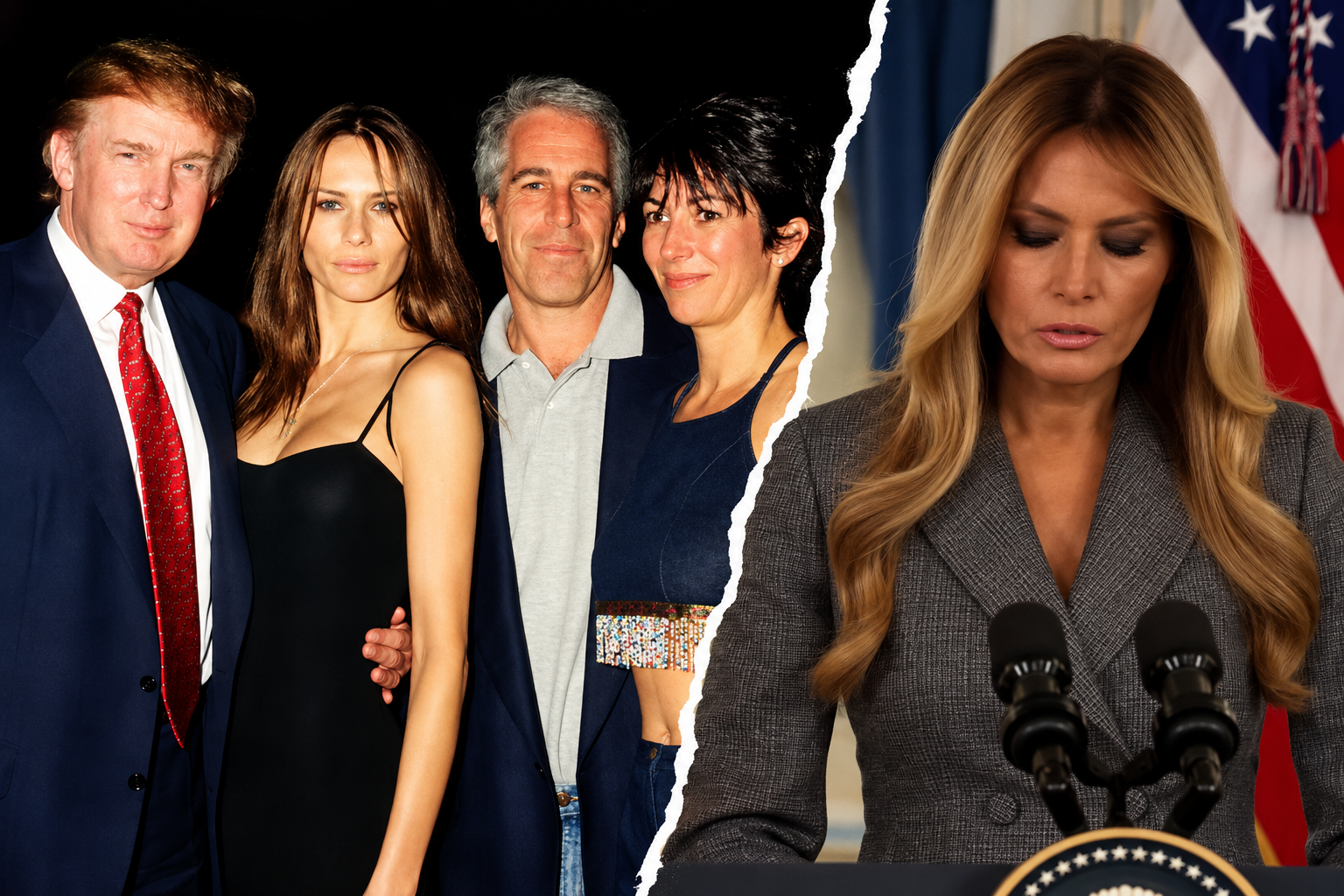
First Lady Melania Trump’s mysterious decision to hold an unexpected White House press conference about Jeffrey Epstein is coming under fresh scrutiny, with a former Trump administration insider suggesting the appearance may have been an attempt to get ahead of damaging revelations involving her husband.
Sarah Matthews, who served as deputy White House press secretary during President Donald Trump’s first term, is raising serious questions about why Melania publicly addressed her connections to the disgraced financier months before congressional Democrats released an explosive report examining Trump’s past relationship with Epstein.
During an October 27 appearance on The Bulwark podcast, Matthews suggested the first lady’s unusual April appearance suddenly makes more sense in light of the new allegations.
And according to the former White House aide, the timing may be particularly revealing.
Matthews described Melania’s appearance as a “weird, random press conference” and suggested it was among the strongest reasons she suspected the findings of the new Democratic congressional report could be accurate.
The controversy centers on a report released October 26 by Democrats on the House Judiciary Committee, which examines allegations involving Trump, Epstein and women who encountered them during the 1990s.
Among its most startling findings is an FBI interview summary in which a former Epstein assistant claimed the financier personally introduced Melania to Donald Trump.
That account directly contradicts the first lady’s longstanding explanation of how she met her husband.
But the report goes considerably further, detailing allegations from several women who accuse Trump of sexual misconduct during the period when he and Epstein socialized in New York and Palm Beach.
One woman, former Swiss beauty queen Beatrice Keul, alleges Trump sexually assaulted her at New York City’s Plaza Hotel in November 1993 after offering to help her obtain a visa and pursue educational opportunities in the United States.
Trump has denied wrongdoing, and the allegations have not been established in criminal court. The White House has dismissed the Democratic report as a politically motivated attack.
For Matthews, however, the revelations brought renewed attention to an unusual moment that initially left political observers scratching their heads.
On April 9, Melania unexpectedly appeared before reporters inside the White House to deliver a prepared statement categorically denying any close relationship with Epstein or his associate Ghislaine Maxwell.
The first lady insisted she had never participated in or known about Epstein’s crimes and rejected suggestions that the financier had played a role in introducing her to Trump.
She maintained that she first met her future husband at a New York City party in 1998 and did not encounter Epstein until 2000, when she and Trump attended the same social event as the financier.
“Epstein did not introduce me to Donald Trump,” Melania declared.
She also dismissed allegations connecting her to the disgraced financier as politically motivated attacks on her reputation.
But the press conference raised questions at the time because Melania rarely addresses reporters at length, particularly on controversies involving her husband’s past.
She delivered her statement without taking questions, leaving journalists wondering what had prompted such a forceful public denial.
Matthews now suspects the first lady may have been aware that additional scrutiny was coming.
Speaking with podcast host Tim Miller, a former Republican strategist turned Trump critic, Matthews suggested Melania could have learned about references to her in Epstein-related records and decided to confront the issue before it escalated.
The former aide argued that the appearance ultimately risked generating more suspicion rather than putting the controversy to rest.
Miller agreed that the press conference had seemed unusually defensive, recalling how unexpected the first lady’s decision to speak publicly had been.
There is, however, an important complication with that theory.
The FBI interview containing the disputed introduction claim had already become public in early February 2026, more than two months before Melania’s statement. Her April appearance therefore could have been a response to allegations already circulating rather than advance knowledge of the October congressional report.
Matthews has not presented evidence that Melania knew about the forthcoming report or its contents, and her interpretation remains speculation.
Still, the latest congressional findings have revived questions about the Trumps’ connections to Epstein, whose social circle included numerous powerful figures before his crimes became widely known.
Photographs taken at Mar-a-Lago in 2000 show Donald and Melania Trump posing alongside Epstein and Maxwell, documenting that the four attended at least one event together.
Those photographs do not establish knowledge of criminal activity, but they provide a visual record of the social connections that have repeatedly drawn scrutiny.
Meanwhile, the House Judiciary Democrats’ report calls for an independent investigation into allegations involving Trump and other individuals associated with Epstein.
The White House has strongly rejected the report’s conclusions, insisting the president was not involved in Epstein’s crimes and maintaining that Trump eventually severed ties with the financier.
Melania has likewise repeatedly denied any improper relationship with Epstein or Maxwell, and she has not been accused or charged with participating in their criminal activities.
But the controversy has taken on renewed political significance as Democrats continue demanding greater transparency about the Epstein files and the government’s handling of evidence.
For Matthews, who once worked inside Trump’s White House, the question is no longer simply why Melania felt compelled to defend herself in April.
It is whether the public has received a complete explanation of the president’s past association with Epstein and why competing accounts of the Trumps’ history continue to emerge.
With congressional Democrats pressing for further investigation and the White House rejecting the allegations, the dispute shows little sign of disappearing.
And an extraordinary press conference that initially seemed to raise more questions than it answered is once again at the center of the controversy.
Discover more from Next Gen News
Subscribe to get the latest posts sent to your email.
 What's Up Today Editorial Team
We’ll believe Melania over an unnamed liar from evil WOKE NextGen…