

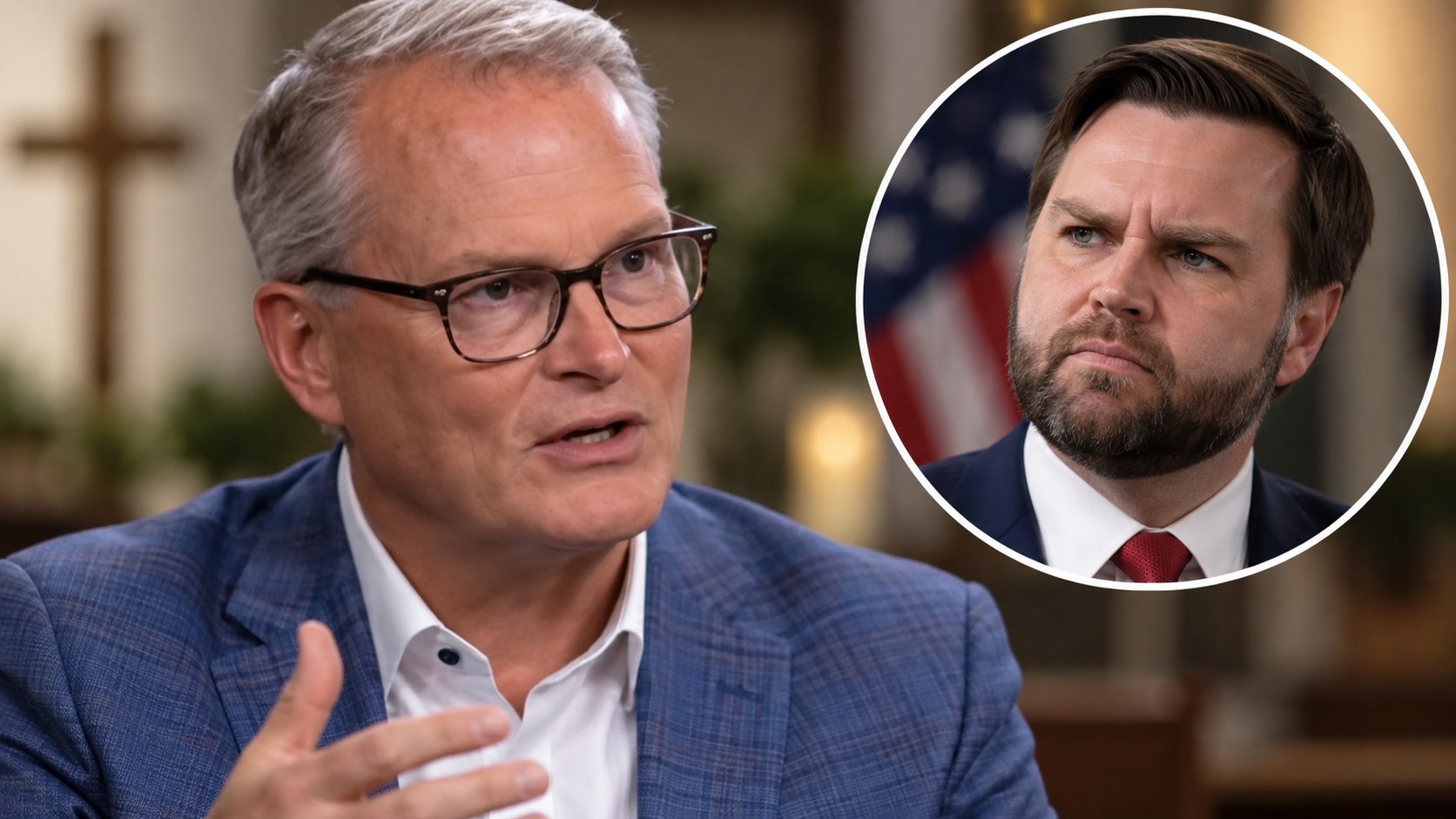
A prominent Kansas pastor running for the U.S. Senate has fired back at Vice President JD Vance after the Republican leader publicly questioned his Christian faith, setting off a heated dispute over religion, politics, and what it truly means to follow Jesus.
The Rev. Adam Hamilton, 62, a United Methodist minister and Democratic Senate nominee, didn’t hold back during an appearance on ABC’s This Week on Sunday, October 11. Speaking with host Jonathan Karl, Hamilton condemned Vance’s remarks as deeply personal and suggested the vice president’s attacks reflected growing concern among Republicans about a surprisingly competitive Senate race.
“I thought it was really sad. It was pathetic,” Hamilton said, describing Vance’s criticism as a sign of political desperation.
The confrontation began during a September 14 campaign rally in Olathe, Kansas, where Vance appeared in support of Republican Sen. Roger Marshall, who is seeking reelection. Rather than focusing exclusively on policy differences, the vice president took aim at Hamilton’s religious beliefs and accused him of using Christianity to advance liberal political causes.
Vance portrayed the pastor’s views as radical politics disguised as religion and claimed Hamilton supported organizations that mocked Christian values. At one point, he declared, “That is not Christianity.”
The vice president also accused Hamilton of believing that being white and raising cattle for meat were sinful, statements the pastor strongly rejected during Sunday’s interview.
Hamilton explained that Vance appeared to have distorted a sermon in which he discussed repentance, racism, and the importance of understanding other people’s experiences. He insisted that he had never preached that being white or eating beef was a sin.
The minister said the accusations were particularly troubling because they came from one of the nation’s highest-ranking elected officials.
“He doesn’t know me. Doesn’t know anything about my faith,” Hamilton told Karl, questioning why political leaders had begun attacking the religious convictions of their opponents.
Rather than retreating from the confrontation, Hamilton invited Vance to examine his decades of ministry and consider how their respective religious beliefs influence their treatment of others.
The pastor described beginning each morning in prayer, reading Scripture, and seeking guidance from the Holy Spirit. He said Christianity was not simply part of his public identity but the foundation of how he attempts to live.
Hamilton then issued a pointed challenge to the vice president, suggesting they examine their theology, their conduct, and the impact of their faith on the people around them.
He quickly clarified that his intention was not to declare himself a better Christian, but to defend the sincerity of his beliefs against what he considered an unfair political attack.
Hamilton’s background makes the dispute particularly unusual. For more than three decades, he has led Resurrection, a United Methodist Church headquartered in the Kansas City suburbs. What began as a small congregation meeting in a funeral-home chapel has grown into the largest United Methodist congregation in the United States, with approximately 24,000 members.
He has also written 36 books addressing Christianity, Scripture, and religious life, building a national reputation well before entering politics.
His decision to run for Senate has created an unexpected challenge for Republicans in Kansas, a state that has not elected a Democrat to the U.S. Senate since 1932.
Hamilton initially explored running as an independent before announcing his Democratic candidacy in April. He has described himself as a political moderate whose congregation includes Republicans, Democrats, and independents, and his campaign emphasizes finding common ground in an increasingly divided country.
That message has attracted attention from some prominent Kansas Republicans. Former Republican governors Mike Hayden and Bill Graves have endorsed Hamilton, while other GOP voters have expressed frustration with Marshall’s close alignment with President Donald Trump.
The shifting political landscape has forced Republicans to devote additional resources to a race that once appeared comfortably in their favor. Both The Cook Political Report and ABC News have moved the Kansas contest into the toss-up category, reflecting growing uncertainty about the outcome.
For Hamilton, the race is about more than partisan loyalty. During Sunday’s interview, he criticized Washington’s handling of economic issues affecting Kansas farmers, including tariffs, rising fertilizer expenses, and fuel costs.
He also made clear that he does not agree with every position associated with the national Democratic Party. Hamilton said he opposes allowing biological males to compete in women’s sports and favors practical government regulation rather than sweeping ideological approaches.
At the same time, he criticized the Trump administration’s rhetoric toward transgender Americans, arguing that vulnerable groups should not become political targets.
The pastor’s effort to appeal across party lines helps explain why his candidacy has attracted national attention. Hamilton was registered as a Republican until earlier this year and acknowledged that he spent much of his life identifying with the GOP.
He has also previously supported Democrats, including former President Barack Obama, and participated in religious events associated with Obama’s presidency.
His political independence has become a central part of his campaign as he attempts to persuade traditionally Republican voters to consider supporting a Democrat.
Vance, meanwhile, has increasingly emphasized religion in his political messaging. The vice president converted to Catholicism in 2019 and frequently discusses how his faith influences his views on family, government, and American society.
His approach to Christianity has sometimes generated disagreements with Catholic leaders, particularly over immigration and the responsibilities governments have toward vulnerable populations.
At the 2025 National Catholic Prayer Breakfast, Vance acknowledged that he was still learning about the Catholic Church’s teachings, describing himself as a relatively new convert.
The religious disagreement with Hamilton reflects a broader debate within American Christianity over how faith should influence public policy and whether politicians should question the religious authenticity of those who hold different views.
For Vance and his supporters, issues involving religious liberty, sexuality, and traditional values remain important political concerns. Hamilton, while maintaining some socially conservative positions of his own, argues that compassion, humility, and respect for people with differing beliefs are equally essential expressions of Christian faith.
As the November 3 midterm election approaches, the increasingly personal attacks underscore just how much is at stake in Kansas.
Marshall remains a formidable incumbent in a historically Republican state, but Hamilton’s growing support among moderates and disaffected Republicans has transformed the contest into one of the nation’s most closely watched Senate races.
Whether the religious dispute will influence voters remains unclear. What is increasingly evident, however, is that a pastor who built his reputation bringing people of different political beliefs together has become a serious challenge to a Republican incumbent.
And after Vance’s criticism, Hamilton appears determined to keep his faith at the center of the conversation while refusing to let his political opponents define it for him.
Discover more from Next Gen News
Subscribe to get the latest posts sent to your email.
JD Vance is a disgrace to America
Sometimes There Is A Big Difference Between The Methodist Minister,A So-Called Christian, And A Real Christian Follower Of Christ’s Teaching!!!Sent from my iPhoneOn Oct 11, 2026,