

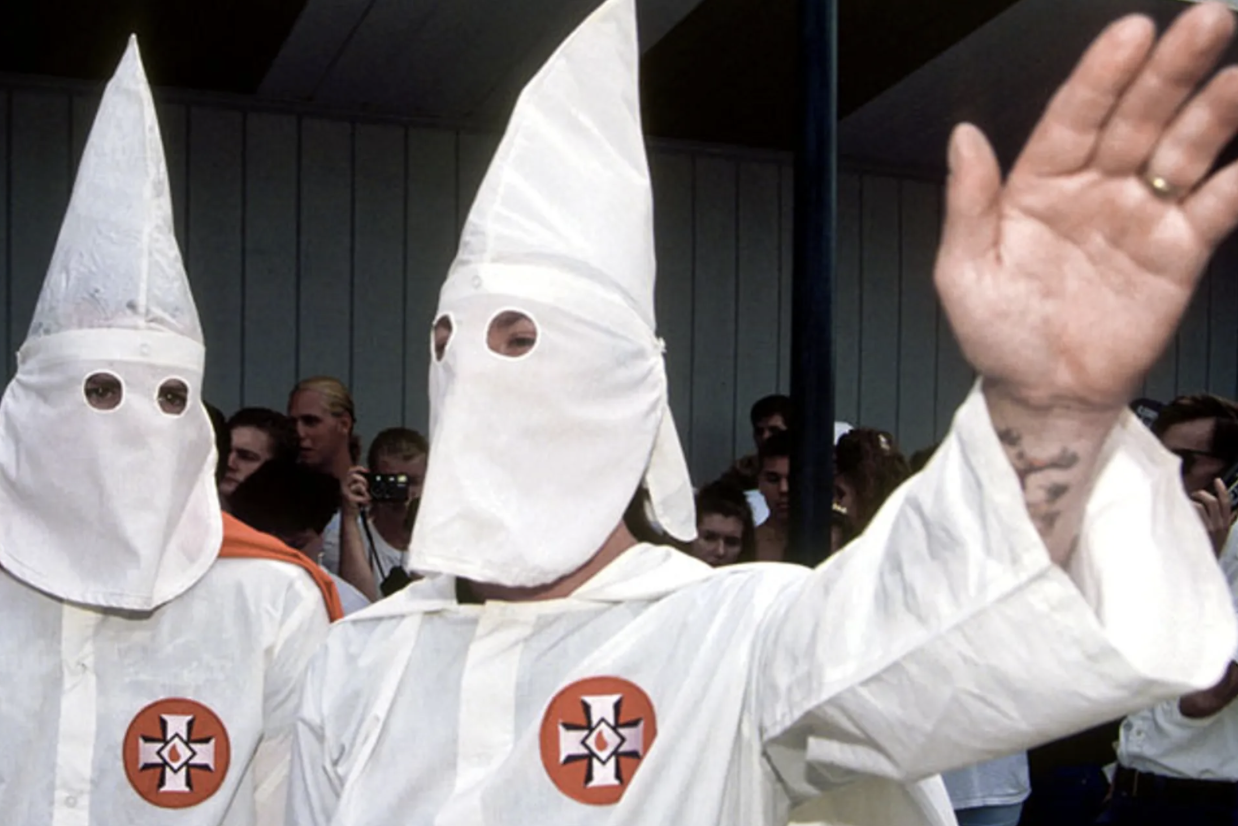
Ku Klux Klan leader Thomas Robb is claiming that support for his white nationalist movement is on the rise as the United States heads toward the November midterm elections — though he offered no membership numbers or other evidence to back up the assertion.
Robb, the longtime leader of the Arkansas-based Knights Party, formerly known as the Knights of the Ku Klux Klan, made the remarks during a recent interview with Al Jazeera correspondent Phil Lavelle.
“Support for us is growing, there’s no question about that,” Robb said.
But when pressed about the actual size of his organization, Robb declined to provide membership figures, leaving his claim impossible to independently verify.
The interview offered a rare look inside one of the country’s longest-running white supremacist organizations as its leaders attempt to present a more publicly acceptable image built around religion, family and cultural identity.
Behind that effort, however, Robb continued to express openly racist views.
During the interview, Lavelle asked Robb about New York City Mayor Zohran Mamdani and Abdul El-Sayed, the Democratic nominee for Michigan’s U.S. Senate seat.
Robb responded by declaring that the two men were “not Americans.”
Lavelle pointed out that El-Sayed was born and raised in Michigan. Robb dismissed that fact and argued that being American should instead be determined by race.
El-Sayed was born in Southeast Michigan and is currently running against Republican Mike Rogers in one of the most closely watched Senate contests of the 2026 election.
Robb’s comments reflect the racial ideology that has defined the Klan throughout its history. The Ku Klux Klan emerged after the Civil War and became notorious for terrorism, intimidation and violence aimed primarily at Black Americans, while later factions also targeted Jewish people, immigrants and other minority groups.
Robb has led the Knights organization since the 1980s after the departure of former Klan leader David Duke. Over the years, he has attempted to soften the group’s public appearance, replacing traditional Klan terminology and increasingly using the name “Knights Party.”
The Southern Poverty Law Center still identifies the organization as a hate group and describes Robb as a longtime promoter of white supremacist and Christian Identity ideology.
That distinction became apparent again when Lavelle asked whether a Black person would be welcome at Robb’s Arkansas church.
Robb said no and described it as a white nationalist church.
The church associated with Robb also promotes a racial interpretation of Christianity centered on people of Anglo-Saxon, Germanic, Celtic and Scandinavian ancestry.
Robb additionally weighed in on President Donald Trump during the interview, defending him amid political criticism over economic pressures and the ongoing conflict involving Iran.
Robb praised Trump’s immigration policies, including construction of the southern border wall, and suggested he remained supportive even if Americans were forced to endure sharply higher fuel prices.
The remarks come at a politically sensitive moment.
Republicans and Democrats are battling for control of Congress ahead of the November 3 midterm elections, with immigration, inflation, foreign policy and the cost of living emerging as major issues.
There is evidence that white nationalist organizations remain active in the United States, but Robb’s suggestion that his own Klan faction is experiencing significant growth should be treated cautiously.
The Southern Poverty Law Center has documented numerous active white supremacist organizations across the country, while research into traditional Klan organizations has repeatedly found them fragmented into relatively small competing factions.
Even Robb acknowledged during the interview that convincing sympathizers to formally join his organization remains difficult.
That makes the broader significance of his comments less about whether the Klan itself is suddenly attracting large numbers of members and more about whether ideas once associated with fringe extremist movements are finding new audiences in an increasingly polarized political environment.
For Robb, the answer is clearly yes.
The available evidence, however, does not establish that his organization is experiencing the kind of dramatic resurgence his comments might suggest.
Discover more from Next Gen News
Subscribe to get the latest posts sent to your email.
 What's Up Today Editorial Team
The Democrat KKK has little appeal to any of the 3 main Parties any more… although SPLC may be funding them… in order to get donations for ‘hating’ them…