

Jared Kushner is pushing back hard against a sweeping profile questioning his business dealings, diplomatic influence and background — but one line in his lengthy response is drawing plenty of attention.
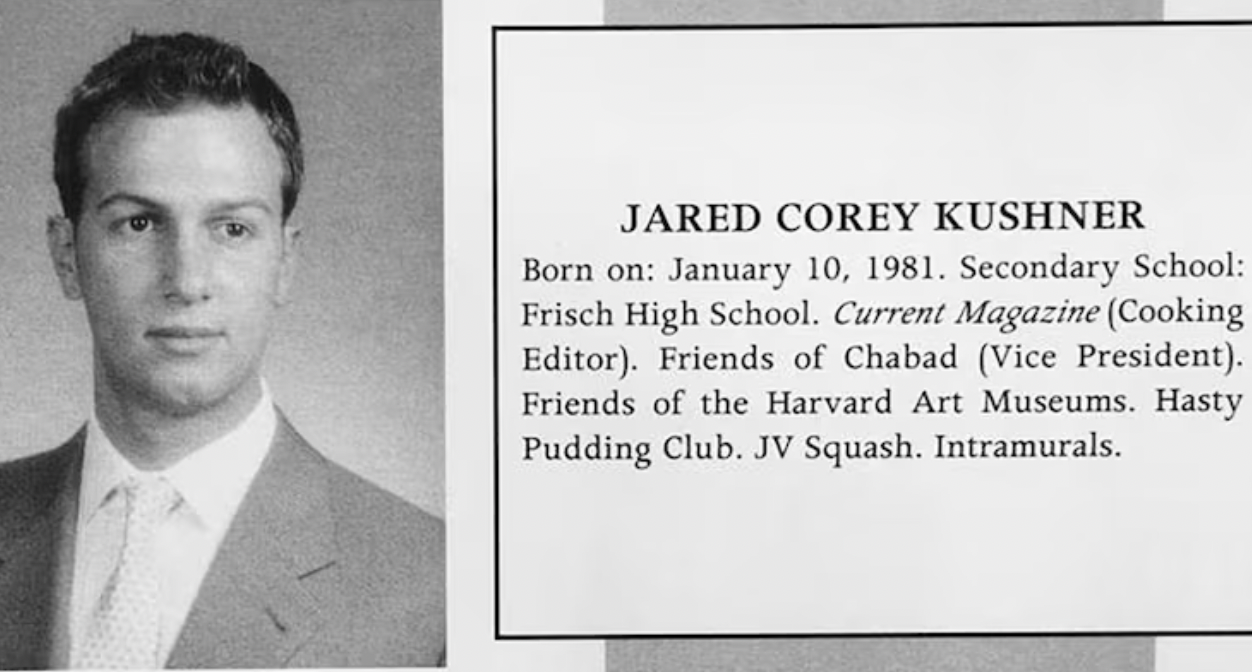
The 45-year-old son-in-law of President Donald Trump acknowledged that his father’s philanthropy “may have played a role” in his admission to Harvard University, even as he rejected the suggestion that he was an undeserving or mediocre student who gained entry because of his family’s wealth.
Kushner made the admission while responding to a recent New Yorker profile titled “Jared Kushner’s Dollar Diplomacy,” which examined his growing international influence during Trump’s second term and the overlap between his diplomatic work and private business interests.
Kushner does not currently hold a formal government position, but he has remained deeply involved in some of the administration’s most sensitive foreign-policy efforts. His role has included work alongside special envoy Steve Witkoff on negotiations involving the Middle East, Russia and Ukraine.
On Thursday, Kushner published an extensive response challenging 14 claims or characterizations in The New Yorker story.
Among the most personal was a decades-old controversy surrounding his acceptance to Harvard.
The New Yorker noted that Kushner was admitted after his father, real-estate developer Charles Kushner, pledged millions of dollars to the university, with donations beginning around the time Jared enrolled.
That allegation has followed Kushner for years.
“This allegation has been repeated for nearly two decades, but that doesn’t make it true,” Kushner wrote.
But his response also contained a notable qualification.
“His philanthropy may have played a role in my admission,” Kushner acknowledged.
That statement stops well short of saying his father bought his way into Harvard. College admissions decisions are based on numerous factors, and there is no public evidence proving that Charles Kushner’s contribution was the deciding factor.
Still, the admission is significant because Kushner himself is now acknowledging that his family’s charitable relationship with Harvard could have helped.
He argued that the donation has been portrayed without the broader context of his father’s philanthropy.
“My father’s philanthropy was not limited to Harvard,” Kushner wrote, saying Charles Kushner has donated more than $100 million over several decades to charitable organizations, schools and other institutions — including many with no connection to the family.
Kushner also strongly rejected another part of the New Yorker profile describing him as a “middling student” before college.
He graduated in 1999 from the Frisch School, a private Jewish high school in Paramus, New Jersey.
According to Kushner, the portrayal does not match his record.
“The claim that I was a mediocre student is contradicted by the contemporaneous record,” he wrote.
Kushner said he was a top student, captain of the basketball team, assistant captain of the hockey team and an award-winning debater. He also noted that he completed the New York City Marathon while still in high school.
To bolster his case, Kushner released two letters written in 2006 by officials connected to his former high school.
One came from former administrator Margot Krebs, whose past comments about Kushner had been cited in reporting about his Harvard admission.
Krebs wrote that her comments had been “totally distorted” and said Kushner possessed qualities including “individuality, enterprise and great charisma” that made him an attractive candidate for Harvard.
A second letter came from Frisch School principal Kalman Stein.
Stein said the school was upset by what it considered misleading reporting about Kushner, although he also wrote that Kushner may not have been “absolutely at the top” of his class.
Stein nevertheless said Kushner had “special qualities and strengths” that could reasonably have caught the attention of Harvard admissions officials.
The letters therefore support Kushner’s argument that school officials believed he had qualities worthy of admission, but they do not independently establish his grades, class ranking or precisely why Harvard accepted him.
The dispute stretches back nearly two decades.
Questions about whether wealthy families receive an advantage in elite college admissions have repeatedly focused on practices such as legacy preferences, donor relationships and recruitment priorities.
Kushner’s case became one of the most widely cited examples after reports linked Charles Kushner’s multimillion-dollar giving to Harvard with the period surrounding his son’s admission.
Jared Kushner later graduated from Harvard in 2003 before earning graduate degrees from New York University.
The resurfaced controversy comes as Kushner again occupies an unusually influential position in American politics.
Although he is not formally serving as a White House official, he has continued working on major international negotiations during Trump’s second presidency. On Thursday, Reuters reported that Kushner and Witkoff were preparing to meet Ukrainian officials as part of continuing efforts to negotiate an end to the war with Russia.
His father has also returned to public prominence.
Charles Kushner was confirmed by the Senate in 2025 as U.S. ambassador to France and Monaco after being nominated by Trump.
The elder Kushner had previously pleaded guilty to federal charges involving tax offenses, witness retaliation and false statements to the Federal Election Commission. He was sentenced to two years in prison and was later pardoned by Trump in December 2020.
For Jared Kushner, however, the latest controversy is less about his father’s criminal history than a question that has followed him since his twenties: How much did family wealth and influence matter in his path to one of America’s most prestigious universities?
Kushner insists his own accomplishments have been unfairly minimized.
But with his latest response, he has also publicly conceded something his critics have argued for years — his father’s philanthropy may indeed have helped.
Discover more from Next Gen News
Subscribe to get the latest posts sent to your email.