

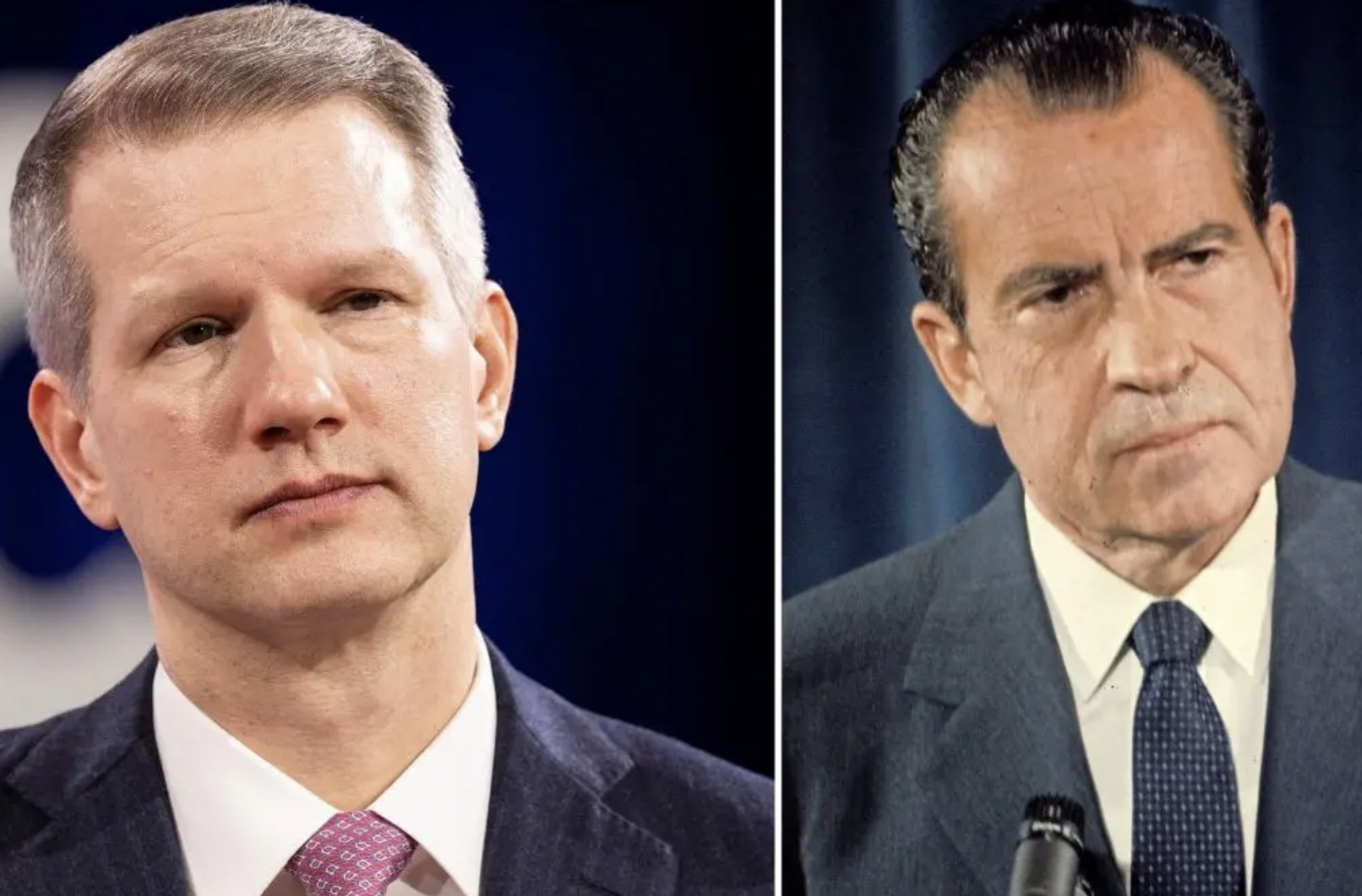
A Republican congressman is reopening one of the most explosive chapters in American political history, claiming Richard Nixon was “framed” during Watergate and comparing the former president’s downfall to investigations that targeted President Donald Trump.
Rep. Riley Moore of West Virginia made the striking remarks Thursday while speaking at the Richard Nixon Foundation’s Grand Strategy Summit in Washington, D.C., where politicians, diplomats and national-security figures gathered to discuss American foreign policy and Nixon’s legacy. The foundation confirmed the summit was held September 30 and October 1 at the Ritz-Carlton in Washington.
Moore argued that the conventional understanding of Watergate is wrong and claimed Nixon was pushed from office by forces inside the federal government.
“Richard Nixon was absolutely couped out of office and was framed,” Moore told the audience, according to reporting on his appearance. “All of this was fake, and we now know more about the deep state and its power and its ability to literally change things at the top.”
He then drew a direct comparison to Trump, arguing that the controversy surrounding Nixon resembled what he described as the “fake Russia collusion hoax” during Trump’s first term.
Moore further claimed Nixon knew powerful government institutions were working against him but remained quiet because he did not want Americans to lose confidence in the country’s system of government.
He said Americans are now more willing to reconsider Nixon’s presidency and discuss what Moore described as Nixon’s accomplishments.
The remarks come amid renewed conservative interest in challenging the traditional account of Watergate more than half a century after Nixon became the only U.S. president to resign from office.
But Moore’s characterization of Watergate as “fake” sharply conflicts with the extensive historical record surrounding the scandal.
Watergate began after five men were arrested on June 17, 1972, for breaking into the Democratic National Committee headquarters inside Washington’s Watergate complex.
The investigation eventually expanded beyond the burglary itself and focused heavily on efforts within the Nixon administration to obstruct investigators and conceal information connected to the case.
One of the most consequential pieces of evidence was a secretly recorded White House conversation from June 23, 1972 — only six days after the break-in.
According to the National Archives, the recording showed Nixon discussing an effort to have the CIA pressure the FBI to limit its Watergate investigation by portraying the matter as involving national security. The recording later became widely known as the “smoking gun” tape.
The tapes did not become public easily.
Nixon fought efforts to obtain White House recordings, leading to the landmark 1974 Supreme Court case United States v. Nixon. The Supreme Court unanimously ruled that the president had to comply with a subpoena seeking evidence for the criminal proceedings connected to Watergate.
The House Judiciary Committee was already considering impeachment.
On July 27, 1974, the committee approved an article accusing Nixon of obstruction of justice. It subsequently approved articles alleging abuse of presidential power and contempt of Congress.
Then came the tape that dramatically changed Nixon’s political situation.
After the Supreme Court ruling, the White House released the June 23 recording on August 5, 1974. The National Archives says the conversation documented Nixon’s early involvement in an attempt to interfere with the FBI investigation.
With his political support collapsing and impeachment looming, Nixon announced his resignation and left office on August 9, 1974.
His successor, President Gerald Ford, granted Nixon a full presidential pardon on September 8, 1974.
What makes Moore’s comments particularly timely is that questions about the conduct of Watergate prosecutors are receiving fresh attention inside the Justice Department.
Former Nixon White House aide Geoff Shepard recently delivered a roughly two-hour presentation to Justice Department officials laying out his long-running argument that prosecutors acted improperly during the Watergate investigation.
Shepard has spent years challenging the traditional account of the prosecution and has accused Watergate prosecutors of improper contacts with judges and other misconduct.
However, the Justice Department has stressed that hearing Shepard’s presentation does not mean it has opened a formal investigation.
The department’s Office of Professional Responsibility previously declined Shepard’s request for an investigation in 2022. The more recent meeting represents a new review of his allegations, but officials have explicitly distinguished that process from a formal misconduct probe.
Moore is also not the first prominent Republican this year to suggest Nixon’s downfall deserves another look.
Vice President JD Vance made similar comments during a June 25 appearance at the Richard Nixon Presidential Library in California.
“If Watergate happened tomorrow, it would be like a 12-hour news story,” Vance said. “The idea that it would have taken down a presidency is crazy.”
Vance also compared Nixon’s experience with Trump’s first term.
“If you look at the story of how the ‘deep state’ took down Richard Nixon, it’s not all that different from what the same groups of people, the same institutions tried to do to Donald Trump in the first Trump administration,” Vance said. “There is a parallel.”
Those comparisons have become part of a broader debate over Nixon’s legacy.
Supporters of reassessing Watergate argue that previously overlooked evidence raises legitimate questions about the behavior of prosecutors and government officials. Shepard, in particular, has spent decades pursuing that argument.
But those claims do not erase the evidence developed during the original investigation, including Nixon’s own secretly recorded conversations, the Supreme Court battle over the tapes and the articles of impeachment approved by the House Judiciary Committee.
For now, the Justice Department has not announced a new Watergate investigation or concluded that Nixon was framed.
What has clearly changed is the political conversation surrounding the 37th president.
More than 50 years after Nixon boarded a helicopter and left the White House following his resignation, some of the most powerful figures in today’s Republican Party are once again arguing over exactly what brought his presidency to an end.
Discover more from Next Gen News
Subscribe to get the latest posts sent to your email.
All the evidence is clear Nixon GUILTY!