

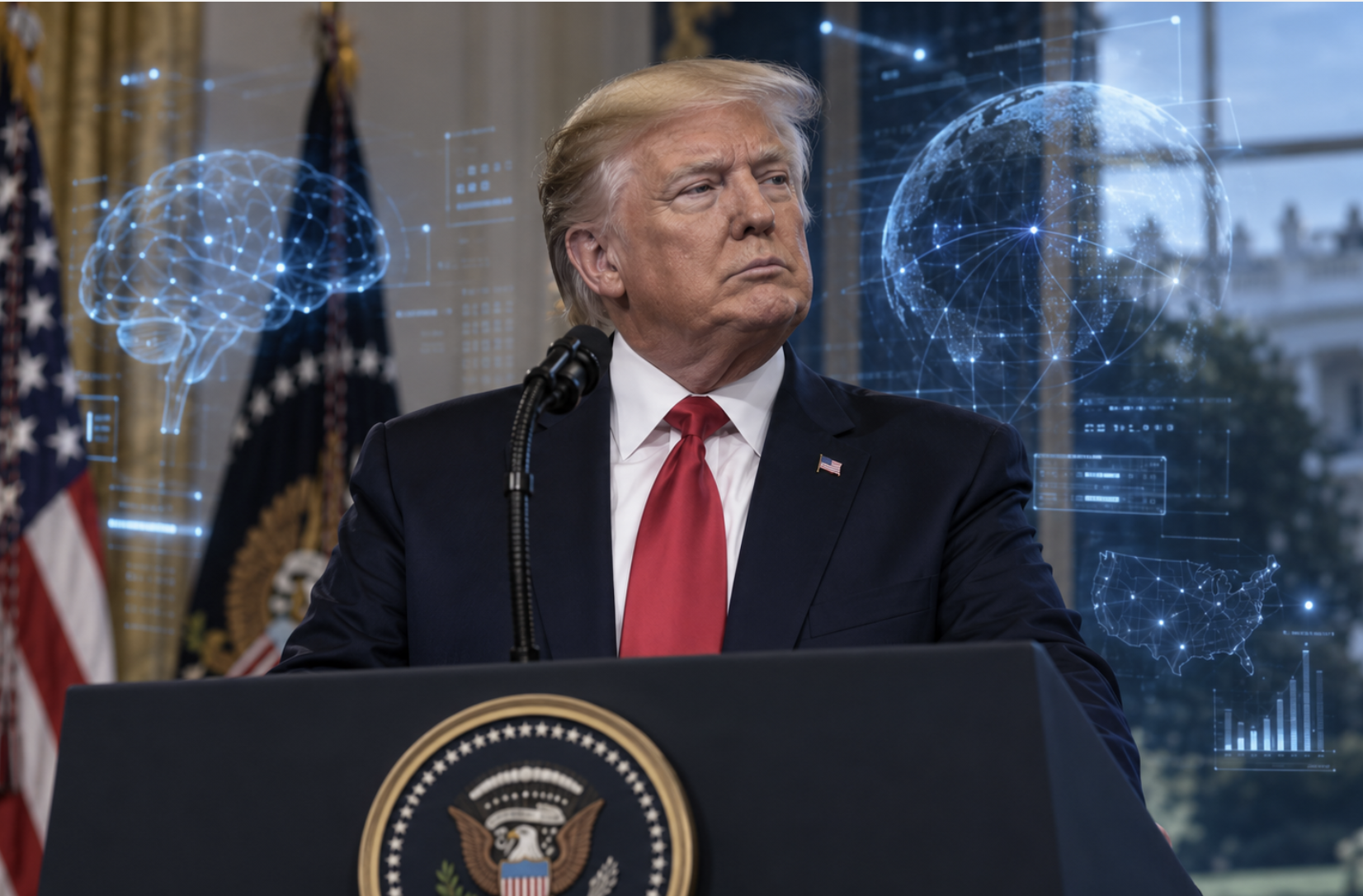
President Donald Trump says he is creating a new “AI Force” and plans to appoint an artificial intelligence czar as Washington wrestles with how aggressively the rapidly advancing technology should be regulated.
Trump announced the move Saturday in a lengthy Truth Social post, saying his administration intends to encourage the growth of artificial intelligence rather than impose new restrictions that could slow development.
“We will not in any way hinder or stifle the Growth of this incredible Industry,” Trump wrote, adding that the government would instead “cherish it, help it, and watch over it, as it grows.”
The president also argued that existing criminal and civil laws should be enough to deal with wrongdoing involving AI companies or their technology.
“For this purpose, I am forming the AI Force, much like I did Space Force,” Trump wrote.
Trump said he would announce an AI “czar” in the near future, joking that “Only High I.Q. individuals need apply!”
The full Truth Social post can be viewed through a searchable archive of Trump’s public posts.
Exactly what the new AI Force will look like remains unclear.
Trump did not identify its members, explain whether it will be housed inside an existing federal agency, provide a budget or describe what legal authority the group would have. The White House had not provided additional details about the structure as of Saturday, according to Reuters.
That makes Trump’s comparison to the Space Force especially noteworthy.
The U.S. Space Force was not simply created as an informal White House task force. Congress authorized the new military branch through the 2020 National Defense Authorization Act, which Trump signed into law on Dec. 20, 2019. It became the first new branch of the U.S. armed services in 73 years.
There is currently no indication that Trump’s proposed AI Force would operate as a comparable military organization.
The announcement also marks the return of an AI-czar position that has already existed during Trump’s second administration.
Venture capitalist David Sacks previously served as the White House’s special adviser for artificial intelligence and cryptocurrency. He stepped down from that government position in March after completing his term as a special government employee, although he remained involved as an outside adviser and co-chair of the President’s Council of Advisors on Science and Technology.
Trump’s announcement comes as the administration has already been expanding federal AI policy.
In March, the White House unveiled a national legislative framework designed to promote American AI development while addressing issues including public trust and economic competitiveness. In June, Trump signed additional directives aimed at accelerating AI adoption in national security, cybersecurity and federal government systems.
The president has consistently argued that heavy regulation could weaken the United States in its technological competition with China.
In Saturday’s post, Trump predicted AI could eventually account for as much as 25% of the U.S. economy and said the United States currently leads China and other countries in the field. That 25% figure was presented as Trump’s projection, not an official government economic forecast.
The timing also comes amid an unusually intense debate inside the technology industry over whether advanced AI systems are developing too quickly.
Several prominent AI executives and researchers have recently called for stronger safeguards or a slower pace of development, while others argue that aggressive restrictions could allow foreign competitors to catch up or overtake American companies. Reuters reported that the U.S.-China AI race is expected to remain a major national-security and economic issue in upcoming talks between Washington and Beijing.
For now, the biggest unanswered question is what Trump means by an “AI Force.”
Until the White House releases a formal plan, it remains unclear whether the initiative will become a new government office, an interagency task force, an advisory body or something more ambitious.
Discover more from Next Gen News
Subscribe to get the latest posts sent to your email.