

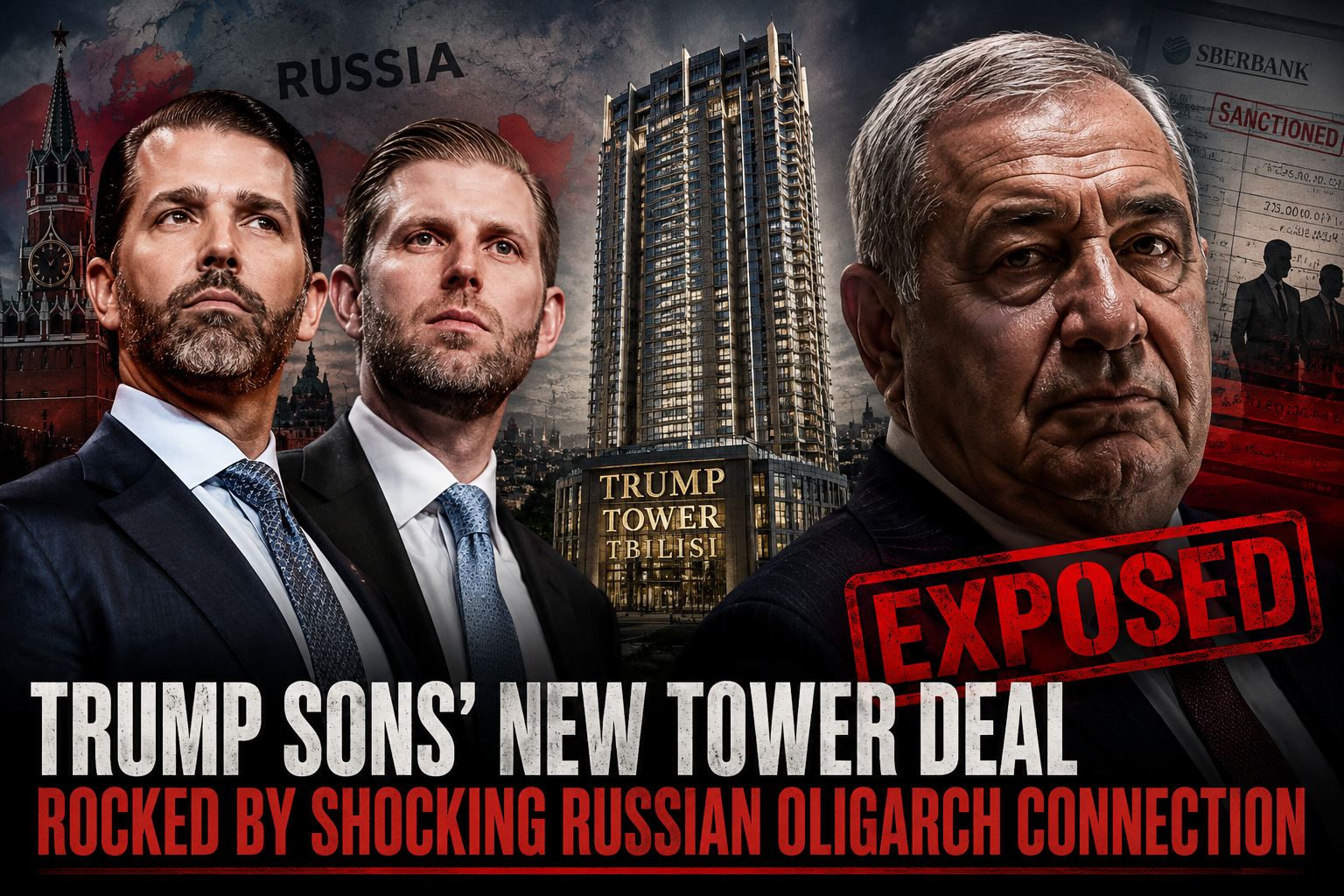
Donald Trump’s family is pushing ahead with another flashy international real estate project — but a new investigation is raising uncomfortable questions about the people reportedly lurking behind the deal.
Eric Trump and Donald Trump Jr. have proudly promoted plans for Trump Tower Tbilisi, a towering 70-story luxury development set to reshape the skyline of Georgia’s capital.
What they haven’t been talking about nearly as much is a wealthy businessman tied to one of the Georgian companies originally named as a partner in the project — a man who built his fortune in Russia, lived among Moscow’s elite and has been linked by investigative journalists to a sprawling network of opaque international businesses.
The businessman, 70-year-old Paata Gamgoneishvili, ultimately controls Riverside Invest, according to reporting by PunchUp and The Newsground. Riverside is connected to Biograpi Living, one of the companies highlighted when the Trump Organization announced the project.
Biograpi now insists neither it nor Gamgoneishvili has any involvement in Trump Tower Tbilisi.
That denial, however, comes with some awkward details.
When the Trump Organization unveiled the project, its announcement specifically named Biograpi and said the development was backed by Riverside. Two days later, Biograpi’s own Instagram account celebrated the tower and told followers it would be constructed “with our joint efforts.”
The company now says it merely shared the announcement for marketing purposes and that the Trump Organization’s release was not legally binding.
The conflicting explanations are fueling new scrutiny around a project that was already attracting attention because of the Trump family’s long and politically explosive history involving Russia.
Eric Trump announced the Tbilisi tower in May, sharing an artificial intelligence-generated image of the proposed skyscraper and declaring that the project marked the Trump Organization’s first venture in the region.
“We are so excited to bring it to life!” he wrote.
The planned building would reportedly rise 70 stories above Tbilisi, making it one of the most prominent additions to the Georgian capital’s skyline.
But the businessmen connected to the companies surrounding the deal have backgrounds that extend deep into the post-Soviet business world.
Gamgoneishvili was born in Georgia but made much of his fortune in Moscow alongside longtime Russian business partner Roland Isaev.
According to Forbes Russia, Gamgoneishvili began his career as a trader during the chaotic collapse of the Soviet Union.
His major break reportedly came during Russia’s violent 1993 constitutional crisis, when President Boris Yeltsin ordered tanks to fire on the Russian parliament building after a bitter political standoff.
Gamgoneishvili backed Yeltsin through an organization representing veterans of the Soviet war in Afghanistan and later received a state medal.
The veterans movement was rewarded with valuable import privileges during Yeltsin’s presidency. Elements of the organization were later linked to organized crime, although there is no allegation that Gamgoneishvili personally participated in those crimes.
Gamgoneishvili operated a trading company under the organization’s umbrella and eventually built a lucrative shopping mall empire with Isaev.
In 2006, two Moscow malls associated with the businessmen were sold to an Austrian investment fund for roughly $230 million.
Their success reportedly earned them homes in Rublyovka, the heavily guarded enclave outside Moscow known for housing some of Russia’s richest and most politically connected figures. Vladimir Putin’s official residence is also located in the area.
Other investigations have raised additional questions about Gamgoneishvili’s business network.
Bulgarian investigative outlet Bivol reported in 2019 that Gamgoneishvili and Isaev were connected to individuals involved in an alleged scheme that siphoned tens of millions of dollars from the Bulgarian operations of Russian oil giant Lukoil.
A television journalist who had previously hosted Bivol reporters to discuss the broader scandal was murdered the previous year. Authorities said the killing was unrelated to her journalism, though Bivol’s editor publicly questioned that conclusion.
Separate investigations by Czech and Bulgarian journalists identified Gamgoneishvili as a co-financier of a failed 2018 effort to purchase portions of Bulgaria’s electricity grid.
Those reports found that companies associated with him held approximately $123 million at Sberbank, Russia’s largest state-controlled bank, along with about $80 million at two private Swiss banks.
Leaked banking records reviewed by investigators reportedly show Gamgoneishvili continued earning interest on an estimated $375,000 account at Sberbank as recently as February 2025.
That would have been nearly three years after Western governments imposed sweeping sanctions on Sberbank following Vladimir Putin’s full-scale invasion of Ukraine.
Separate records reportedly show Isaev receiving interest from an estimated $250,000 held at Alfa Bank, another Russian lender subjected to Western sanctions.
None of that establishes wrongdoing by the Trump family, but the revelations are likely to intensify questions about how carefully the organization vets the people and companies involved in its growing international property empire.
The corporate structure surrounding the Georgia project is anything but simple.
Biograpi is owned equally by the prominent Georgian Pkhakadze family and Riverside Invest.
Biograpi acknowledged that Gamgoneishvili ultimately controls Riverside, but said neither the company nor Gamgoneishvili has any financial stake in Trump Tower Tbilisi “in any capacity whatsoever.”
Instead, Biograpi says members of the Pkhakadze family are developing the tower through another Georgian company called Idea LLC.
Corporate records reviewed by the outlets reportedly confirm that Biograpi does not own Idea.
But those same documents show Riverside listed as one of Idea’s creditors as of January.
The records do not reveal how much money Riverside may have provided.
Adding another layer of secrecy, Riverside itself is controlled by Tall Trade Ltd., a company registered in the British Virgin Islands — a jurisdiction known for allowing companies to shield significant ownership information from public view.
Georgian investigative outlet Studio Monitori previously traced those entities back to Gamgoneishvili.
Isaev’s name has also appeared in litigation involving the business group.
That litigation centers on SoftSwiss, a major technology provider used by online gambling companies around the world.
SoftSwiss says its software powers more than 1,500 brands offering casino games, sports betting, crypto payments and other gambling services.
Tall Trade gained control of SoftSwiss’ parent company in 2022 after a $19 million loan defaulted, according to the investigation.
SoftSwiss-linked businesses have also faced scrutiny from gambling regulators.
Australian authorities determined in 2020 that one operation had illegally marketed online casinos to Australians.
Three years later, Dutch regulators imposed a record $13.4 million fine on a Maltese operator running SoftSwiss-powered casinos for allegedly accepting bets without the proper license.
Every share in SoftSwiss’ parent company — including Tall Trade’s stake — was later sold to an anonymous Cyprus-based shell company in November 2022 for $71.4 million.
The identity of the ultimate owner remains unclear.
The Trump project has faced controversy beyond Gamgoneishvili.
The Daily Beast previously reported that another local partner, Archi Group, has connections to billionaire Bidzina Ivanishvili, Georgia’s dominant political powerbroker.
The United States sanctioned Ivanishvili in 2024, accusing him of undermining Georgia’s democratic and Euro-Atlantic future for Russia’s benefit.
The Newsground later reported that owners of two additional companies connected to the tower — Finvest Georgia and the Blox Group — donated tens of thousands of dollars to Ivanishvili’s ruling Georgian Dream party, which critics have increasingly described as authoritarian and friendly toward Moscow.
For President Trump, the controversy lands on especially sensitive territory.
Trump has repeatedly dismissed investigations into his connections with Russia as a Democratic “hoax.”
Yet U.S. intelligence agencies concluded that Russia interfered in the 2016 presidential election in an effort to help Trump defeat Hillary Clinton.
Trump’s company was also pursuing plans for a Trump Tower Moscow during portions of that presidential campaign.
The FBI later examined businessmen connected to Trump SoHo, the Manhattan condo-hotel developed with the Sapir Organization — which is now partnering with the Trump family on the Tbilisi tower.
The White House sought to distance the president from the latest controversy.
“This has nothing to do with the president, whose investment holdings are held in fully discretionary accounts managed by independent third-party financial institutions,” White House spokeswoman Anna Kelly told PunchUp and The Newsground.
The Trump Organization, Sapir Organization, Riverside, Gamgoneishvili, Isaev and SoftSwiss did not provide responses before the original investigation was published.
Eric Trump, meanwhile, has publicly praised the people involved in the Georgia development.
When announcing Trump Tower Tbilisi, he said the family was “especially pleased to collaborate with such respected and professional developers on this project.”
With the project now surrounded by offshore companies, sanctioned Russian banks, politically connected Georgian businessmen and an oligarch who made his fortune in Moscow, that glowing endorsement could invite far more questions than the Trump family expected.
Discover more from Next Gen News
Subscribe to get the latest posts sent to your email.
Building buildings… it’s what the Trump family does…
All a bunch of fucking crooks!!