

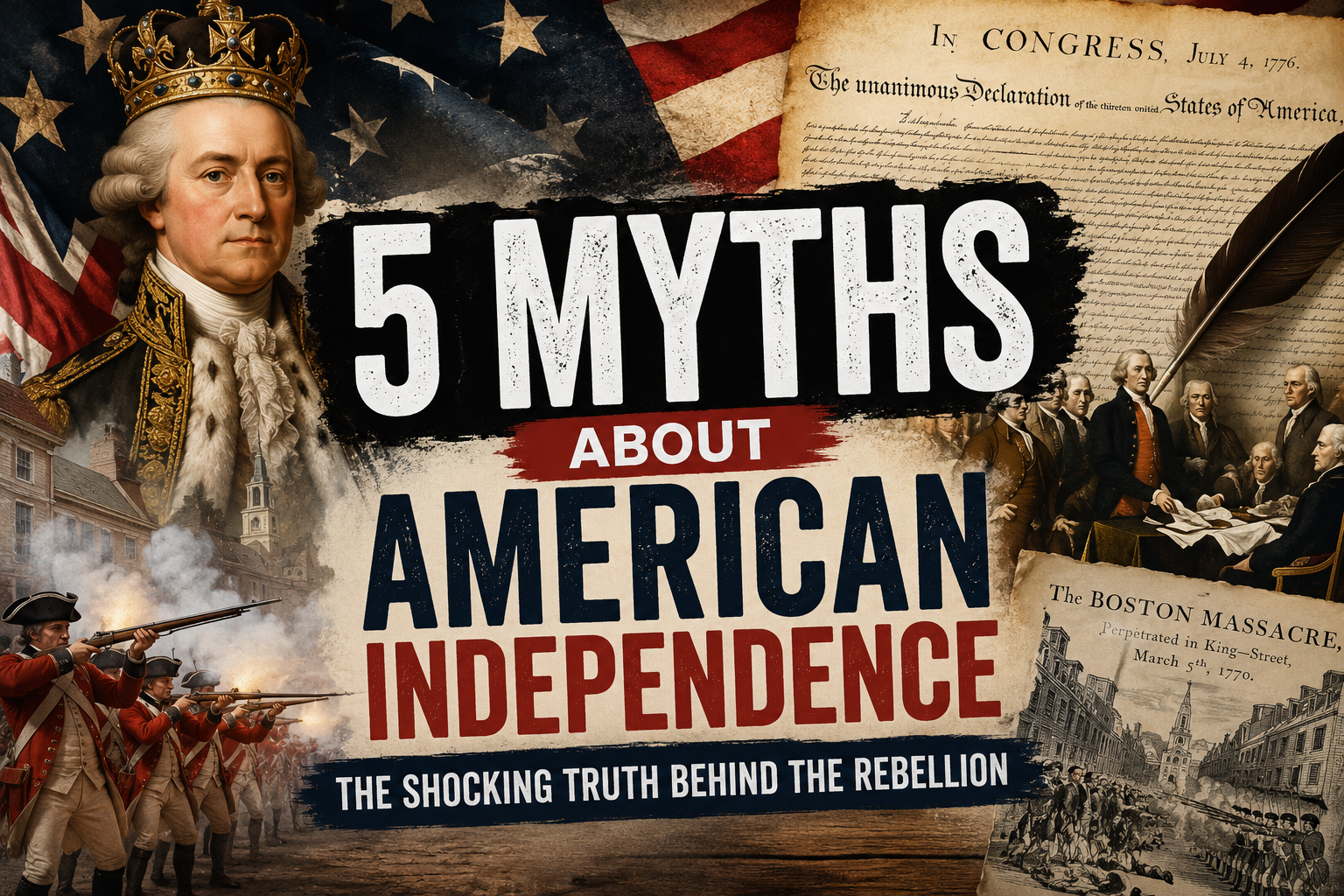
Every Fourth of July, Americans celebrate a story that has been repeated so often it can feel almost untouchable.
A united people rose up against a tyrannical king, declared that all men possessed self-evident rights and bravely defeated British oppression to create a new nation.
As the United States marks its 250th anniversary, that familiar version of the founding will once again echo through public readings of the Declaration of Independence, patriotic speeches and fireworks displays across the country.
But the surviving documents reveal a far more complicated and, in many ways, more fascinating story.
That does not make the American Revolution less important or less extraordinary. It shows that the men who led it understood a powerful truth: Political freedom requires a convincing argument, and convincing arguments are rarely neutral.
Before America puts 250 candles on its birthday cake, here are five enduring myths about independence worth examining.
Myth 1: The Declaration of Independence Was Simply a List of Proven Facts
The Declaration of Independence openly invites the world to judge its case.
“Let facts be submitted to a candid world,” the document declares.
For generations, many Americans have treated the accusations that follow as established historical findings. But the declaration itself reveals a more strategic approach.
After its soaring language about unalienable rights, the document launches into a relentless series of grievances against King George III. Again and again, each accusation begins with the same phrase: “He has.”
That repetition was deliberate.
Real colonial complaints involving taxation, trade, sovereignty and self-government were compressed into a powerful and sharply focused story of tyranny. The disputes were genuine, but they were presented from only one side.
Loyalists recognized that immediately.
Thomas Hutchinson, the exiled former governor of Massachusetts, published an anonymous response in 1776 dismissing the accusations as “imaginary grievances.” London barrister John Lind also issued a lengthy rebuttal that same year.
Modern historians have increasingly returned their attention to the declaration’s 27 grievances rather than focusing only on its famous opening words.
In Tyrants and Rogues, published for America’s 250th anniversary, historian Robert Parkinson argues that the accusations were the section the document’s authors worked hardest to craft. According to Parkinson, they were carefully structured to portray George III as a usurper.
There is also a detail that complicates the popular belief that the king was personally responsible for every colonial complaint.
Only the first 12 grievances directly target the Crown. Grievances 13 through 22 are aimed primarily at Parliament.
The Declaration of Independence was therefore more than a philosophical statement. It was also one of America’s earliest and most important works of international persuasion.
It was written to convince uncertain colonists, foreign governments and future generations that the colonies were not staging an unlawful rebellion. They were carrying out a justified separation.
The complaints were not simply invented. However, they were selective, adversarial and sometimes exaggerated.
The declaration was morally serious, but it was also written like a prosecutor’s case. Prosecutors do not normally present history from every possible angle.
Myth 2: King George III Was a Deranged Tyrant in 1776
The King George III remembered by many Americans is cruel, unstable and personally obsessed with destroying colonial freedom.
That image was partly created by wartime propaganda and has been reinforced in modern popular culture, including Lin-Manuel Miranda’s musical Hamilton.
The real George III opposed American independence and eventually took an increasingly hard line against the colonies. But historical records show a more complicated figure than the power-hungry madman of legend.
He was a constitutional monarch attempting to manage Parliament, ministers and a growing imperial crisis.
Some of the most revealing evidence comes from the Georgian Papers Programme, a project launched at Windsor Castle in 2015 in the presence of Queen Elizabeth II.
The effort, led by the Royal Collection Trust and King’s College London, was created to preserve and digitize hundreds of thousands of pages that had long remained under restricted access in the castle’s Round Tower.
One 1766 memorandum concerning the Stamp Act significantly challenges the traditional image of George as an unthinking tyrant.
The king wrote that repealing the act was “infinitely more eligible than enforcing” it. He urged Parliament to “redress any just grievances” and warned that enforcement could “widen the breach” with the colonies.
That position showed a level of sympathy and caution rarely reflected in American portrayals of him.
By the fall of 1774, however, George’s position had hardened dramatically.
With the First Continental Congress underway, he told Prime Minister Lord North that the “dye is now cast” and that the colonies must either “submit or triumph.”
“I do not wish to come to severer measures but we must not retreat,” the king wrote. He added that he believed calmness and an “unremitted pursuit” of existing policies would eventually force the colonists to submit.
George III was deeply involved in government and frequently worked through correspondence, ministerial advice and official paperwork rather than ruling as a personal dictator.
The Georgian Papers show him copying dispatches, reviewing policy details and annotating documents.
He also had serious interests outside politics. His reign coincided with important developments in British literature, art, science and philosophy, and he supported several intellectual and cultural pursuits.
That does not mean George was innocent of responsibility for the imperial crisis. It does mean the cartoon version of him often remembered today is incomplete.
Recent 250th-anniversary reassessments have gone even further.
British biographer Andrew Roberts has described much of the Declaration of Independence’s grievance list as wartime propaganda, arguing that many of the accusations do not withstand close scrutiny.
Other scholars, including Parkinson, emphasize that the complaints were deeply felt and involved real suffering.
Both positions can contain some truth.
The colonists had sincere grievances. At the same time, placing nearly all the blame on one man was a strategic political choice.
A complicated network of parliamentary power, imperial finance, ministerial conflict, western land disputes and constitutional theory was difficult to turn into a rallying cry.
A king, however, had a face, a name and a crown.
George III was far more useful to the revolutionaries as a villain than he was as a complicated human being.
Myth 3: The Boston Massacre Happened Exactly the Way the Famous Picture Shows
Five people died on Boston’s King Street on the night of March 5, 1770.
The killings became one of the most influential events leading to the Revolution. But the scene most Americans remember did not come directly from court testimony.
It came from Paul Revere’s famous engraving.
Published within weeks of the violence, the hand-colored image showed a neat line of British soldiers firing together into a group of apparently defenseless civilians.
The customs house in the picture was dramatically renamed “Butcher’s Hall.”
The engraving became one of the most successful propaganda images of the colonial era. Revere, however, had borrowed the design from another Boston artist, Henry Pelham.
The trials that followed presented a much more confused and chaotic scene.
Witnesses contradicted one another on crucial details. They could not even agree on what Captain Thomas Preston had been wearing.
Several witnesses testified that Preston had been standing in front of his soldiers rather than behind them shouting orders to fire.
Preston was acquitted.
Of the eight soldiers placed on trial, six were cleared. Two were convicted of manslaughter rather than murder.
Their defense attorney was a young Boston lawyer named John Adams, who famously told the jury that facts are stubborn things.
The Boston Massacre demonstrates how effective propaganda usually works.
It does not always invent an event from nothing. Instead, it strips away uncertainty and complexity until the event becomes a simple and emotionally powerful symbol.
The deaths were real. Boston’s residents genuinely resented the presence of British troops in their city.
The point is not that the incident was harmless or insignificant. It is that the version preserved in popular memory is far cleaner and more organized than the available evidence suggests.
Before the Boston Massacre became settled history, it became an unforgettable image.
Myth 4: Most Americans Already Wanted Independence
American independence was not inevitable.
Even in 1775, after fighting had already broken out at Lexington and Concord, separation from Britain was not necessarily supported by a majority of colonists.
A full year before the Declaration of Independence, the Second Continental Congress sent King George III the Olive Branch Petition.
Drafted by moderate Pennsylvania statesman John Dickinson, the document asked for reconciliation and addressed the colonists as “His Majesty’s faithful subjects.”
“The union between our Mother country and these colonies, and the energy of mild and just government, produced benefits so remarkably important,” the petition said.
It argued that the relationship had helped Great Britain achieve a level of power that inspired the “wonder and envy of other Nations.”
Among the men whose names appeared on the petition were John Adams, Thomas Jefferson and Benjamin Franklin.
George III refused to receive it.
In August 1775, he formally declared that the colonies were in open rebellion.
Independence was not the first demand of a completely united population. It emerged as the final step in a failing effort at reconciliation.
Colonial leaders had asked for the relationship with Britain to be repaired. Only after that effort collapsed did the movement cross a line from which there could be no return.
Thousands of Americans also openly sided with Britain during the war.
Mount Vernon estimates that Loyalists made up roughly one-fifth of the colonial population. The American Battlefield Trust estimates that approximately 25,000 Americans served the British Crown, most of them in Loyalist provincial units.
Some radicals had wanted independence much earlier, particularly in New England.
But the idea that all 13 colonies had already reached the same conclusion before July 1776 is simply not supported by the evidence.
The colonies remained deeply divided.
Myth 5: The Revolution Was One United American People Fighting Britain
The American Revolution was not only a war against a foreign empire.
It was also a civil war.
The conflict became especially brutal in the South. The National Park Service has described the fighting there as “a bloody civil war often pitting neighbor against neighbor.”
The Carolina backcountry was torn apart by raids, revenge killings, confiscations and personal feuds. Communities were divided, and in some cases, members of the same family chose opposite sides.
Patriots fought Loyalists.
Enslaved people, Native nations and settlers along the frontier made their own strategic choices in a war whose promises of liberty did not apply equally to everyone.
The final version of the Declaration of Independence also reveals how much compromise was required to hold the revolutionary coalition together.
While Congress met as a committee of the whole on July 3 and 4, 1776, delegates removed an entire paragraph in which Thomas Jefferson condemned the slave trade.
Jefferson later blamed the deletion on pressure from South Carolina, Georgia and Northern merchants involved in the trade.
The declaration was therefore shaped by both principle and political limitation.
Its authors had powerful ideals, but they also had to satisfy the people and colonies whose signatures were required.
That does not mean the founding was nothing more than hypocrisy.
The revolutionary commitment to liberty was genuine, and its ideals eventually helped broaden the meaning of freedom far beyond what many founders were willing to accept in 1776.
But the myth of a single united “American people” hides the central question that existed from the beginning: Who was included in that phrase?
The Civil War, which erupted less than a century later, grew in part from divisions that were already present at the nation’s founding.
The Real Story of July 4 Is More Powerful Than the Myth
The fireworks will explode, the Declaration of Independence will be read aloud and Americans will once again celebrate the familiar story of national freedom.
That tradition is both understandable and valuable.
But the real story of independence is more compelling than a flawless national fairy tale.
The United States was founded through courage and propaganda, principle and fear, compromise and conviction.
The country did not receive a perfectly settled definition of liberty. Americans argued over it, fought for it and repeatedly failed to apply it equally.
Much of that struggle occurred within the Revolution itself.
America was born from an argument about freedom powerful enough to outlive the people who first made it.
Two hundred and fifty years later, that argument is still not over.
Discover more from Next Gen News
Subscribe to get the latest posts sent to your email.
Historians like to blame bad events on just one person: King George, Hitler, Putin… freeing up most other supporters… hiding and protecting the real causes…