

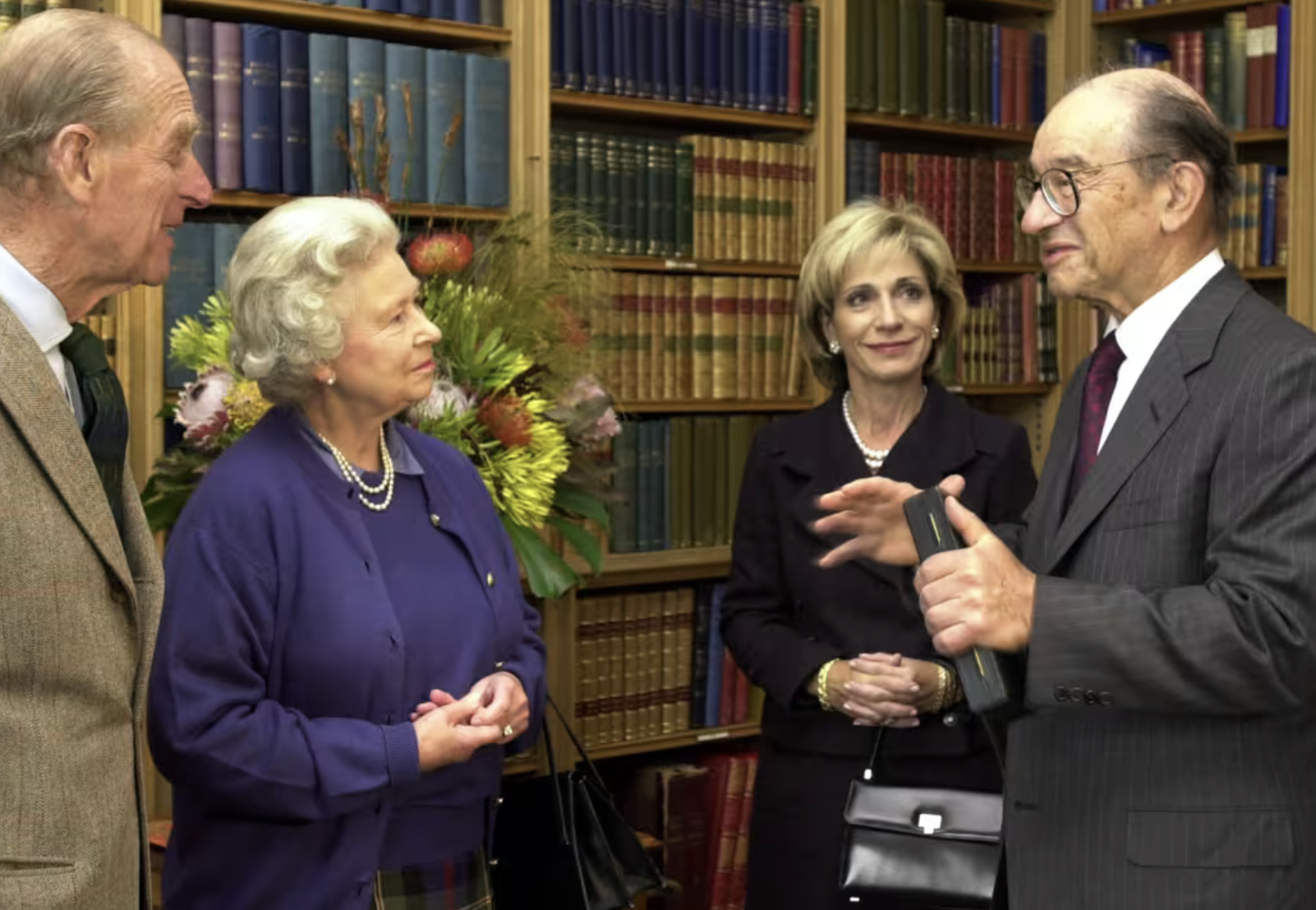
Alan Greenspan, the legendary former Federal Reserve chairman who helped steer the U.S. economy through booms, crashes, bubbles and political storms for nearly two decades, has died at 100.
Greenspan died Monday morning at his home from complications of Parkinson’s disease, his wife, longtime NBC News correspondent Andrea Mitchell, announced. The couple had been married for 29 years.
For generations of Americans, Greenspan was not just another Washington economist. He was one of the most powerful unelected figures in the country, a man whose words could shake Wall Street, calm markets or send investors scrambling. From the 1987 stock market crash to the dot-com boom, the post-9/11 economy and the early warning signs of the housing bubble, Greenspan sat at the center of some of the most consequential financial moments in modern U.S. history.
“Alan passed away at our home this morning at the age of 100 from complications of Parkinson’s disease,” Mitchell said in a statement. “He was a giant of a man who helped shape the U.S. economy for decades under presidents of both parties, but was always honest in acknowledging his mistakes.”
To Mitchell, however, Greenspan was more than the famously cryptic Fed chairman known for moving global markets with a few carefully chosen words.
“To me he was my husband, who shaped my life from our very first date in 1984,” she said. “He had ‘irrational exuberance’ for baseball, the Washington Commanders, tennis, golf and music, especially jazz.”
She added, “He will be remembered for his brilliance and his kindness. Being his life partner was the joy of my life.”
The Federal Reserve also honored Greenspan, saying his work left “a lasting mark” on the central bank, the field of economics and the country.
Born on March 6, 1926, in the Washington Heights neighborhood of New York City, Greenspan showed a gift for numbers early in life. But before he became one of the most powerful economic voices in the world, he had another passion: music.
As a young man, Greenspan attended the Juilliard School and played jazz saxophone and clarinet. That love of music stayed with him throughout his life, even as his career took him from smoky jazz clubs to the highest levels of American power.
Greenspan later studied economics at New York University, earning his bachelor’s degree in 1948 and a master’s degree in 1950. He went on to begin doctoral work at Columbia University under economist Arthur F. Burns, who would later become chairman of the Federal Reserve.
In the 1950s, Greenspan also became close with author Ayn Rand, the controversial writer of “Atlas Shrugged” and a champion of laissez-faire capitalism. Rand’s philosophy helped shape Greenspan’s early views on markets, self-interest and limited government.
He later wrote in his 2007 memoir, “The Age of Turbulence,” that Rand had a major influence on him.
“I was intellectually limited until I met her,” Greenspan wrote.
Greenspan built his career in economic consulting before stepping into the world of politics. He advised Richard Nixon’s 1968 presidential campaign and later served as chairman of the Council of Economic Advisers under President Gerald Ford.
But his most powerful role came in 1987, when President Ronald Reagan nominated him to lead the Federal Reserve.
Just weeks after Greenspan took the job, disaster hit.
On Oct. 19, 1987, a day that became known as Black Monday, the Dow Jones Industrial Average plunged more than 22% in a single day. It remains the largest one-day percentage drop in the history of the blue-chip index.
Greenspan moved quickly to calm the panic and keep money flowing through the financial system. His response helped establish a reputation that followed him for years: when markets were in trouble, the Fed under Greenspan would step in.
That idea became known on Wall Street as the “Greenspan put.”
Over the next two decades, Greenspan became a towering figure in American economic life. He served under four presidents: Ronald Reagan, George H.W. Bush, Bill Clinton and George W. Bush. He remained Fed chairman for five consecutive four-year terms and retired on Jan. 31, 2006.
Only William McChesney Martin served longer as Fed chair.
Greenspan’s supporters credited him with helping guide the U.S. through one of the longest economic expansions in American history, from 1991 to 2001. During that period, the country saw the rise of the internet, the acceleration of globalization and a soaring stock market that turned Greenspan into an unlikely celebrity.
He was called “the maestro.” The Economist dubbed him a “rock star.” His economic forecasts and congressional testimony were watched with near-obsessive attention.
One of Greenspan’s most famous phrases came in 1996, when he warned that “irrational exuberance” may have been inflating stock prices. The phrase became instantly iconic and followed him for the rest of his career.
But Greenspan’s legacy was not without controversy.
After the global financial crisis of 2007-08, critics argued that Greenspan’s faith in deregulation and self-policing financial markets helped create the conditions for disaster. He was accused of failing to recognize the danger of the housing bubble and the explosion of risky mortgage-backed securities.
In 2011, the bipartisan Financial Crisis Inquiry Commission said the crisis was fueled in part by decades of deregulation and reliance on self-regulation by financial institutions, policies Greenspan had championed.
Greenspan later acknowledged that the crisis had exposed flaws in his thinking.
Testifying before Congress in 2008, he called the financial meltdown a “once-in-a-century credit tsunami” and admitted it had turned out to be “much broader” than he had imagined.
After leaving the Fed, Greenspan launched a consulting firm in Washington and wrote several books. In his memoir, he offered frank assessments of the presidents he worked with.
He described Nixon as intelligent but paranoid, Ford as a genuinely decent man and Reagan as a leader who deeply believed in a small set of principles. Though Greenspan was a lifelong Republican, he developed a strong working relationship with Bill Clinton and praised his fiscal discipline. He even joked that Clinton “was the best Republican president we’ve had in a while.”
His relationship with both Bush presidents was more complicated. George H.W. Bush blamed Greenspan for economic weakness that helped cost him re-election, while Greenspan later criticized George W. Bush and congressional Republicans for abandoning fiscal restraint.
“The Republicans in Congress lost their way,” Greenspan wrote. “They swapped principle for power. They ended up with neither.”
Over the course of his life, Greenspan received some of the world’s highest honors. France awarded him the Legion of Honor in 2000. Queen Elizabeth II named him an honorary Knight of the British Empire in 2002. President George W. Bush awarded him the Presidential Medal of Freedom in 2005.
The Federal Reserve said Greenspan brought “rigorous analytical discipline” to monetary policymaking and helped build the credibility that remains one of the central bank’s most important assets.
“Chairman Greenspan’s legacy endures at the Federal Reserve,” the Fed said, “in those he mentored directly, in the economists and public servants he inspired, and in the frameworks and practices he helped shape.”
For supporters, Greenspan was the steady hand who helped America ride a historic wave of prosperity. For critics, he was a powerful believer in deregulated markets whose blind spots helped set the stage for economic catastrophe.
But few dispute that Alan Greenspan was one of the most consequential economic figures of the last century — a jazz musician turned Washington power broker whose decisions shaped the financial lives of millions of Americans.
Discover more from Next Gen News
Subscribe to get the latest posts sent to your email.
It wasn’t a “housing bubble”… Democrats always blame the wrong things/causes… it wasn’t caused by housing… it was The Toxic Mortgage Scam used to fake the economy UP… people were getting mortgage loans that didn’t have enough income to even make the first of 360 monthly payments… then the Toxic Mortgages were hidden in REITS – Real Estate Investment Trusts… a fake Investment Grade Rating was slapped on them and they were sold into the Stock Market to unsuspecting Retirement Funds… by Sept. 2008, people had looked for the MONEY and discovered there was NONE! The mortgages weren’t being paid off… loans backing the mortgages failed… banks failed… Instant economic collapse and bankrupcy of the entire USA… requiring Bailout Loans from China to move forward… of course one can’t really borrow their way out of debt/corruption…