

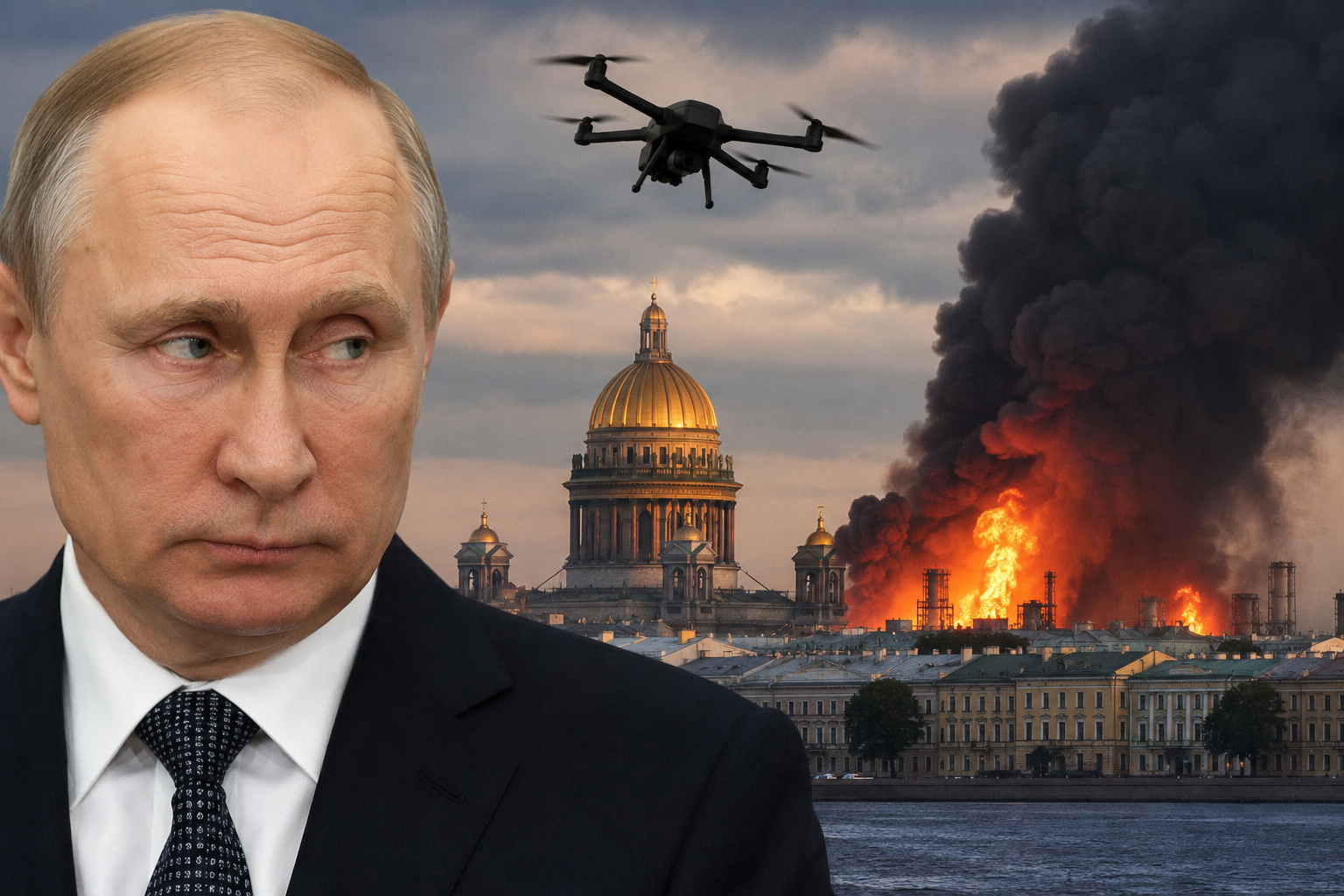
Vladimir Putin’s war is suddenly looking a lot more dangerous for him at home.
For more than four years, the Russian leader has tried to project strength as his forces pound Ukraine with missiles, drones, and artillery. But a stunning Ukrainian drone attack near St. Petersburg has exposed a weakness Putin can no longer hide: Russia’s own skies are not safe.
The strike hit during the opening of Putin’s international economic forum in St. Petersburg, the Russian president’s hometown. It was supposed to be a carefully staged display of power and stability. Instead, Ukraine’s drones reportedly struck a naval base, ignited an oil terminal, and threw the city’s airport into chaos.
For Putin, it was a public embarrassment at one of the worst possible moments.
The attack reached roughly 657 miles into Russian territory, a distance Ukrainian officials say would have seemed almost impossible at the start of Russia’s full-scale invasion in 2022. Now, Ukraine is not just defending its cities. It is showing it can bring the war to places Putin once assumed were far beyond Kyiv’s reach.
Serhiy Goncharov, a Ukrainian defense industry figure and director of Ukraine’s National Association of Defense Industries, said the country’s growing drone capabilities are giving Ukrainians new hope.
“That would have been unimaginable in 2022, when the war started,” Goncharov told the Daily Beast. At the time, he said, Ukraine’s biggest concern was simply survival.
Now, Ukraine is trying to do something much more ambitious: outsmart Russia.
The new wave of Ukrainian drones is changing the battlefield at frightening speed. Some so-called middle-strike drones can fly around 100 miles and hit moving targets on roads or even trains. Other long-range drones are reaching much deeper into Russia, striking oil refineries and other strategic sites on a near-daily basis.
That matters because Putin’s war machine depends heavily on oil, logistics, and the illusion that ordinary Russians can remain untouched while Ukraine suffers. Every successful strike inside Russia chips away at that illusion.
The St. Petersburg attack was especially symbolic. Putin used his economic forum to urge Russian forces to keep fighting, even as smoke rose over his hometown and Ukrainian President Volodymyr Zelensky shared footage of the damage online.
For Ukraine and its supporters, the message was clear: Putin may still want war, but he no longer controls where that war is felt.
Western officials have taken notice. U.S. Defense Secretary Pete Hegseth praised Ukraine’s ability to rapidly scale up advanced weapons systems. European Commissioner Andrius Kubilius went even further, saying Ukraine has “the best army in Europe and perhaps in the world.”
The praise comes as Ukraine’s defense industry races forward under relentless Russian attacks. New drone models are appearing constantly. One Ukrainian company recently unveiled a satellite-controlled drone called Adis, which could allow operators to strike targets from far beyond the limits of traditional radio-controlled drones.
The technology could make Ukrainian drone operations even harder for Russia to stop.
But the drone war is also becoming more brutal and more personal. Both Russia and Ukraine have expanded the range and power of unmanned weapons. The so-called “kill zone” along the front lines is growing wider as drones are able to fly farther, identify targets faster, and strike with greater precision.
For Ukrainians, drones are not an abstract battlefield tool. They are a daily terror. In May alone, Russia reportedly launched a record-breaking 8,150 drones at Ukraine, killing and injuring more than 600 civilians. Ukrainian officials warn Moscow may soon increase attacks using faster drones that are harder to shoot down.
Still, Putin now has his own reasons to worry.
Ukraine’s drones are increasingly reaching military and economic targets inside Russia. At the same time, reports suggest senior Russian officials have warned the Kremlin that the cost of the war is becoming harder to sustain.
That combination could be dangerous for Putin. His war was built on the promise of Russian dominance. Instead, Ukraine is still fighting, still innovating, and now striking deeper into the country that invaded it.
Zelensky seized the moment after the St. Petersburg attack, sending Putin an open letter calling for direct talks and a ceasefire.
“Ukraine is ready for a full ceasefire for the duration of the negotiations,” Zelensky wrote, calling for a face-to-face meeting to end the war.
The offer put Putin in a difficult position. He can keep demanding more territory while Russia’s own cities face more drone attacks, or he can sit down with the leader whose country he failed to crush.
For now, the St. Petersburg strike has delivered a humiliating reminder to the Kremlin: Ukraine is no longer just surviving Putin’s war.
It is finding ways to make him feel it.
Discover more from Next Gen News
Subscribe to get the latest posts sent to your email.
Ukraine needs to do what Trump did, take off the heads of the evil snakes: Putin and Pope…