

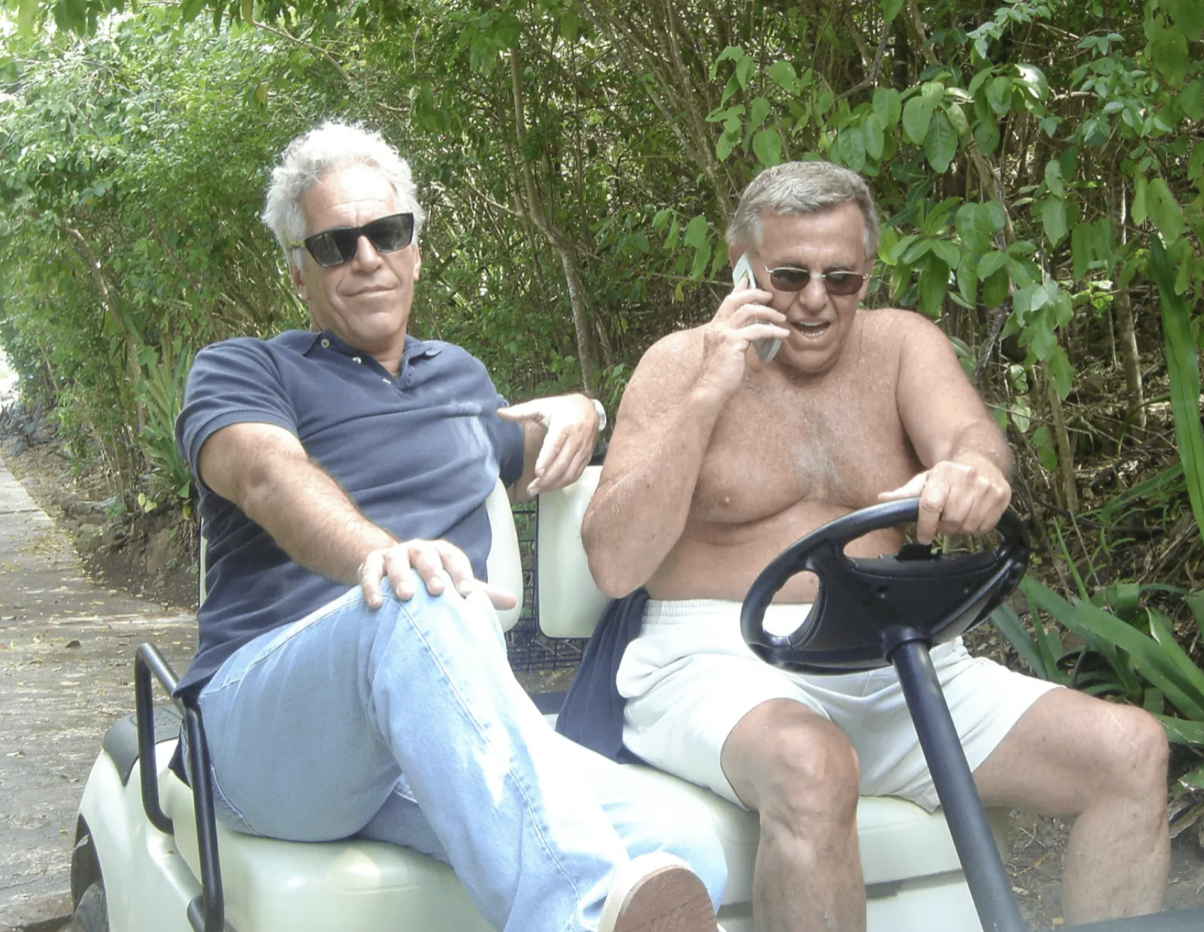
Newly released Justice Department documents are raising fresh and deeply unsettling questions about Jeffrey Epstein’s powerful inner circle.
Among the latest revelations is a startling 2009 email exchange between Epstein and his longtime friend, billionaire psychiatrist Dr. Henry Jarecki, that reads like a playbook for dodging law enforcement. The memo, titled “What If I Get Caught,” laid out a chilling list of ideas for avoiding accountability — from disguises and plastic surgery to fake documents, hidden cash, and fleeing overseas.
The email, dated May 1, 2009, was reportedly sent to Epstein by one of Jarecki’s assistants, along with a message saying the doctor was supposedly thinking about writing a book and needed a co-author. But what followed was no literary brainstorm. Instead, the document mapped out strategies that sound less like fiction and more like a rich man’s survival guide for escaping justice.
At the time, Epstein was nearing the end of his notorious 13-month Florida jail sentence tied to his 2008 sweetheart non-prosecution deal — the widely blasted agreement that allowed him to avoid federal charges despite mounting allegations involving underage girls. Against that backdrop, the email takes on an even darker tone.
The two-page note lists a seven-step plan for “trouble avoidance,” including basic instructions like avoiding credit cards and tightening up computer security. But the most jaw-dropping section comes later, under the heading “post-trouble,” where the suggestions become far more extreme.
That portion mentions “disguises,” “plastic surgeon,” and “documents generation: birth certificate, driver’s license.” It also advises collecting damaging information on accusers and prosecution witnesses using private detectives and the internet — language that now reads as especially disturbing given the decades-long system of intimidation, secrecy, and manipulation that surrounded Epstein.
Another entry stresses the need for “multiple passports.”
That detail is especially striking because federal investigators previously found a fake Austrian passport in Epstein’s Upper East Side mansion during the 2019 raid that exposed piles of cash, diamonds, and other evidence. The passport, bearing Epstein’s photo and the false name “Marius Robert Fortelni,” had reportedly been used for travel to the United Kingdom, France, and Saudi Arabia in the early 1980s.
The email also asked a question that now sounds almost grotesque in hindsight: “Have a stash of cash ready: how much is enough?”
The final section, labeled “flight,” discusses extradition laws in countries including Germany, Israel, and Brazil, suggesting Epstein may have been thinking in concrete terms about where he could run if legal pressure mounted. The memo also mentions money stashed abroad and ways to stay in contact with family while “in hiding” or overseas.
For many observers, the document reinforces a long-running fear at the heart of the Epstein scandal: that wealth, elite access, and institutional protection created an environment where powerful men could treat accountability as just another obstacle to manage.
Jarecki, now 92, was far more than a casual acquaintance. The newly released files show the psychiatrist and commodities billionaire was part of Epstein’s orbit for years. He traveled on Epstein’s private jet and spent time with him in the Caribbean. In one birthday message for Epstein’s infamous 50th birthday book, Jarecki reportedly praised the disgraced financier for liking to work “in private, or better yet, utter secrecy.”
The two also appeared to stay in close contact after Epstein’s release from custody in 2009. On the morning of July 22 of that year, Epstein emailed Jarecki, “home and free,” announcing that he was out. Jarecki’s response was disturbingly cheerful: “I hope you do not come to your senses. And when’s the party?”
The files also include another eyebrow-raising exchange from 2011 in which Epstein scolded Jarecki over his behavior with women, writing that he was driving them away and “poisons the water for future candidates as the reputation becomes widespread.”
That message has drawn renewed attention because Jarecki himself has faced serious allegations. One of Epstein’s accusers claimed in a 2024 Manhattan federal complaint that she was trafficked to Jarecki in 2011 after Epstein referred her to him for mental health treatment, calling him the “best doctor in New York City.” The complaint alleged Jarecki acted as Epstein’s go-to doctor for victims, shared confidential information with him, and helped shield him from law enforcement.
Jarecki denied wrongdoing and described his relationship with the accuser as consensual, non-secretive, and mutually respectful. The lawsuit was later voluntarily dismissed in November.
A spokesperson for Jarecki’s business office said the 2009 email was meant as humorous “advice” to someone about to be released from prison for crimes he claimed were fabricated. The spokesperson added that, in light of what is now known about Epstein’s crimes, the tone of the message was “completely inappropriate.” They also said Jarecki now suffers from advanced dementia and is non-communicative.
Still, the newly released material is likely to intensify scrutiny not just of Epstein, but of the wealthy, influential men who stayed close to him even after his first conviction. For critics, the email is yet another example of how elite circles normalized behavior that should have set off alarm bells long ago.
Jarecki’s family also appears in the files. His son Andrew Jarecki became famous for the true-crime series The Jinx, while another son, filmmaker Nicholas Jarecki, was also reportedly friendly with Epstein. According to the documents, Nicholas wrote to Epstein after his 2009 release, “Let’s hang out. When are the bracelets off?” He later said he never witnessed anything inappropriate by Epstein, though he has expressed regret about some of their past interactions.
Years after Epstein’s death, the drip of new records continues to paint a broader and uglier picture of the ecosystem that protected him. And with each release, the question becomes harder to ignore: how many powerful people knew exactly what kind of man they were dealing with — and chose to stay close anyway?
Discover more from Next Gen News
Subscribe to get the latest posts sent to your email.
 What's Up Today Editorial Team
Was in a store Friday and the clerk looked like Jeffrey Epstein… he swore he wasn’t him…