

They thought the air they breathed was safe.
Now pilots and flight attendants say it’s killing them.
A stunning new Wall Street Journal investigation has exposed what insiders call aviation’s “dirty secret” — toxic fumes leaking into passenger cabins aboard some of the world’s most popular jets. The alleged fallout? Fatal heart attacks. Brain damage. Neurological collapse. Even suicide.
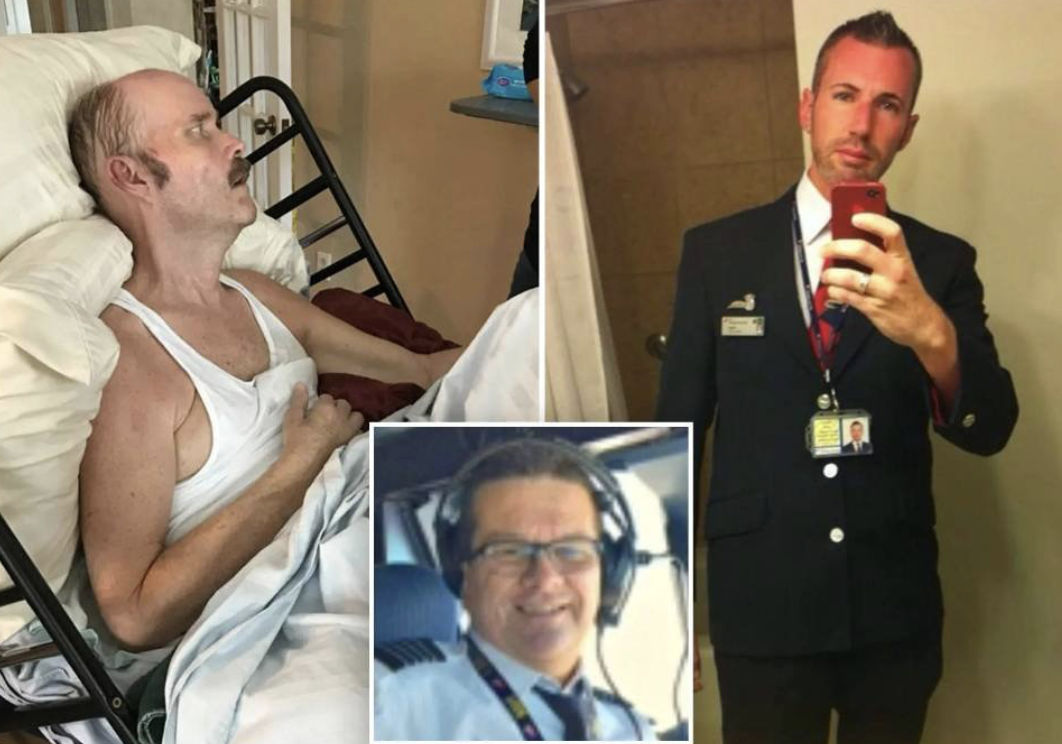
American Airlines Captain Ron Weiland was strong, fit, and sharp. Then one day in 2016, as his Boeing 767 filled with a foggy haze and the stench of burning oil, his life began to unravel.
Months later, the once-healthy pilot was staggering, slurring his speech, and gasping for words. Doctors called it ALS — Lou Gehrig’s disease. He called it something else.
Using an iPad after he lost his voice, Weiland repeatedly typed just one haunting word: “Fumes.”
His widow, Martha Weiland, told reporters, “Ron loved flying more than anything. But in the end, it was flying that killed him.”
Weiland died in 2019. Boeing quietly settled with his family in 2022, just before the case was set to go before a jury. The amount was never disclosed.
In another horrifying case, Spirit Airlines pilot James Anderberg suddenly collapsed mid-flight in 2015 after toxic smoke filled the cockpit of his Airbus A319. His co-pilot, Eric Tellman, barely managed to strap an oxygen mask on his face before the unthinkable happened.
“To be clear,” Tellman later wrote to his union, “had I not put that mask on, we would have killed everyone on that aircraft.”
Anderberg survived the landing — but never recovered. He suffered tremors, vomiting, and confusion before dying 50 days later. His autopsy couldn’t rule out toxic exposure. Postmortem scans showed damage consistent with nerve poisoning.
British Airways flight attendant Matthew Bass, just 34, was laughing and eating pizza with friends one night in 2014 when he suddenly stopped breathing. For weeks he had complained of fatigue and muscle spasms — symptoms eerily similar to those reported by other fume victims.
His parents ordered their own investigation. The results were chilling: brain tissue showing signs of chemical toxicityfrom heated jet engine oil.
Yet a coroner blamed alcohol and refused to link his death to the aircraft.
American Airlines captain Andy Laczko, 63, suffered a “fume event” on an Airbus A330 in 2018 when mechanics repaired the wrong engine. Days later, he complained of pounding headaches, panic attacks, and muscle pain. His wife said he “became a completely different person — frightened, paranoid, broken.”
Months later, Laczko took his own life.
“He told me, ‘Something happened to my brain up there,’” she said. “Nobody believed him.”
The Journal found hundreds of similar cases worldwide — pilots and flight attendants collapsing, losing motor skills, and suffering mysterious neurological breakdowns after reported fume events.
In 2010, seven U.S. Airways crew members were poisoned by fumes aboard a Boeing 767. Six were later diagnosed with brain injuries. Two died of cancer. Their captain died by suicide.
“It’s aviation’s version of asbestos,” said one former safety inspector. “Everyone knows it’s there — but no one wants to take responsibility.”
Boeing insists the claims are unfounded. “The cabin air inside Boeing airplanes is safe,” the company said, adding that “no indoor environment is free from contaminants.”
The aircraft maker pointed to decades of independent studies showing “low contaminant levels” and said top aerospace medical groups have found no proof of a link between cabin air and major illness.
Critics say that response sounds like denial.
“These are real people dying,” said former pilot John Lindstrom, who now campaigns for mandatory air-monitoring systems. “They’re choking on their own cockpits while companies say, ‘Everything’s fine.’”
The Federal Aviation Administration and National Transportation Safety Board have declined to impose new air quality rules. The FAA says existing systems meet safety standards. But flight crews say those standards are decades out of date.
“We check our fuel, our hydraulics, our flight path — but not the air we breathe,” Lindstrom said. “That’s insane.”
Behind the glossy image of modern air travel, a growing number of families say the true cost is being hidden in sealed autopsy reports and confidential settlements.
“They call it a fume event,” said one widow. “But it’s murder by neglect.”
Discover more from Next Gen News
Subscribe to get the latest posts sent to your email.
Get Outlook for iOShttps://aka.ms/o0ukef