

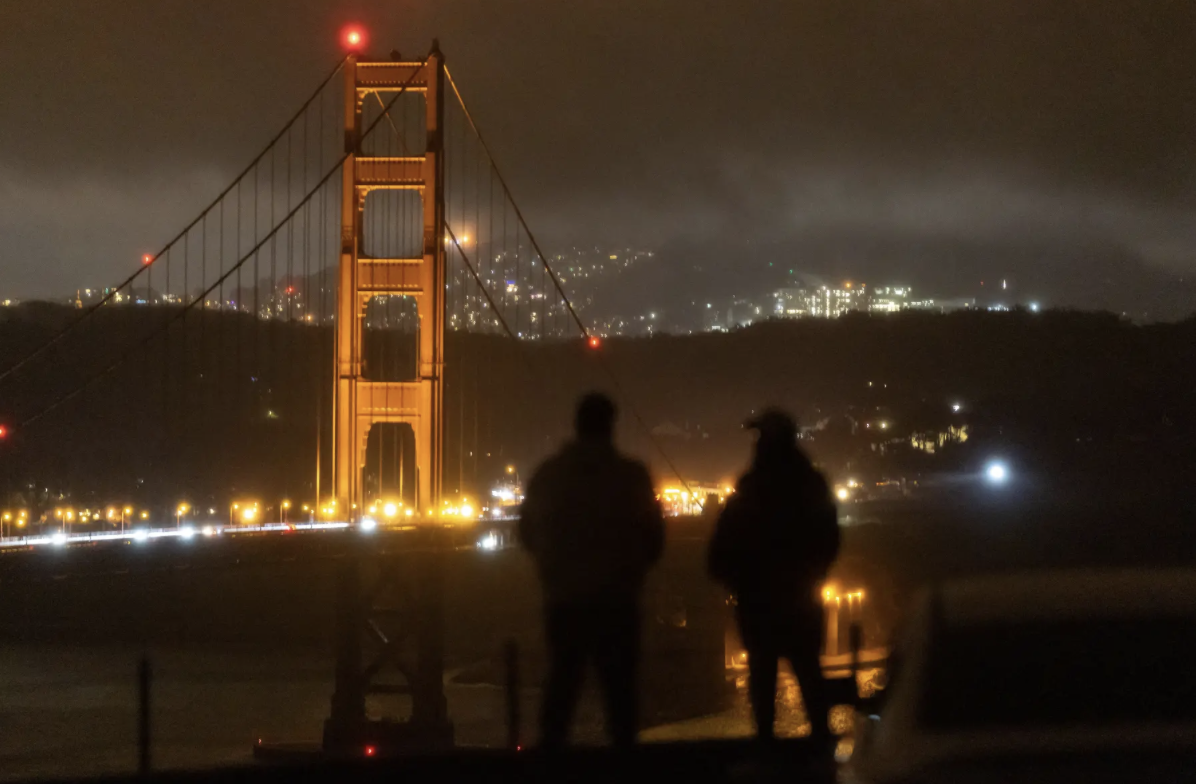
San Francisco plunged into confusion and chaos Saturday night as a massive power outage darkened nearly a third of the city—crippling traffic lights, shutting down public transit, and leaving driverless cars frozen in intersections like abandoned robots.
Pacific Gas & Electric said more than 130,000 homes and businesses lost power at the height of the outage, which spread across the Richmond, Sunset, Presidio, and Golden Gate Park neighborhoods. “It was like the city just stopped breathing,” said local resident Marina Lopez, who spent two hours trapped in traffic near Ocean Beach. “You couldn’t see anything—no lights, no signals, just the sound of alarms and horns.”
The blackout had a particularly bizarre effect on San Francisco’s fleet of Waymo self-driving cars, which rely on sensors and functioning traffic signals to navigate. Without power, the AI-operated vehicles simply froze where they stood—creating gridlock and confusion in multiple intersections.
At least four Waymo vehicles were spotted with their hazard lights flashing in North Beach, blocking an entire lane of traffic. “They just stopped dead,” said one witness who filmed the incident. “No one knew if we should go around them or wait for them to move.”
A passenger reportedly became trapped inside one of the cars for several minutes before being released.
Waymo confirmed it suspended all driverless ride-hailing services citywide around 8 p.m. “We’re focused on keeping our riders safe and ensuring emergency crews have the access they need,” a company spokesperson said in a statement.
Authorities traced the initial outage to a fire at a PG&E substation near 8th and Mission Streets. Firefighters rushed to the scene and contained the flames using carbon dioxide, but not before power failures rippled across San Francisco’s western half.
The blackout began around 9:40 a.m. and grew worse throughout the day. By nightfall, entire neighborhoods were without electricity, cell service, or public transit.
Mayor Daniel Lurie announced on X that power had been restored to 90,000 customers by 10 p.m. but warned others to stay alert. “For those of you still without power, please stay safe,” Lurie wrote. “Check on your neighbors—but remember to blow out your candles before bed.”
The blackout reignited public anger over PG&E’s reliability issues. Many residents took to social media to vent.
“Sitting here in the dark for hours with zero cell service—but hey, at least the city’s got a reparations fund now,” one user posted on X. Another fumed, “It’s unacceptable that a city with the highest electric rates in the country can’t keep the lights on.”
PG&E said crews worked overnight to restore power to remaining customers and that the grid had been stabilized by early Sunday morning.
Police increased patrols in powerless neighborhoods to prevent looting and manage stalled intersections. Rail lines, buses, and trolleys were either delayed or rerouted. “We’re asking residents not to drive unless absolutely necessary,” the city’s Department of Emergency Management said.
By midnight, the city began to flicker back to life—but the night left a stark reminder of how dependent San Francisco has become on automation and technology.
As one frustrated commuter summed it up: “The future’s here—and apparently it shuts down when the lights go out.”
Discover more from Next Gen News
Subscribe to get the latest posts sent to your email.
Another small detail that has created a mishap with traveling. My automobile has so many sensors on it that when one goes haywire it effects four to seven other sensors? If one of these sensors go out in a “Self-Driving-Vehicle”? Who is held responsible? Is it me again? The automobile? The Maker of the automobile? The designer of the chip that went bad creating more to go bizzerck? Who pays for damages? Deaths? Or do we just accept it all for technology? NO? The PEOPLE GET SCREWED AGAIN!!!!!!!!
The problem with all “self-driving vehicles” is that they usually do not operate entirely with on-board intelligence of any sort, and rely on an external system, unlike human controlled vehicles. I have written to Congress more than once asking that they force these companies to install a limited instruction set that tells the cars what to do if they lose connection to the main system. The on-board system could tell the cars to use its own sensors to pull safely to the side of the road, unlock all of the doors if passengers are inside, and turn on emergency blinkers. That simple change could have prevented a lot of these problems.