

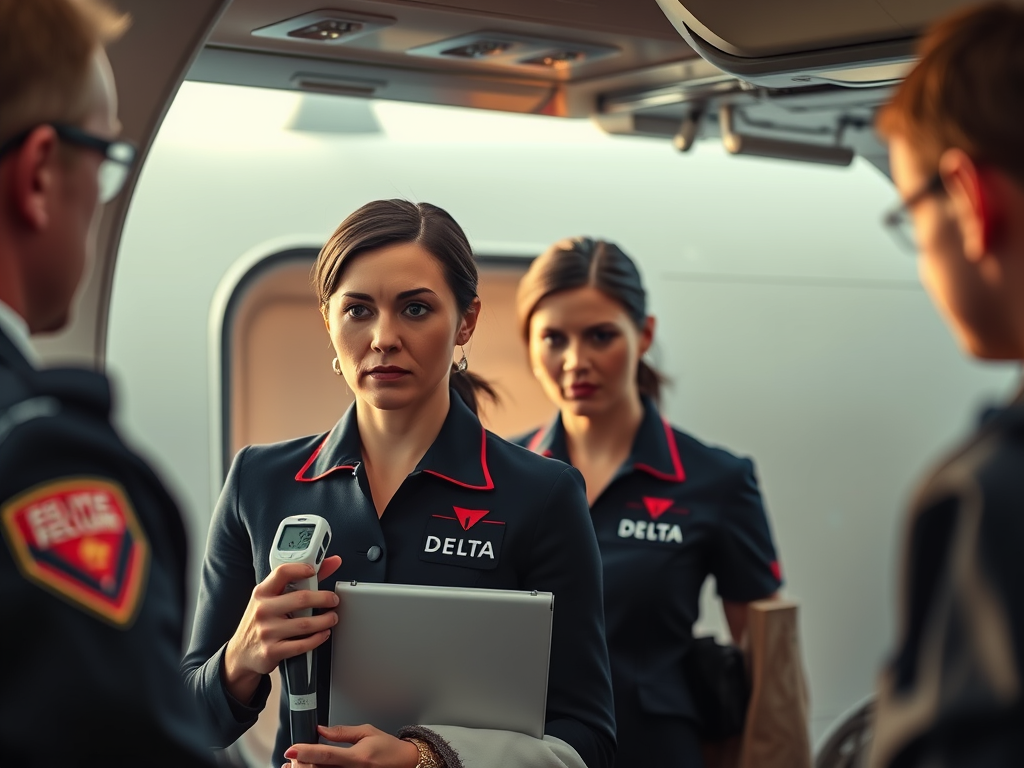
Two Delta Air Lines flight attendants were removed from a transatlantic flight from Amsterdam to New York’s John F. Kennedy Airport after failing routine breathalyzer tests — with one testing at a staggering seven times over the legal limit.
The tests were part of a random screening conducted Friday at Amsterdam’s Schiphol Airport. Of the 445 airline employees tested, three failed, including the two Delta attendants. According to Dutch authorities, the legal blood alcohol content (BAC) limit for flight crews in the Netherlands is 0.02%.
One of the Delta attendants registered a BAC of 0.024%, just slightly over the threshold. The other blew a shocking 0.143%, nearly double the legal limit for driving in the U.S. and seven times the limit for aviation staff.
Both were immediately fined, with the first receiving a $290 penalty. The second was hit with the maximum fine of $1,900.
“Zero Tolerance for Violation”
Delta Air Lines quickly addressed the incident, assuring passengers that the situation did not disrupt the flight.
“Delta’s alcohol policy is among the strictest in the industry, and we have zero tolerance for violation,” a Delta spokesperson told CBS News. “The employees were removed from their scheduled duties, and the flight departed as scheduled.”
The airline emphasized its commitment to passenger safety, noting that all employees must adhere to stringent guidelines regarding alcohol consumption.
Not an Isolated Incident
Dutch police also confirmed that a third flight attendant, working for a different airline, failed the same round of tests. That individual, whose BAC was not disclosed, was also fined the maximum penalty of $1,900.
The Netherlands enforces strict regulations for aviation personnel, requiring a minimum of 10 hours between alcohol consumption and flight duties. This policy is even stricter than U.S. Federal Aviation Administration (FAA) guidelines, which recommend an eight-hour gap.
Rising Concerns Over Crew Sobriety
Incidents like this raise questions about the pressures faced by airline crew members and the potential risks to passenger safety. While rare, such cases spark public concern, especially for travelers already anxious about flying.
According to aviation expert David Marston, alcohol-related incidents among flight crews remain low but are taken extremely seriously. “The margin for error in aviation is zero,” Marston said. “Even the slightest impairment can have catastrophic consequences.”
As the holiday travel season ramps up, airlines are under heightened scrutiny to ensure all crew members are fit to fly. “Passengers put their trust in these individuals,” Marston added. “Airlines must uphold that trust by maintaining rigorous safety standards.”
Delta has not disclosed whether the attendants will face further disciplinary action, but industry insiders suggest that termination is likely.
For now, the message from Delta and other airlines is clear: safety first, and no tolerance for alcohol-related infractions.
Discover more from Next Gen News
Subscribe to get the latest posts sent to your email.
Unsubscribe me immediately Sent from my iPhone