

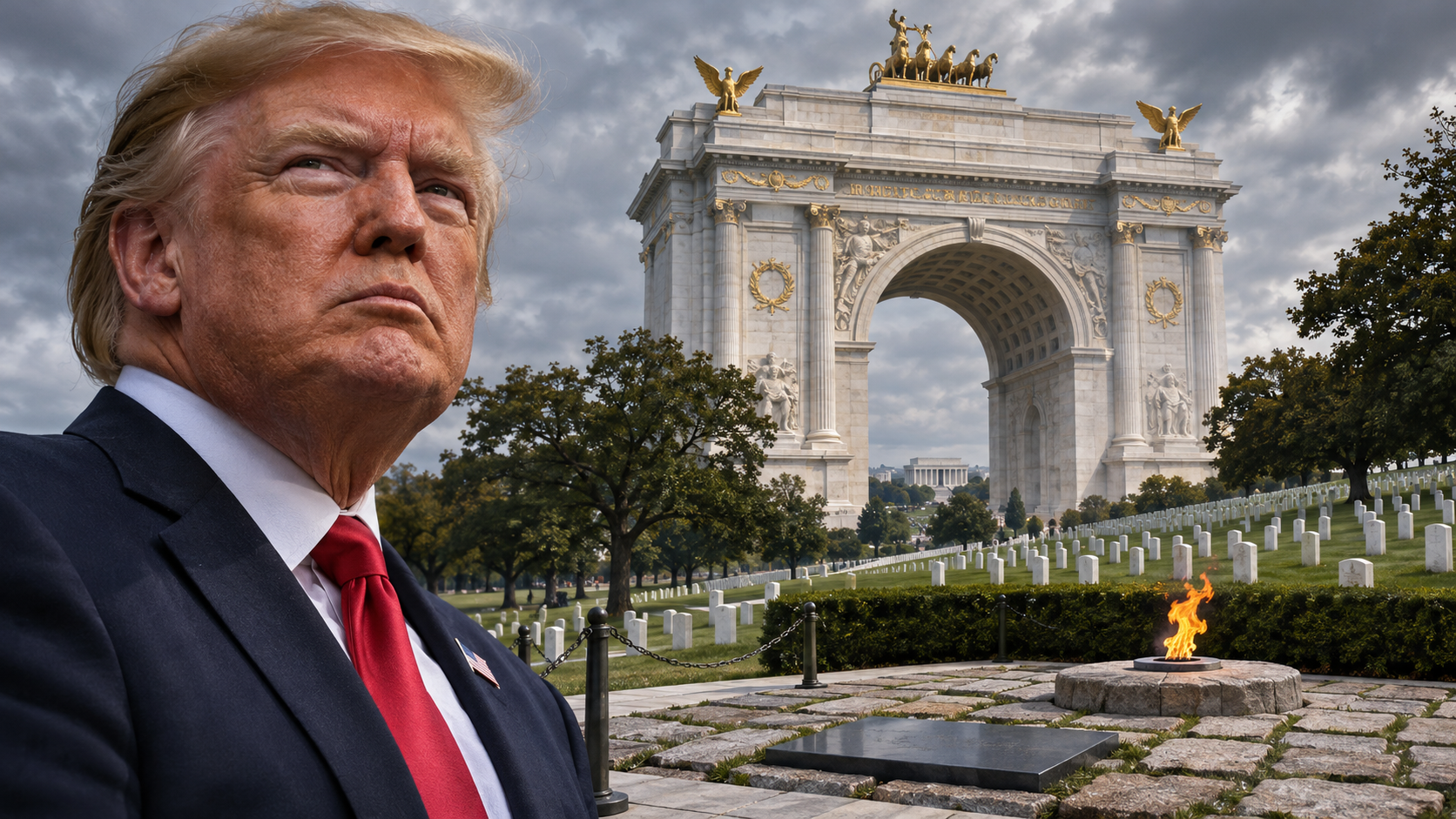
A bitter legal battle has erupted between President Donald Trump and members of the Kennedy family over plans to build a towering, gold-adorned monument near Arlington National Cemetery, where former President John F. Kennedy is buried.
Nine members of the prominent political family filed a legal motion Tuesday, November 10, seeking to block construction of Trump’s proposed 250-foot triumphal arch, warning that the massive structure could cast shadows over JFK’s grave and permanently alter one of America’s most sacred historic landmarks.
The proposed monument, which would stand roughly as tall as a 25-story building, is planned for Memorial Circle between the Lincoln Memorial and Arlington National Cemetery.
But the Kennedy family argues that Trump’s ambitious project threatens far more than the appearance of Washington’s historic landscape.
According to their court filing, the arch would obstruct views of the Kennedy family gravesites and the Eternal Flame honoring the assassinated president, while potentially casting shadows across thousands of military graves.
The dispute has already reached federal court, where U.S. District Judge Tanya Chutkan temporarily halted construction on November 5, just hours after a federal commission approved the project.
The judge’s order prevents construction-related work for 14 days while the court considers legal challenges to the monument.
Among the nine Kennedy relatives seeking to intervene are former Democratic Congressman Joe Kennedy III, Edward Kennedy Jr. and seven children of Robert and Ethel Kennedy.
Notably absent from the legal action is Health and Human Services Secretary Robert F. Kennedy Jr., who serves in Trump’s administration and has publicly broken with several members of his politically prominent family.
The Kennedys argue that the monument could permanently disrupt the solemn atmosphere surrounding the graves of JFK, his brothers Robert and Edward Kennedy, and other relatives memorialized at Arlington.
In a statement, Rory Kennedy and Maxwell Kennedy said their lawsuit was about protecting historic sites that belong to the American people.
They also accused the Trump administration of disregarding federal laws intended to protect national memorials.
The family’s concerns gained additional attention following a Washington Post investigation into the proposed arch’s potential impact on Arlington National Cemetery.
Using a digital model of the planned structure, the newspaper estimated that its shadow could reach burial sites on 284 days each year.
Even more striking, the analysis found that the shadow could touch JFK’s memorial on approximately 50 days annually and briefly pass over the Eternal Flame on 18 days.
The newspaper’s modeling also suggested that shadows could sweep across more than 75,000 graves throughout the year, including those of military veterans and their families.
Those estimates, however, have been disputed by the Trump administration.
The Interior Department said its own modeling showed that only a limited portion of the cemetery would be affected after opening hours, for fewer than two weeks annually.
The competing assessments have become a central point of disagreement in the growing controversy.
Beyond the shadows, the Kennedy family argues that the arch would interfere with a carefully preserved historic view stretching from the Lincoln Memorial across the Potomac River toward Arlington House.
That visual connection was designed to symbolize national reconciliation following the Civil War.
Their legal filing contends that the administration moved forward without obtaining the congressional authorization required under federal laws governing commemorative works.
The family is asking the court to invalidate the project’s approval and prevent construction unless the necessary legal requirements are satisfied.
Their challenge joins existing lawsuits brought by Washington, D.C., Virginia, three Vietnam War veterans and a historic preservationist.
The proposed arch received approval from the National Capital Planning Commission in an 8-4 vote on November 5, following hours of debate over its design, location and historical implications.
The monument would feature elaborate gold ornamentation and gray granite, making it one of the most prominent new structures near the nation’s capital.
Trump has championed the project as a tribute to America’s history and military heroes as the country celebrates its 250th anniversary.
White House spokesman Davis Ingle defended the administration’s plans, describing the proposed monument as a tribute to American greatness and expressing confidence that the project would survive its legal challenges.
The administration maintains that the arch would honor the nation’s military history, while opponents argue that its scale and location threaten the dignity of an important national memorial.
The controversy comes as Trump pursues several high-profile changes to Washington’s historic landscape, including a new White House ballroom.
For the Kennedy family, however, the Arlington dispute carries a deeply personal significance.
President Kennedy was assassinated in Dallas on November 22, 1963, and buried at Arlington National Cemetery three days later. His gravesite, marked by the Eternal Flame, has since become one of the nation’s most recognizable presidential memorials.
His brothers Robert and Edward Kennedy are also buried nearby, making the cemetery an especially meaningful place for generations of the family.
The relatives argue that the proposed arch would permanently change the experience of visiting those graves, as well as the resting places of countless American service members.
With construction temporarily suspended, the fate of Trump’s monument now rests with the federal courts.
The judge has not yet decided whether the Kennedy relatives may formally join the existing lawsuits or whether the administration can ultimately proceed.
What began as an ambitious architectural proposal has become a significant legal confrontation over presidential authority, historic preservation and how America honors its fallen leaders.
Discover more from Next Gen News
Subscribe to get the latest posts sent to your email.