

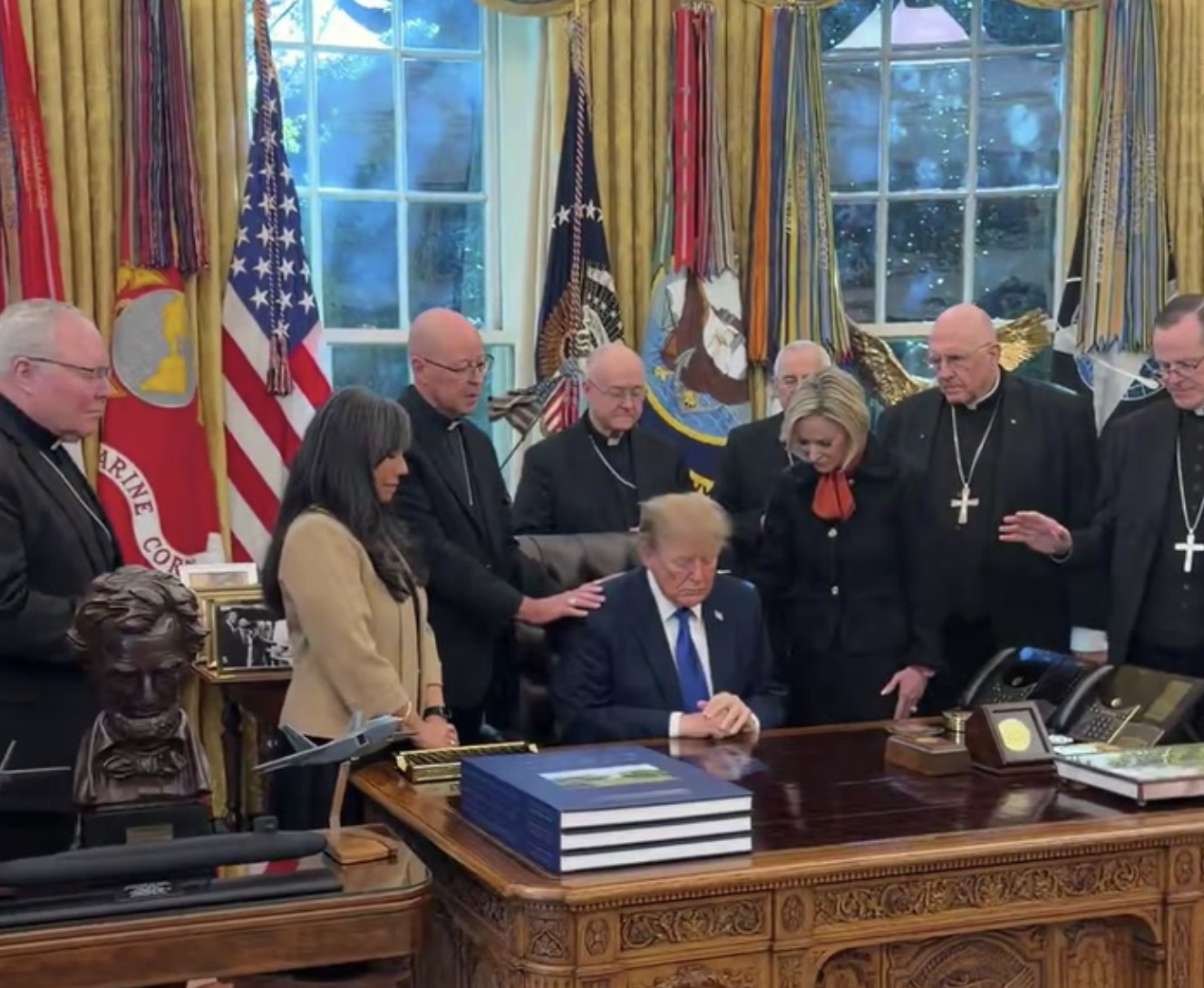
A prominent Catholic archbishop has issued a striking public apology after appearing in a White House prayer video with President Donald Trump, accusing the administration of turning a private religious gathering into a political publicity stunt just days before the midterm elections.
Archbishop Jeffrey S. Grob of Milwaukee said Sunday that he deeply regrets participating in the October 22 gathering, which brought 12 Catholic bishops to the White House for what they understood would be a private discussion about immigration, religious freedom and other issues affecting their communities.
Instead, the bishops found themselves standing behind Trump in the Oval Office as cameras captured them praying over the president. The footage was subsequently shared by White House officials, sparking criticism from Catholics who questioned whether the religious leaders were publicly endorsing Trump and his policies.
In his October 25 statement, Grob made clear that he believed the administration had taken advantage of the bishops’ good intentions.
“I feel a heavy sadness, not only over the pain I caused, but also for the fact that something so sacred to a group of religious leaders, prayer to our Heavenly Father, would be manipulated in that way,” he wrote.
According to Grob, the meeting was arranged after the bishops were invited to discuss concerns involving immigration enforcement, visas for religious workers and human dignity. They were told there might also be an opportunity to pray privately with Trump.
After spending approximately 90 minutes speaking with White House policy advisers, the group was escorted into the Oval Office. Trump greeted the bishops, presented them with commemorative tokens and sat behind his desk as they were directed to gather around him in prayer.
Grob acknowledged that photographs were taken but said the bishops were unaware that video was being recorded. He also maintained that they never authorized the administration to publicly distribute the images.
The timing made the situation particularly sensitive. The footage appeared less than two weeks before the November 3 midterm elections, raising concerns that the images could be interpreted as an endorsement of Trump and the Republican Party.
For Grob, the controversy was especially painful because he has previously spoken out against the administration’s treatment of immigrants.
In December 2025, he joined other Wisconsin Catholic bishops in criticizing federal immigration enforcement practices, expressing concern about racial profiling, family separations, poor detention conditions and the treatment of vulnerable migrants.
The bishops argued that enforcing immigration laws must go hand in hand with protecting human dignity and treating families with compassion.
Those concerns were among the reasons Grob agreed to visit the White House. He hoped speaking directly with administration officials might help improve the lives of people affected by federal policies.
But after the prayer video circulated, he began hearing from Catholics who felt betrayed by the appearance, including people whose families had suffered under Trump’s policies.
Grob emphasized that his participation was never intended as political support.
“We came in good faith to try to work for the betterment of our fellow human beings, to ease their suffering, to build up the common good, and to pray with a president, not to pose for a political photo opportunity to benefit the few,” he wrote.
The Milwaukee archbishop was not the only religious leader to express regret.
Bishop William Joensen of Des Moines, Iowa, also criticized the White House’s handling of the gathering, saying he believed the bishops had been exploited for partisan political purposes.
Joensen acknowledged that several actions taken by the Trump administration conflict with Catholic teachings. He also admitted that the religious leaders should have been more cautious about attending such a politically sensitive gathering so close to an election.
The controversy has underscored the complicated relationship between the Catholic Church and the Trump administration. Although some Catholic leaders support the president’s positions on abortion and religious liberty, others have challenged his immigration policies and warned against allowing religious institutions to become political tools.
The White House previously defended Trump’s relationship with Catholic Americans, describing his record on religious issues in strongly favorable terms. The U.S. Conference of Catholic Bishops, meanwhile, clarified that it had neither organized nor sponsored the October 22 gathering.
For Grob, the experience has become a public lesson about the risks of mixing faith with presidential politics.
“I did not go without reservations. I wish I had heeded them,” he wrote.
He concluded by apologizing to those who felt hurt or misled by his appearance, leaving little doubt that he believes the White House crossed a line by turning a moment of prayer into a public political spectacle.
Discover more from Next Gen News
Subscribe to get the latest posts sent to your email.
ALL religions hate out USA!