

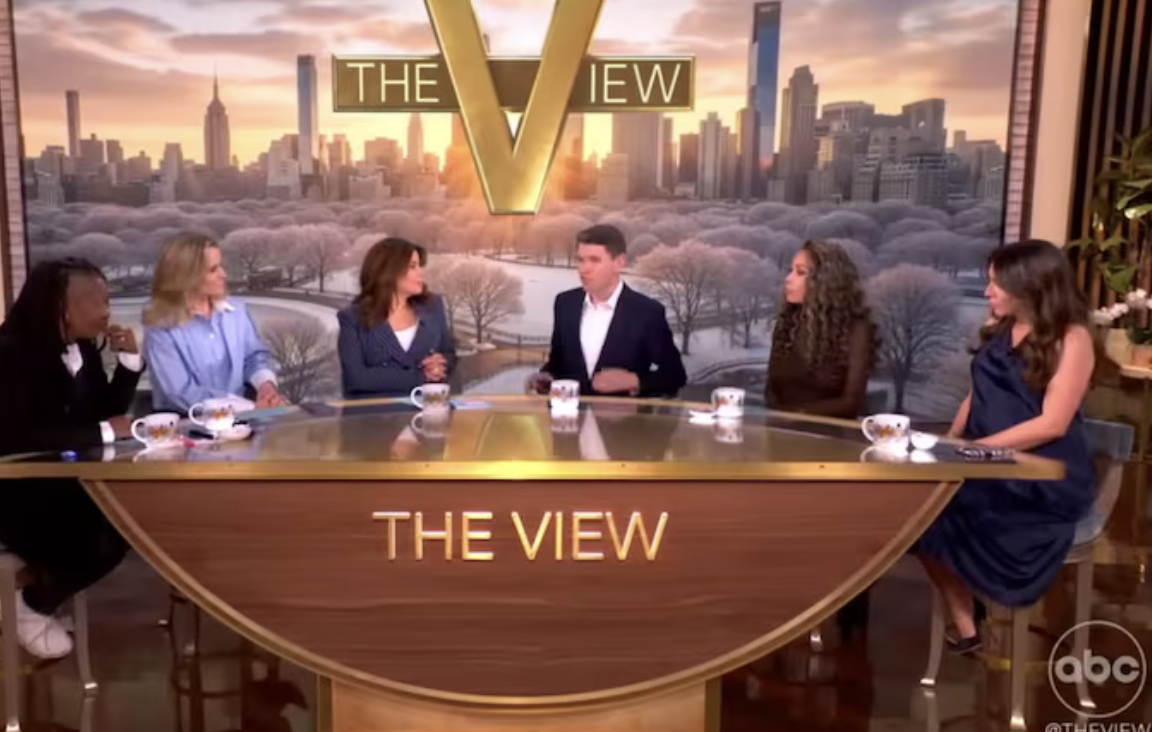
ABC says pressure from President Donald Trump’s administration has become so intense that the network is changing what it puts on television — including political coverage on “The View.”
The extraordinary admission came Tuesday during a federal court battle between ABC and the Federal Communications Commission, where an attorney for Disney argued that the administration’s actions are already having a chilling effect on the network’s editorial decisions.
“We are watching everything we do,” Disney attorney Beth Wilkinson told the court as she described how ABC has begun second-guessing programming decisions amid heightened scrutiny from the Trump-controlled FCC.
One of the clearest examples involves “The View.”
According to Wilkinson, ABC decided not to use clips of political candidates during the daytime show’s popular “Hot Topics” discussions this election cycle because executives feared doing so could trigger additional FCC scrutiny under federal equal-opportunities rules.
The decision offers a striking glimpse into ABC’s broader argument: that government pressure has become strong enough to influence what one of the country’s largest television networks is willing to broadcast.
ABC is currently suing the FCC, accusing the agency of retaliating against the network because of programming and commentary disliked by Trump and his administration.
The FCC strongly denies that accusation and says its actions are legitimate regulatory oversight.
At the center of the dispute is an unusual decision by the FCC to force eight ABC-owned television stations to undergo early license renewal reviews, even though their licenses were not scheduled to expire for several more years.
Reuters reported that such an accelerated review has not been undertaken in more than 50 years.
ABC argues that threatening the licenses of its local stations gives the government enormous leverage over the network because losing those licenses could prevent stations from broadcasting over the public airwaves.
Wilkinson compared that possibility to a corporate “death penalty.”
The controversy surrounding “The View” began earlier this year after the program hosted Democratic Texas state Rep. James Talarico, who is now the Democratic nominee for U.S. Senate.
Talarico is running against Republican Texas Attorney General Ken Paxton, a Trump-backed candidate who defeated longtime Sen. John Cornyn for the GOP nomination earlier this year.
The Senate contest has become unexpectedly competitive in a state Republicans have dominated for decades.
After Talarico appeared on “The View,” the FCC began examining whether the program was complying with the federal government’s political broadcasting rules.
Those rules generally require broadcasters that give airtime to one legally qualified candidate to provide comparable opportunities to opposing candidates.
But federal law contains exemptions for certain legitimate news programming, including “bona fide news interview” shows.
ABC has asked the FCC to formally declare that “The View” qualifies for that exemption.
In May, the FCC itself publicly acknowledged ABC’s petition and opened a proceeding to determine whether the long-running daytime program qualifies as a bona fide news interview program.
ABC argues that it does.
Until that question is resolved, however, the network says the scrutiny has affected its decisions.
And “The View” apparently isn’t the only example.
Wilkinson told the judge that ABC executives also worried about angering Trump after the network decided not to carry one of his July speeches on its traditional television network.
ABC instead streamed the speech in full on ABC News Live.
According to Wilkinson, the network made sure the speech remained available through its streaming service partly because executives feared the president would become angry if ABC did not carry it at all.
Trump criticized ABC anyway.
For Disney, those examples form part of a larger argument that the administration is using the government’s regulatory powers in ways that can pressure news organizations over their editorial choices.
That is exactly what the First Amendment is supposed to guard against, ABC argues.
The dispute intensified after FCC Chairman Brendan Carr ordered the eight ABC-owned stations to seek early renewal of their broadcast licenses.
Carr was appointed FCC chairman by Trump.
ABC filed its federal lawsuit in August, accusing the FCC of mounting an “extraordinary assault” on its First Amendment rights and attempting to punish the company over speech the administration dislikes.
The FCC has rejected that characterization.
The agency says the accelerated license review stems from an investigation into whether Disney and ABC violated federal employment rules through their diversity, equity and inclusion policies.
Government attorneys have argued that the proceeding is not retaliation over “The View,” Jimmy Kimmel or ABC’s coverage of Trump.
The FCC has also argued that ABC’s lawsuit is premature because the agency has not revoked any licenses and has not made a final decision on the renewal applications.
ABC disputes that explanation.
Disney says it has already turned over thousands of pages of documents during the DEI inquiry and argues that the extraordinary license review cannot be separated from repeated public criticism of ABC programming by Trump and Carr.
The timing has added fuel to those concerns.
ABC was ordered to begin the early renewal process shortly after Trump publicly attacked late-night host Jimmy Kimmel, another prominent ABC personality who frequently criticizes the president.
Kimmel has repeatedly drawn Trump’s fury for his nightly monologues, with the president publicly calling for ABC to remove him from the air.
Carr and the FCC have also faced scrutiny over their response to Kimmel and other programming critical of the administration.
ABC nevertheless continues to air “Jimmy Kimmel Live!” and “The View,” two programs whose hosts routinely criticize Trump and his policies.
The escalating confrontation raises a broader issue that goes far beyond a daytime talk show.
Broadcast stations use public airwaves and therefore operate under FCC licenses, giving the federal government regulatory authority that does not apply in the same way to newspapers, cable networks or online platforms.
Historically, however, that authority has existed alongside strong First Amendment protections intended to prevent the government from using licensing power to dictate political viewpoints.
That is why ABC’s latest argument is potentially significant.
The company is not merely claiming that government officials criticized its coverage.
It is telling a federal court that fear of regulatory consequences is already changing its editorial decisions.
Wilkinson described the result as an immediate chilling effect, arguing that ABC is “thinking twice” about what it broadcasts.
The FCC insists it is simply enforcing federal law.
Now a federal judge will have to decide whether the agency is conducting legitimate oversight of one of America’s largest broadcasters — or whether the government crossed a constitutional line by using its regulatory authority in a way that pressures a television network over political speech.
For viewers of “The View,” however, the impact may already be visible.
According to Disney’s own lawyer, ABC has already begun changing what Americans see on television because of what could happen if the network draws the administration’s wrath.
Discover more from Next Gen News
Subscribe to get the latest posts sent to your email.
Trump has already successfully sued ABC for lying and won $10Million from them!
ABC better keep its nose clean and stop lying unless it wants to lose even more…
Even get shut down…
Why would you do that? He is a disgrace and a big crybaby.