

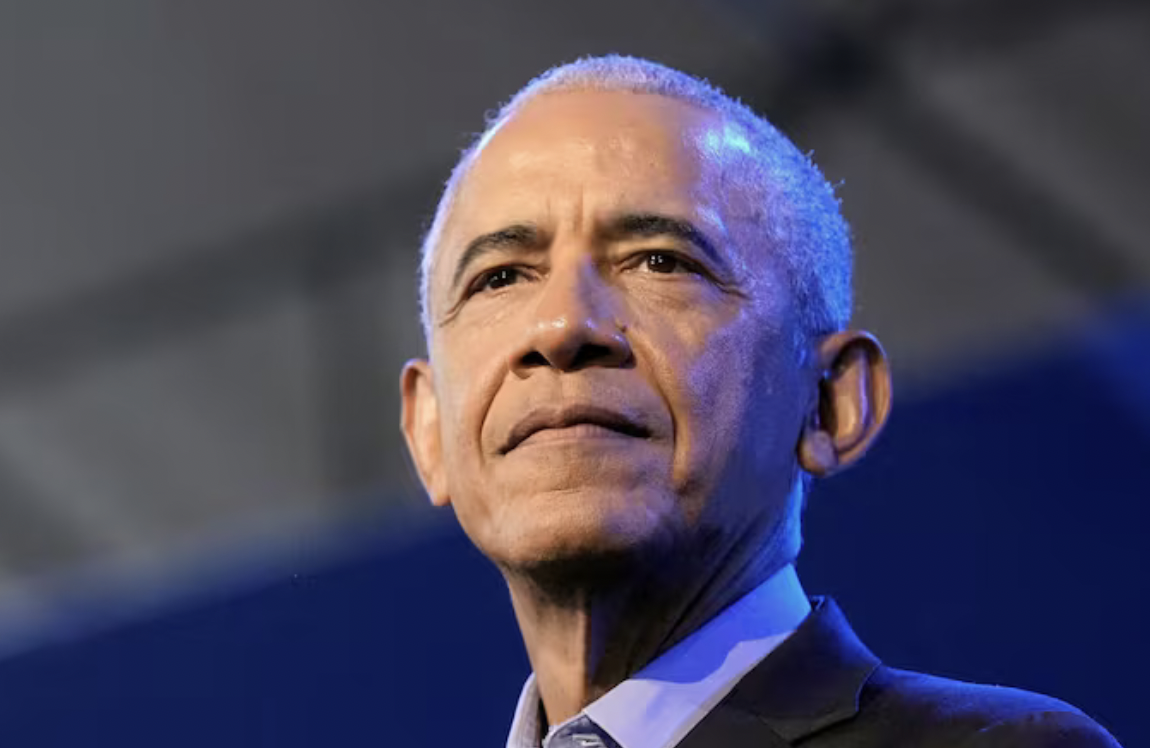
Barack Obama is stepping back onto the political stage just weeks before voters decide control of Congress — and Democrats are hoping the former president can help energize their base during the final stretch of the 2026 midterms.
Obama is scheduled to headline a Democratic Senatorial Campaign Committee fundraising event in the Washington, D.C., area on October 7, less than a month before Election Day on November 3.
The appearance will mark Obama’s first DSCC fundraiser of the current midterm cycle and comes as Democrats see an increasingly competitive path to taking back the Senate.
Obama is also expected to take part in a discussion with Delaware Sen. Lisa Blunt Rochester, a DSCC vice chair, centered on control of the Senate and the stakes of the November election.
The timing is significant.
Republicans entered the election cycle with a Senate majority, meaning Democrats need a net gain of four seats to regain control of the chamber.
That once looked like an especially difficult task. But the political landscape has tightened considerably as Election Day approaches.
The nonpartisan Cook Political Report said on September 23 that the battle for Senate control had become a “true toss up,” with its current range of possible outcomes stretching from a Democratic gain of one seat to a gain of five.
That means Democrats now have a plausible path to the four-seat pickup they need, but Cook cautioned that several of their opportunities are in states that have historically leaned heavily Republican.
Some races that were not initially expected to be major battlegrounds are drawing new attention.
Texas may be the most striking example.
Republican Ken Paxton and Democrat James Talarico are fighting for the Senate seat currently held by John Cornyn, and a string of September polls has shown an unusually close contest in a state where Democrats have not won a statewide race in decades.
A University of Texas compilation of public polling showed Talarico ahead 50 percent to 44 percent in a September 17-20 NPR/Marist survey. A Texas Southern University/YouGov survey taken September 15-19 put Talarico at 47 percent and Paxton at 46 percent.
Other recent surveys have also shown a close race, though polling remains only a snapshot of the electorate and does not guarantee the November result.
RealClearPolling’s September 29 average had Talarico at 47.6 percent and Paxton at 44.7 percent, a 2.9-point margin.
Texas is hardly the only place attracting attention.
The Cook Political Report has also moved several Senate contests in Democrats’ direction in recent weeks, including races in Georgia, Kansas and South Carolina. Still, Republicans retain substantial advantages in money and in several states Democrats would need to win, making control of the chamber far from settled.
That uncertainty makes Obama’s return to the campaign trail especially notable.
Nearly a decade after leaving the White House, the former president remains one of the Democratic Party’s most recognizable political figures, and Democrats have repeatedly deployed him during the closing weeks of competitive elections.
His involvement also comes as some Republican congressional candidates appear to be putting more daylight between their campaigns and President Donald Trump.
A CNN analysis of more than 500 Republican television ads aired during the first half of September found just 12 that mentioned Trump. Republicans and allied groups spent roughly $1 million on those Trump-related ads out of more than $160 million in total advertising during the period — less than 1 percent of their overall spending.
Democrats were doing almost the reverse.
CNN found Democratic candidates and groups had spent nearly $23 million on 95 television ads mentioning Trump during September, representing roughly one-fifth of their advertising budget. Many of those spots attempted to connect Republican candidates directly to the president and his policies.
That distinction matters because Trump himself is not on the ballot in 2026, but both parties are trying to define how much the congressional elections should be viewed as a referendum on his second administration.
Republicans are also spending heavily to protect House seats once considered relatively secure.
Reuters reported that Republican groups had poured money into 39 House races previously viewed as safer territory, reflecting concerns that the political environment has become more competitive. Republicans currently hold only a narrow House majority.
None of that means Democratic control of Congress is guaranteed.
The Senate remains highly competitive, polling can change quickly, and Republicans retain major financial and structural advantages in several of the states Democrats would need to capture.
But Obama’s decision to become more directly involved shows Democrats believe the map has expanded enough to justify bringing one of the party’s biggest names back onto the trail.
With Election Day approaching and control of both chambers potentially at stake, his October appearance could be the beginning of a much more visible role for the former president during the campaign’s final weeks.
Discover more from Next Gen News
Subscribe to get the latest posts sent to your email.
He\’s dead
Can one of The 3 Worst Presidents help anyone?
How can the second worst president, after Biden still be a dominant force at any time he should stay home and play with his money.
As far as I’m concerned, Obama committed treason against this country and all of its citizens and he should be behind bars. We’re just waiting for the arrest prosecution and sentencing .
This Leftist Fascist Democrat Obama is a blatant liar who has been a narcissistic sociopath traitor and continues to attack and discredit President Trump at every turn and doing everything he can to destroy America and our Democracy!!!! 🇨🇳🇨🇳🇨🇳🇨🇳🇨🇳🇨🇳🇨🇳🇨🇳🇨🇳🇨🇳💀💀💀💀👿👿
USA is a REPUBLIC !!! Full democracies/Communisms don’t last very long… for the same reasons…