

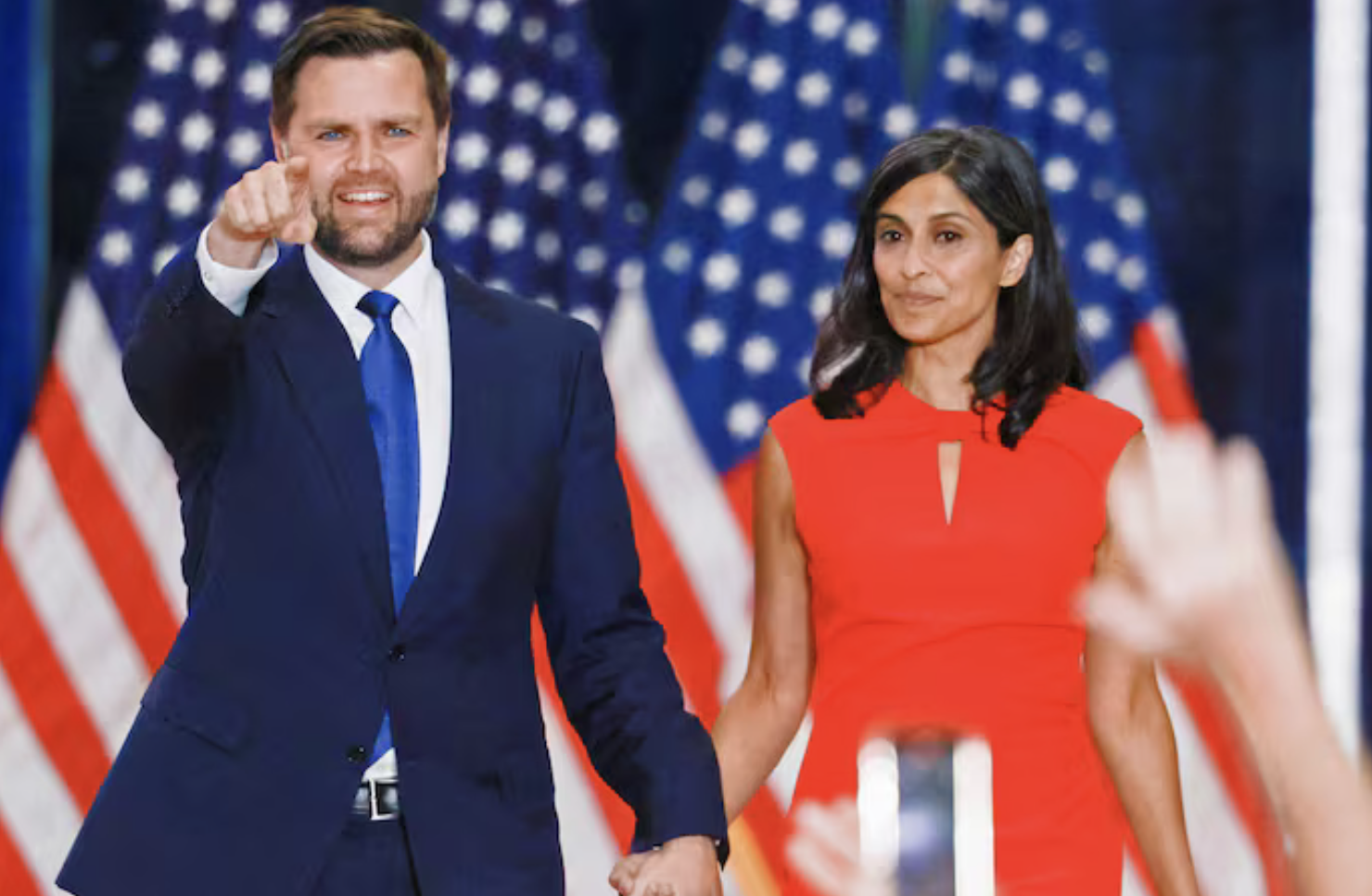
Vice President JD Vance is once again trying to explain one of the most personal political controversies surrounding his family: his public hope that his Hindu wife, Usha Vance, would one day convert to Christianity.
In a new interview with NBC News promoting his upcoming book Communion, Vance admitted that Usha has no plans to become Christian, despite his own wishes.
“And I’m OK with that,” Vance said, describing his wife as “brilliant” and “fiercely independent.”
But the admission comes after months of criticism over remarks Vance made last year, when he told a conservative crowd that he hoped Usha would eventually be “moved” by the same Christian faith that led him to convert to Catholicism in 2019.
For critics, the comment was not just a sweet expression of faith. It sounded like something else entirely: a husband publicly suggesting that his wife’s religion was incomplete.
The controversy erupted during a Turning Point USA event in Mississippi in October 2025, when Vance was asked about raising children in an “intercultural-racial-religious household.” The question centered on whether his children were being taught not to place their father’s religion above their mother’s.
Vance responded by saying that when he and Usha first met, they were both largely atheist or agnostic. But after his conversion to Catholicism, he said Usha often joined him at church on Sundays.
Then came the line that lit up the internet.
“Do I hope eventually that she is somehow moved by the same thing that I was moved by in church? Yeah, I honestly do wish that,” Vance said at the time.
He added that he believes in the Christian Gospel and hopes his wife eventually sees it the same way.
That answer did not sit well with many observers, especially within Indian American and Hindu communities. Usha Vance, who is of Indian descent and was raised Hindu, has previously said her children are exposed to Hindu traditions through her side of the family.
To critics, Vance’s answer felt less like a private reflection and more like a performance for a hard-right Christian audience.
CNN-News18 editor Shubhangi Sharma accused Vance of essentially reassuring the crowd that his wife was “raised Hindu, but not that Hindu.” Suhag Shukla, executive director of the Hindu American Foundation, told The New York Times that Vance’s comments came across as saying that an important part of Usha’s identity was “just not enough.”
Now, Vance is trying to reframe the uproar.
Speaking to NBC News, he said it was a “pretty simple observation” that a Christian who believes deeply in the faith would naturally want to share it with the people closest to him.
“Fundamentally Christianity is a faith where, if you believe in it, you would like other people to believe in it, too,” Vance said.
Still, the controversy has stuck because it taps into something much bigger than one marriage. Vance has built much of his political identity around faith, family, and cultural conservatism. But his own household reflects the kind of religious and cultural pluralism that many of his political allies often struggle to talk about with nuance.
The issue also comes as Vance faces scrutiny over his clashes with Catholic leaders themselves.
Last month, he drew backlash after appearing to challenge Pope Leo XIV over comments about war and theology amid the Iran conflict. Vance suggested the pope should be “careful” when discussing theological matters, after Leo warned that followers of Christ are “never on the side” of those who drop bombs.
That prompted a sharp response from Bishop James Massa, a top U.S. Catholic figure, who defended the Church’s long-standing teaching on war and morality.
The irony was hard to miss: Vance, who has described himself as a “baby Catholic,” was suddenly under fire not only for how he talked about his Hindu wife’s faith, but also for how he talked back to the pope.
In the NBC interview, Vance also credited Usha with helping shape Communion, saying the book “wouldn’t exist” without her. He said she helped organize chapters and cut material that did not add value.
That praise may soften the edges of the story. But it does not erase the central tension.
JD Vance says he respects his wife’s independence. He says he is fine if she never converts. Yet he also made her faith a public talking point in front of thousands of conservative supporters.
For a vice president already trying to sell himself as a serious man of faith, the controversy raises a pointed question: Is Vance defending religious conviction, or asking his wife’s identity to bend around his political and spiritual brand?
Discover more from Next Gen News
Subscribe to get the latest posts sent to your email.
Hinduism is vastly better than Catholic Christian Jew… of course, being a Normal Person is even better yet…