

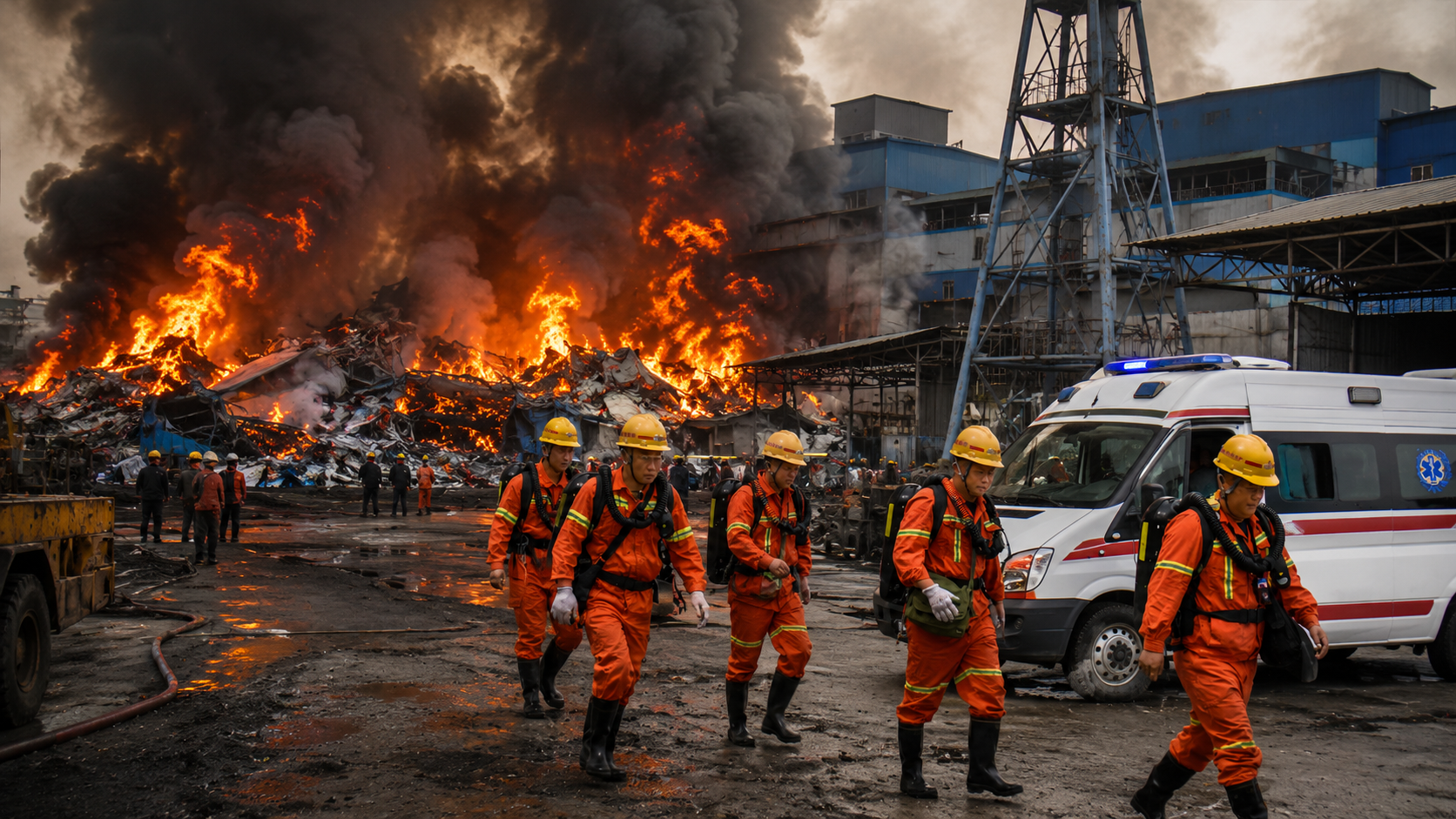
A massive gas explosion ripped through a coal mine in northern China, killing at least 90 people and leaving nine others missing in what state media described as the country’s deadliest mining disaster in years.
The blast happened Friday evening at the Liushenyu coal mine in Changzhi, a city in Shanxi province, China’s coal-producing heartland. Around 247 workers were on duty when the explosion tore through the mine, according to China’s official Xinhua News Agency.
By Saturday afternoon, more than 120 injured workers had been hospitalized. Many were reportedly overcome by toxic gas, while hundreds of rescuers and medical workers rushed to the scene in a desperate effort to find survivors.
The scale of the tragedy has already raised urgent questions about whether warning signs were ignored at a mine that had previously been flagged as dangerous.
President Xi Jinping called for an “all-out effort” to rescue the missing workers and demanded a thorough investigation into what caused the explosion. He also called for accountability “in accordance with the law,” according to Xinhua.
But early details suggest rescuers were not just fighting smoke, gas and rubble. They may also have been up against serious problems with the mine’s own records.
Chinese state broadcaster CCTV reported that blueprints provided by the coal mine did not match the actual underground layout, slowing and complicating rescue efforts at the worst possible moment.
One hospitalized miner, Wang Yong, described the terrifying seconds after the blast.
He told CCTV he smelled sulfur, “like firecrackers,” and saw smoke filling the area.
“I told people to run,” he said. “As I ran, I saw people being choked by the smoke. And then I blacked out.”
The mine is operated by Shanxi Tongzhou Coal & Coke Group and has an annual production capacity of 1.2 million tons. In 2024, China’s National Mine Safety Administration placed it on a national list of disaster-prone coal mines because of its “high gas content.”
That detail is likely to intensify scrutiny over why so many miners were underground at a site already known to carry serious risks.
Xinhua later reported that people responsible for the company involved in the accident had been “placed under control,” citing the local emergency management bureau. In China, that phrase often indicates authorities have detained or restricted the movements of people connected to an investigation.
The State Council, China’s powerful cabinet, has also sent an investigation team to conduct what state media called a “rigorous and uncompromising” probe.
The disaster puts a harsh spotlight back on China’s coal industry, which remains central to the country’s energy system despite its massive investments in solar, wind and other green technologies.
Shanxi province is the beating heart of that coal machine. Larger than Greece and home to roughly 34 million people, the province produced about 1.3 billion tons of coal last year, nearly one-third of China’s total output.
For many Americans watching from afar, the catastrophe is a grim reminder of the human cost of fossil fuel dependence. Even as China races to dominate clean energy, coal still powers much of its economy because it is cheap, abundant and deeply embedded in the country’s industrial system.
Chinese authorities have taken steps in recent years to improve mine safety, but deadly accidents continue to expose the dangers workers face underground.
In February 2023, 53 people were killed when an open-pit mine collapsed in China’s Inner Mongolia region. In November 2009, 108 people were killed in a mine explosion in northeastern Heilongjiang province.
Now, with at least 90 dead in Shanxi and nine still missing, families are waiting for answers — and for China’s latest promise of accountability to mean more than another official statement after another preventable disaster.
Discover more from Next Gen News
Subscribe to get the latest posts sent to your email.