

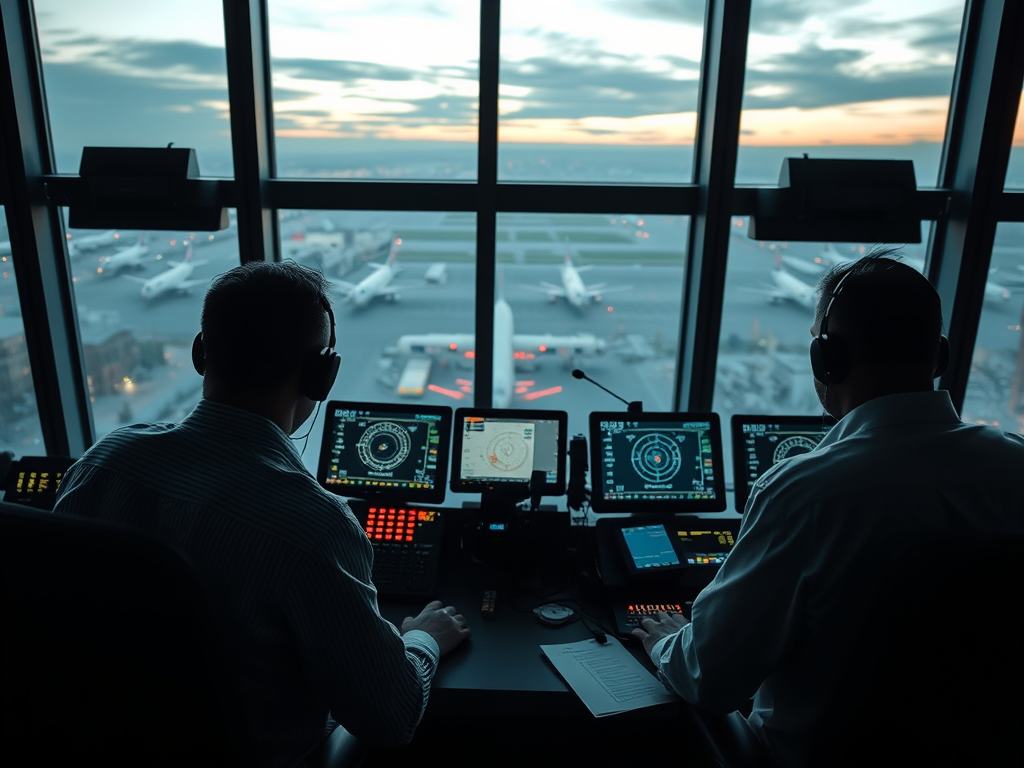
A troubling communications blackout at Newark Liberty International Airport early Friday has once again thrown a spotlight on the crumbling infrastructure and staff shortages plaguing America’s air traffic control system — and it’s happening on Transportation Secretary Sean Duffy’s watch.
At 3:55 a.m., a sudden 90-second radar and radio outage sent air traffic controllers into crisis mode as radar displays and communication lines at Philadelphia TRACON Area C — responsible for guiding aircraft in and out of Newark’s airspace — went dead. According to the FAA, the outage impacted multiple sectors and raised immediate alarms due to the airport’s already fragile safety conditions.
“A failure like this, even for 90 seconds, can be the difference between life and death,” said one veteran controller, speaking on condition of anonymity. “We’re not just short-staffed. We’re stretched to the point of collapse.”
This marks at least the second such communications failure in less than two weeks. On April 28, what officials called a “fried piece of copper wire” wiped out all contact with aircraft over Newark, with controllers reportedly left “unable to see, hear, or talk” to any plane.
“We are flirting with disaster here,” said Rep. Josh Gottheimer (D-NJ), standing just outside the terminal this morning. “It’s the second outage in just days. It’s not a glitch — it’s a warning sign.”
That warning sign is flashing red.
In April, a retired Newark controller revealed a near-catastrophic incident last summer, where a severed data line forced them to direct planes manually — from memory. “Radar contact is lost. Radar contact is lost,” they reportedly repeated over comms while trying to prevent midair collisions. The stress led to the controller’s immediate retirement.
Insiders say more than 20 percent of Newark controllers are now on “trauma leave” due to stress and burnout. One source described the control tower as operating “on a skeleton crew with frayed nerves,” adding: “Nobody wants to talk about the PTSD this job is creating.”
The FAA has advised travelers at Newark to brace for delays of up to four hours — if their flights aren’t canceled altogether.
Duffy in the Crosshairs
Transportation Secretary Sean Duffy, a Trump appointee and former reality TV personality, has come under fire for gutting aviation staffing levels under the guise of “government efficiency.” His Department of Government Efficiency (DOGE) initiative has slashed hiring and fast-tracked retirements, leaving critical sectors like air traffic control dangerously undermanned.
“DOGE is cutting red tape and eliminating the woke garbage,” Duffy declared in March. “This is how we innovate.”
But critics say what he’s really cutting is safety.
Duffy has promised billions for infrastructure upgrades — but failed to offer a clear plan to address the staffing emergency at Newark or other high-volume airports. While he was dining on tacos with his self-described “#LatinaWife” in a tone-deaf social media post Monday, thousands of passengers were stranded at Newark due to yet another walkout by controllers.
“The Secretary is posing for Instagram while our skies are running on fumes,” said Sen. Cory Booker (D-NJ). “This is not leadership — it’s negligence.”
GOP Deflection and Trump’s Blame Game
Rather than addressing the staffing crisis or failed oversight, Donald Trump weighed in on Truth Social by blaming — predictably — the Biden administration. Despite the outages occurring in his administration’s airspace, Trump insisted:
“Air Traffic problems caused by the incompetent Biden Administration, as headed by, in this case, a total novice and political hack, Pete B. I WILL FIX IT!!!”
But aviation experts point out that these breakdowns trace back to Trump-era budget cuts and hiring freezes that hollowed out critical aviation staffing pipelines. The Biden administration had made steps to reverse the damage, but Trump’s reappointment of Duffy appears to have undone those efforts — and then some.
A Crisis Years in the Making
It takes nearly two full years to train an air traffic controller — and with recruitment lagging and retirements accelerating, the U.S. aviation system is buckling. Duffy admitted last week that “we’re still three to four years away from full staffing,” even under optimistic projections.
In the meantime, airports like Newark — a major hub for international and domestic flights — are becoming increasingly volatile. The stress, underfunding, and chaos have pushed experienced controllers out and left younger recruits scrambling to hold it together.
One FAA official told The Beacon: “We’ve created a perfect storm — and now we’re flying straight into it.”
For travelers, the message is clear: Avoid Newark if you can. For lawmakers, the message is louder: Fix it now — or brace for a tragedy.
Discover more from Next Gen News
Subscribe to get the latest posts sent to your email.
I thought Atlanta was “busiest”…
StopSent from my iPhone… Marita