

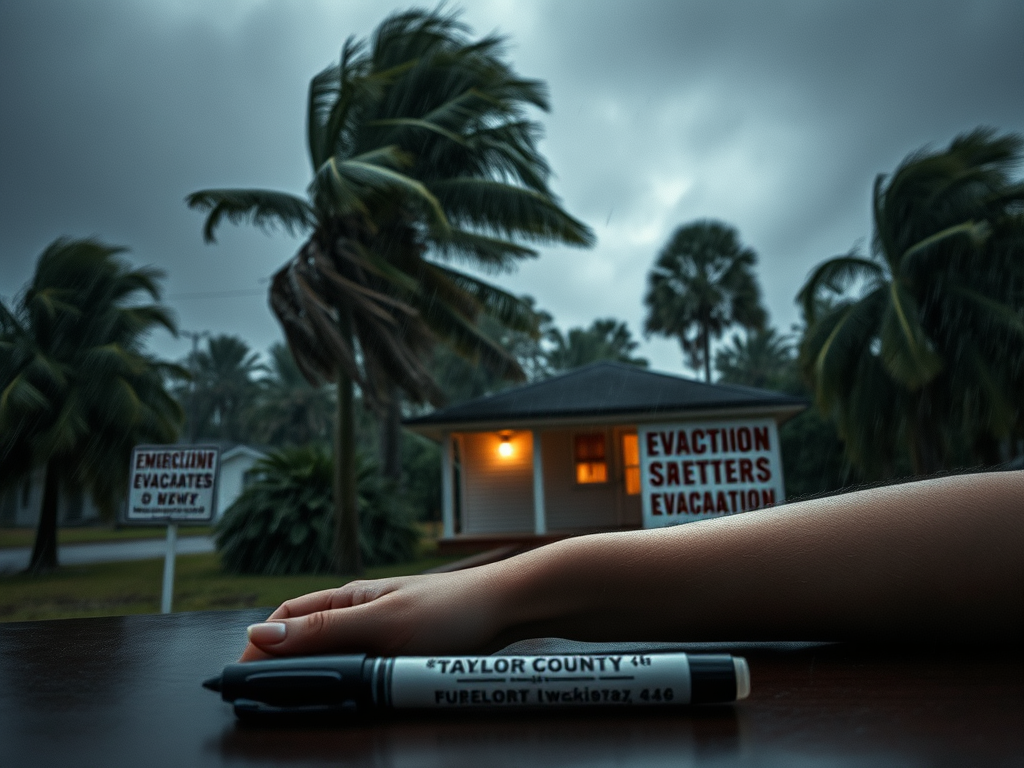
The Taylor County sheriff had a grim warning for residents who chose to ignore evacuation orders and wait out Hurricane Helene at home: Mark yourself with your information so officials can identify you later.
Taylor County expected to take a direct hit from the Category 4 storm. Sheriff Wayne Padgett said the county would be “in the dead center of” the storm.
Taylor County, in northern Florida near the Big Bend region, is home to 20,000 residents, Padgett said.
As in other spots in Florida, mandatory evacuations were ordered for Taylor County, but Padgett estimated that as much as half of his population chose to stay put.
At a certain point Thursday, officials warned it was too late for residents to change their minds and try to head out. Instead they were told to “hunker down, stay put.”
They also made a grim request:
“If you or someone you know chose not to evacuate PLEASE write your name, birthday and important information on your arm or leg in A PERMANENT MARKER so that you can be identified and your family notified,” the Taylor County Sheriff’s Office said in an announcement on social media.
The storm made landfall as a Category 4 hurricane in Florida’s Big Bend region around 11:10 p.m. just east of the mouth of the Aucilla River — about 10 miles west-southwest of Perry, Florida.
It weakened to a tropical storm as it raced into Georgia, but was still packing a punch with 70-mph winds, forecasters said.
Before Helene made landfall, a driver was killed in Ybor City outside Tampa Bay when a sign fell on top of their vehicle, according to Gov. Ron DeSantis and reports.
And in Georgia, two people died in a possible tornado from Helene’s outer bands as the storm bore down on the coast.
Experts have also warned that a large stretch of the Florida Panhandle could see “unsurvivable” storm surge of up to 20 feet.
Helene will bring torrential rainfall — approximately 6 to 12 inches — leading to potentially life-threatening flash and urban flooding, along with significant river flooding, in Florida and beyond, including two distinct areas of the rare level 4 of 4 excessive rainfall risk throughout the Southeast, weather officials said.
A state of emergency has been declared in 61 of Florida’s 67 counties, and several in the storm’s path are under evacuation orders.
Extreme wind damage is also expected up the Florida coast along I-95 into Tennessee, with widespread power outages likely.
After making landfall, Helene is expected to turn northwestward and slow down over the Tennessee Valley on Friday and Saturday. Some additional strengthening is possible, according to the National Hurricane Center.
The storm should weaken as it moves inland, but the fast forward speed will allow strong, damaging winds, especially in gusts, to impact well inland across the southeastern United States, including over the higher terrain of the southern Appalachians.
Tornado warnings were also issued throughout Florida, Georgia and South Carolina.
Helene will likely break “all the records we have” for the size of hurricanes in the modern era, Fox Weather meteorologist Cody Braud told The Post.
“We’re talking an expansive area compared to a typical storm, where maybe the tropical storm force winds only extend 100 or 150 miles out from the center,” Braud said.
“This one is essentially double that, maybe getting close to almost three times as large as a normal storm we see move through the Gulf.”
Helene — which formed Tuesday in the Caribbean Sea — developed an eye early Thursday, satellite images showed, indicating that the storm was continuing to gather strength over the very warm waters of the Gulf of Mexico.
Florida has 3,500 National Guard soldiers ready to respond to the storm, as well as 200 Florida Highway Patrol troopers at the ready and 550 generators and 40 large pumps from the Florida Department of Transportation, NBC News reported.
Helene already swamped parts of Mexico’s Yucatan Peninsula on Wednesday, flooding streets and toppling trees as it passed offshore and brushed the resort city of Cancun.
The storm also caused power outages in Cuba early Thursday.
Airports in Tampa, Tallahassee and Clearwater were closed on Thursday, while more than half of the flights to airports in Sarasota and Fort Myers were canceled, according to FlightAware.
In Atlanta, the world’s busiest airport was also beset with some delays, CNN said, as were Charlotte, NC, and Miami, Fort Lauderdale and Orlando in Florida.
Helene is the eighth named storm of the Atlantic hurricane season, which began June 1. The National Oceanic and Atmospheric Administration has predicted an above-average Atlantic hurricane season this year because of record-warm ocean temperatures.
Discover more from Next Gen News
Subscribe to get the latest posts sent to your email.