

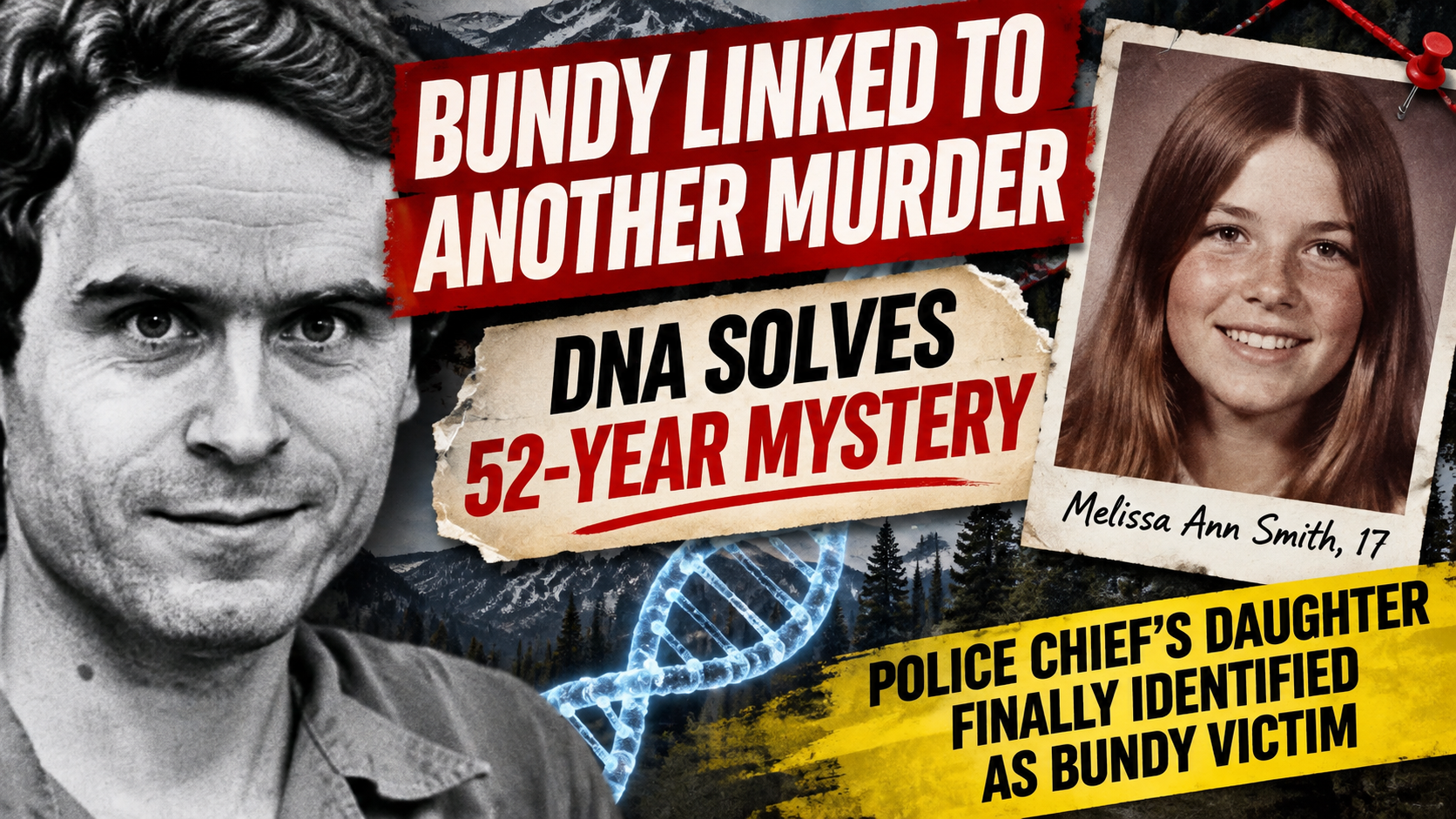
More than half a century after a police chief’s teenage daughter vanished in Utah, investigators have finally solved her murder, uncovering another chilling chapter in the horrifying crimes of notorious serial killer Ted Bundy.
Melissa Ann Smith was just 17 years old when she disappeared in October 1974. Her father, Louis Smith, was the police chief of Midvale, Utah, but even his connections to law enforcement couldn’t provide the answers his family desperately needed.
For 52 years, her murder remained an unsolved mystery. Now, a breakthrough in DNA technology has allowed investigators to officially identify Bundy as her killer, decades after his execution.
Smith disappeared on October 18, 1974, after leaving a pizza restaurant in Midvale, a suburb of Salt Lake City. Nine days later, hunters discovered her body in a wooded area of Summit County, near Park City.
Investigators suspected that her murder might be connected to other attacks on young women in Utah, but they lacked the evidence necessary to identify her killer.
That changed when detectives revisited another disturbing case involving 17-year-old Laura Ann Aime, who disappeared just weeks after Smith.
Aime vanished on Halloween night in 1974 after leaving a party in Lehi, Utah. Her body was discovered nearly a month later in American Fork Canyon.
Bundy had admitted involvement in Aime’s murder before his 1989 execution, but investigators could not conclusively establish his responsibility until April 2026, when advances in forensic testing finally provided the evidence they needed.
The breakthrough immediately raised new questions about Smith’s death.
Investigators compared preserved DNA evidence from both cases, and on July 14, 2026, the Utah State Crime Lab identified a matching DNA profile.
The findings, combined with evidence surrounding the circumstances of Smith’s disappearance and murder, convinced authorities that Bundy had killed her as well.
Summit County Attorney Margaret Olson announced the conclusion on October 27, 2026, exactly 52 years after Smith’s body was discovered.
“This DNA evidence, when considered alongside evidence related to pattern, motive, means and opportunity,” established Bundy’s responsibility for the killing, Olson explained.
The discovery was made possible partly through sophisticated DNA technology introduced at Utah’s state crime lab in 2023. The newer methods allow forensic specialists to recover usable genetic information from old, damaged or mixed samples that previously yielded few answers.
Investigators also had access to Bundy’s DNA profile, developed from a preserved blood sample discovered in Florida in 2011.
For Summit County Sheriff Kacey Bates, the announcement marked the end of an investigation that had frustrated generations of detectives.
“After 50 years, we have reached a point that so many have worked for,” Bates said while announcing the case’s closure.
Authorities confirmed that Smith’s surviving relatives had been notified of the findings. Family members, who no longer live in the area, did not attend the announcement.
Bundy was executed in Florida’s electric chair on January 24, 1989, after being convicted of multiple murders, including the killings of two Florida State University students in 1978.
He confessed to approximately 30 murders committed during the 1970s, although investigators have long questioned whether his actual victim count was higher.
And even with Smith’s case officially closed, authorities believe there may be more unanswered questions surrounding his crimes.
Utah investigators have also examined possible connections between Bundy and three other cases involving teenagers Nancy Wilcox, Susan Curtis and Deborah Smith.
Wilcox, who was 16 when she disappeared in 1974, remains the subject of an active cold-case investigation. Although Bundy reportedly confessed to killing her, detectives have not independently established his responsibility.
Investigators caution that suspicion alone is not enough to close those cases, emphasizing that they will continue pursuing evidence rather than automatically attributing every unsolved murder to the infamous killer.
For Melissa Ann Smith’s family, the answers came far too late for justice in a courtroom. But more than five decades after her death, investigators have finally established who they believe took her life, ensuring that her case will no longer remain among Utah’s unsolved murders.
Discover more from Next Gen News
Subscribe to get the latest posts sent to your email.