

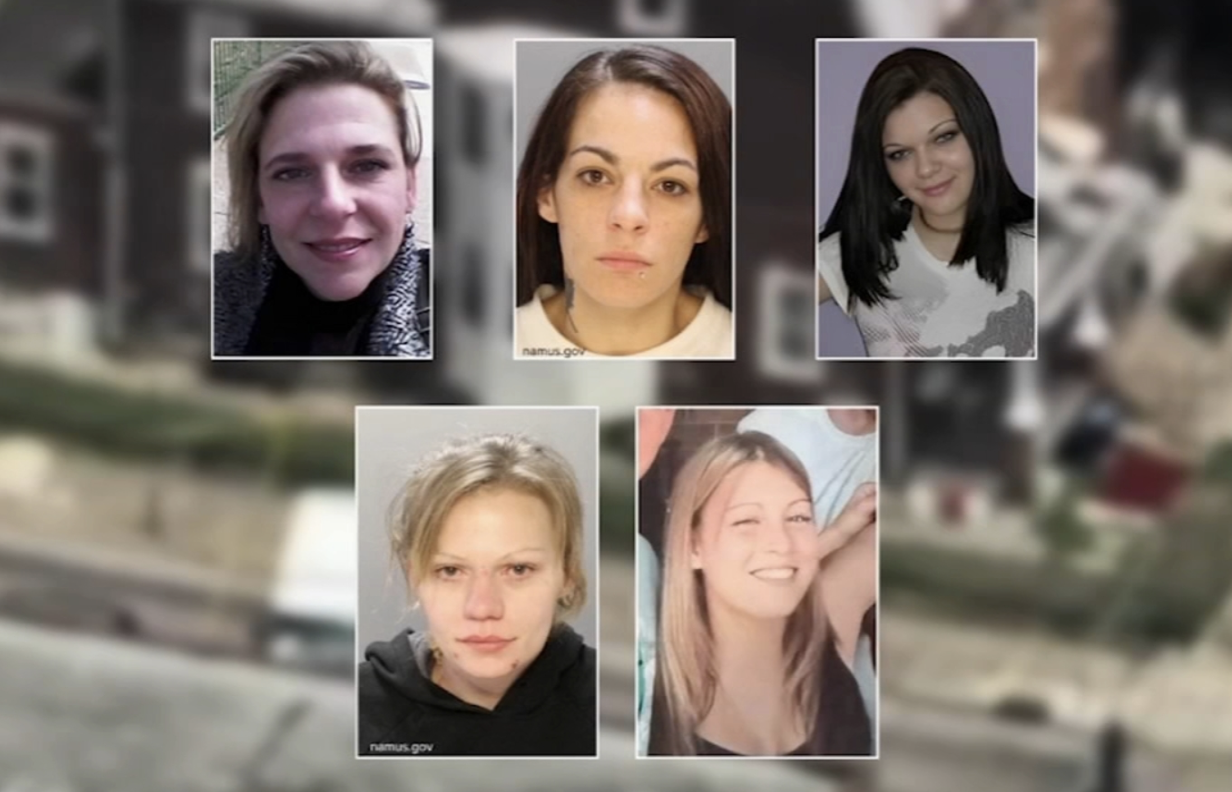
A disturbing investigation centered on a Philadelphia home has expanded dramatically, with authorities now examining possible connections to seven missing women and more than one million digital files seized from the property.
But despite growing speculation about a possible serial killer, police say there are still major unanswered questions.
No bodies have been recovered from the Olney property, no one has been charged with killing any of the women, and investigators are still trying to determine which disturbing videos depict real violence and which may have been staged.
The sprawling investigation centers on a home in the 400 block of West Chew Avenue that was occupied by 44-year-old Eugene Horsch and previously by his father, Raymond “R.C.” Horsch, who died in 2025 at age 82.
Philadelphia Deputy Police Commissioner Frank Vanore said Wednesday that investigators have identified 58 people appearing in the enormous collection of photos and videos recovered during the investigation.
Many of those people have since been located alive.
But investigators say five women appearing in some of the material seem injured, unconscious or possibly dead. Two additional missing women have also been independently connected to the property.
Police have reviewed only about 30% of the digital evidence, meaning hundreds of thousands of files remain to be examined.
The case began with an unexpected encounter miles away from the house.
On June 19, a U.S. Park Police officer spotted Horsch’s black BMW in a restricted area near Independence Hall in Center City Philadelphia.
According to court records reported by The Philadelphia Inquirer and local news outlets, an officer approaching the vehicle heard a woman inside say, “You’re going to hurt me.”
A search allegedly uncovered two loaded firearms, including a .38-caliber revolver with an obliterated serial number, as well as suspected drugs and what appeared to be fraudulent Drug Enforcement Administration credentials.
Authorities said the woman accompanying Horsch also possessed identification belonging to Blair Tonzelli, a woman who had previously been reported missing.
The encounter ultimately led investigators to the West Chew Avenue home.
What they discovered there triggered a much larger investigation.
Authorities recovered firearms and ammunition, suspected drugs, fake federal credentials, containers holding chemicals and oily substances, cremation urns and a huge collection of computers, hard drives and other electronic material.
Investigators also found writings with references to notorious serial killer Ted Bundy and material discussing methods of disposing of waste.
Police eventually excavated plumbing and sewer components beneath the property while searching for potential forensic evidence.
So far, however, investigators have not announced the discovery of any human remains.
Testing also dealt an early setback to investigators. Material inside the house that initially appeared to be blood did not test as human blood, according to law enforcement sources cited by The Philadelphia Inquirer. Investigators also had not found DNA belonging to two of the missing women during that stage of the investigation.
The digital evidence has proved far more troubling.
Police announced in August that recovered images and videos appeared to show missing women Gabrielle Amarando and Maribel Fresses inside the house.
Amarando disappeared in September 2012 when she was 22. Fresses was reported missing in February 2018 at age 27.
Investigators said some footage appeared to show the women alive while later material showed them motionless and injured.
The Philadelphia Medical Examiner’s Office reviewed some of the images and advised investigators that, assuming the material is authentic and has not been altered, the women depicted appear to be dead.
But without remains, the medical examiner cannot perform an autopsy, determine a cause or manner of death or issue the type of findings investigators would ordinarily rely upon in a homicide case.
Police subsequently uncovered even more disturbing footage.
Authorities have described video showing Raymond Horsch with a woman who appears to use narcotics before being restrained with handcuffs. Investigators say the footage then appears to show Horsch tightening a zip tie around the woman’s neck until she loses consciousness.
Police have stressed that seeing someone apparently unconscious in a video does not by itself establish that the person died.
Family members have identified missing woman Nicole Fusaro as a woman connected to the investigation. Fusaro was 27 when she disappeared in 2018.
Two additional women appearing in disturbing footage have also been identified by investigators, although authorities are withholding their names at their families’ request.
Then there are Amy McHale and Blair Tonzelli.
McHale, Raymond Horsch’s former wife, disappeared in June 2016.
Her daughter has said McHale left a voicemail indicating she was at Horsch’s West Chew Avenue home on the night she disappeared.
Tonzelli, meanwhile, had been reported missing before her identification reportedly surfaced during Eugene Horsch’s June encounter with law enforcement.
That brings the number of missing women with some connection to the investigation to seven.
Still, those connections are not all the same.
Some women appear in recovered videos. Others were allegedly known to have visited or stayed at the property. And simply being connected to the house does not establish that a person was harmed there.
That distinction is especially important because Raymond Horsch produced sexually explicit material that included sadomasochistic and violent themes.
Investigators therefore face the difficult task of determining whether graphic scenes captured on camera were staged performances or evidence of actual crimes.
Police say some people appearing in the recovered material have already been interviewed and confirmed to be alive.
Investigators also determined that at least 10 people seen in the material later died from overdoses somewhere other than the Chew Avenue property, further complicating efforts to determine what happened to everyone shown in the files.
The FBI is assisting Philadelphia homicide detectives with the massive digital review.
Special Agent Wayne Jacobs said federal investigators have been helping download, preserve and sort the huge volume of electronic evidence. Police have said the collection now exceeds one million images and videos.
That number has grown substantially since August, when authorities said investigators were dealing with roughly 600,000 images, 70,000 videos and 10,000 pages of writings and drawings.
More searches of the property are expected.
As for Eugene Horsch, his current criminal case is separate from the investigation into the missing women.
A federal grand jury indicted him July 9 on allegations that he illegally possessed loaded firearms despite a previous felony conviction and possessed fraudulent identification purporting to come from the FBI and DEA.
His attorney has previously maintained his innocence and suggested that many of the unusual materials recovered at the house belonged to his late father.
Philadelphia prosecutors later withdrew related state charges as federal authorities took over that portion of the case.
Most importantly, Eugene Horsch has not been charged with killing, assaulting or causing the disappearance of any of the women connected to the investigation.
Raymond Horsch, meanwhile, died before the current investigation began.
That leaves detectives with a particularly difficult puzzle.
They must authenticate years-old footage, identify everyone appearing in it, determine whether violent scenes were staged or genuine, find corroborating physical evidence and establish what happened to women who have been missing for years.
Until that work is complete, references to a Philadelphia “serial killer” remain speculation rather than an established finding by law enforcement.
For now, the confirmed story is disturbing enough: seven missing women have connections to a single Philadelphia property, investigators are examining footage that may depict multiple deaths, and roughly 70% of a massive collection of digital evidence still remained unreviewed as of Wednesday.
Anyone with information about the investigation can contact Philadelphia police at 215-686-TIPS (8477) or the department’s homicide unit at 215-686-3334.
Discover more from Next Gen News
Subscribe to get the latest posts sent to your email.
Looks like we’re waiting on answers to the questions… what did the people found alive have to say about it?