

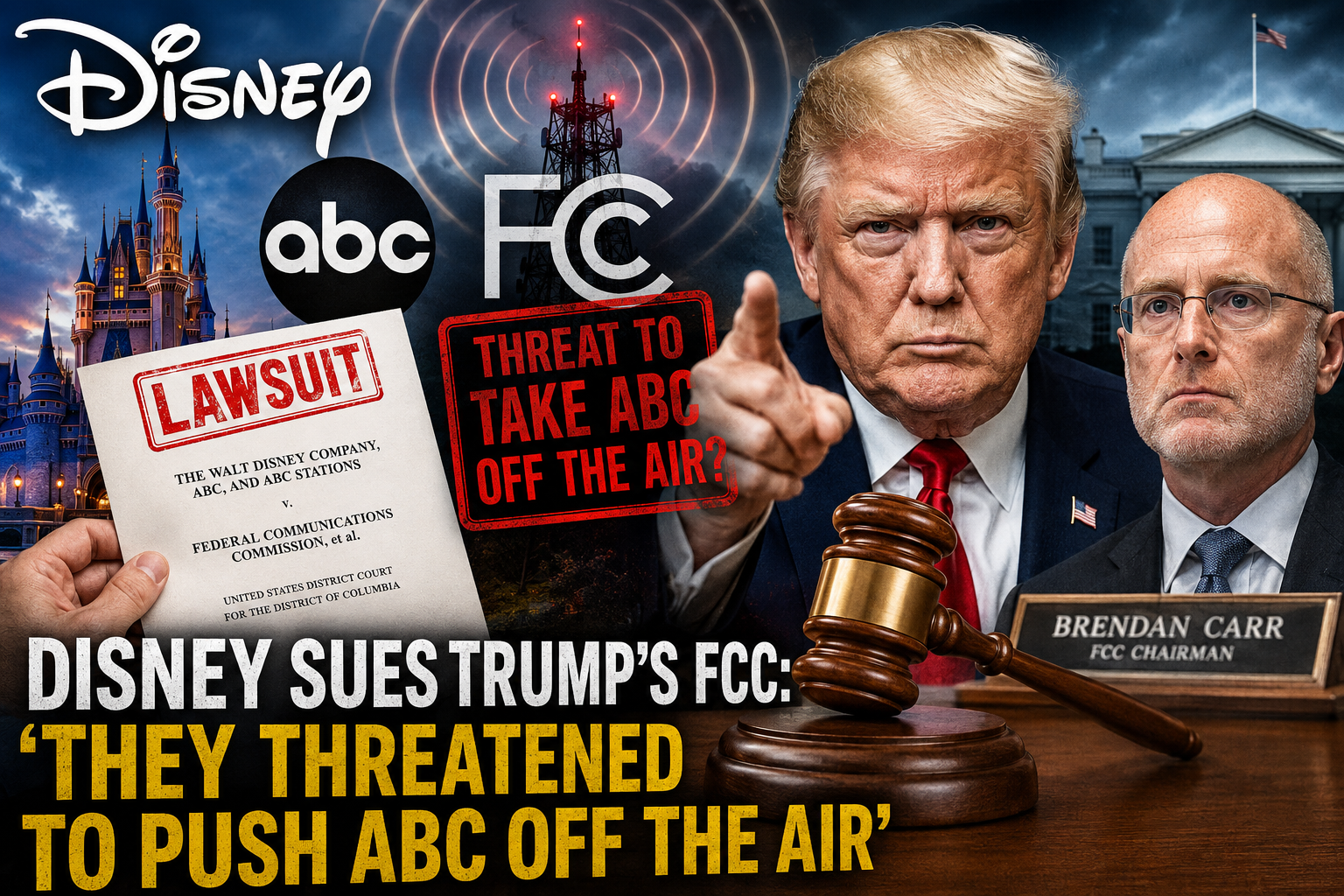
Disney has launched a bombshell legal attack against the Trump administration, accusing federal regulators of using the threat of yanking ABC stations off the air to punish the network for coverage President Donald Trump didn’t like.
The Walt Disney Company and ABC filed a sweeping federal lawsuit Tuesday, Aug. 18, claiming the Federal Communications Commission and Chairman Brendan Carr crossed a dangerous constitutional line by allegedly targeting the network with retaliatory investigations and extraordinary license reviews.
At stake are the broadcast licenses for eight major ABC-owned stations — including outlets in New York, Los Angeles, Chicago and Philadelphia.
Disney’s explosive claim is that the government wasn’t simply regulating broadcasters.
The company says the FCC was trying to scare ABC into submission.
One of the biggest flashpoints in the lawsuit is Jimmy Kimmel.
Trump has repeatedly attacked the late-night host and ABC over programming he considers unfair, and Disney says that political anger was followed by ominous warnings from the country’s top broadcast regulator.
According to the complaint, Carr warned that ABC and its corporate partners could either take action themselves or face more attention from the FCC.
Disney argues the message was unmistakable: Deal with Kimmel — or Washington could make life very difficult.
ABC temporarily pulled Kimmel from the air amid the uproar before eventually bringing him back.
But according to Disney, the pressure did not end there.
Then came the move that helped trigger the lawsuit.
The FCC ordered all eight ABC-owned stations to begin license-renewal proceedings years earlier than expected.
Disney says stations that normally would have had far more time to prepare were suddenly given just 30 days to assemble their applications.
The company asked for additional time.
The FCC said no.
Disney now argues the unusual move was not routine bureaucracy but part of a broader campaign designed to intimidate the network over its political coverage.
The affected stations serve some of the biggest television markets in America, including New York, Los Angeles, Chicago, Philadelphia, Houston, San Francisco, Fresno and Raleigh-Durham.
The media giant claims the regulatory demands quickly snowballed.
According to the lawsuit, Disney and ABC were hit with more than 600 separate information requests and forced to turn over more than 13,000 pages of material as part of two FCC investigations.
Disney says the burden itself is part of the problem.
The company argues that if broadcasters believe criticizing a president could trigger mountains of paperwork, costly investigations and threats to their licenses, they may begin censoring themselves simply to avoid becoming the government’s next target.
That, Disney says, is exactly the kind of chilling effect the First Amendment is supposed to prevent.
The lawsuit also points directly at Trump’s repeated public attacks on ABC.
The president has openly suggested the network should lose its broadcast licenses over programming and coverage he has slammed as unfair.
Disney argues those statements cannot be separated from what happened next at the FCC.
The company says Trump’s threats were followed by concrete regulatory action from an agency run by one of his appointees.
That sequence, Disney alleges, transformed angry political rhetoric into an actual threat backed by federal power.
The battle has also spread beyond Kimmel.
ABC’s daytime powerhouse The View has faced FCC scrutiny over whether appearances involving political candidates should fall under federal equal-opportunity requirements.
Disney says the pressure has already affected programming decisions, with the show reportedly steering clear of candidate interviews amid the regulatory uncertainty.
Critics of the administration say that is precisely why the case matters.
The danger, they argue, is not merely whether the FCC ever actually revokes a license.
It is whether broadcasters begin changing what they air because they fear retaliation from Washington.
The FCC has rejected Disney’s accusations and insists its actions are lawful.
Carr has said the agency is simply carrying out its regulatory responsibilities and has not made any final decision about whether ABC’s licenses are in jeopardy.
The FCC has also linked some of its scrutiny to an investigation involving Disney’s diversity, equity and inclusion policies.
Disney disputes the allegations and argues the regulatory campaign is being used as a convenient excuse to punish the company.
Carr, meanwhile, has suggested Disney may be worried about what investigators could uncover.
The accusations are not coming only from Disney.
Democratic FCC Commissioner Anna Gomez has sharply criticized the agency’s actions, accusing it of engaging in a campaign of “censorship and control.”
Her warning poured even more gasoline on an already explosive legal fight.
If Disney’s allegations hold up in court, the case could become one of the most consequential battles between the federal government and the American media in years.
Disney is asking a federal judge to intervene before regulators can go any further.
The company wants temporary and permanent court orders blocking the FCC from advancing the early renewal proceedings and preventing federal officials from using threats, sanctions or regulatory pressure to influence ABC’s editorial decisions.
The fight now threatens to become much bigger than Disney, ABC or Jimmy Kimmel.
At its core is a question that cuts directly into the First Amendment:
Can a presidential administration use the threat of federal broadcast licenses to pressure a television network over what it says about the president?
Disney says that is exactly what happened.
And now the Mouse House is taking Trump’s FCC to court to prove it.
Discover more from Next Gen News
Subscribe to get the latest posts sent to your email.
 Next Gen News Team
ABC needs to stop lying…
stop
Trump please leave
Sent from my iPadOn Aug 18, 2026,