

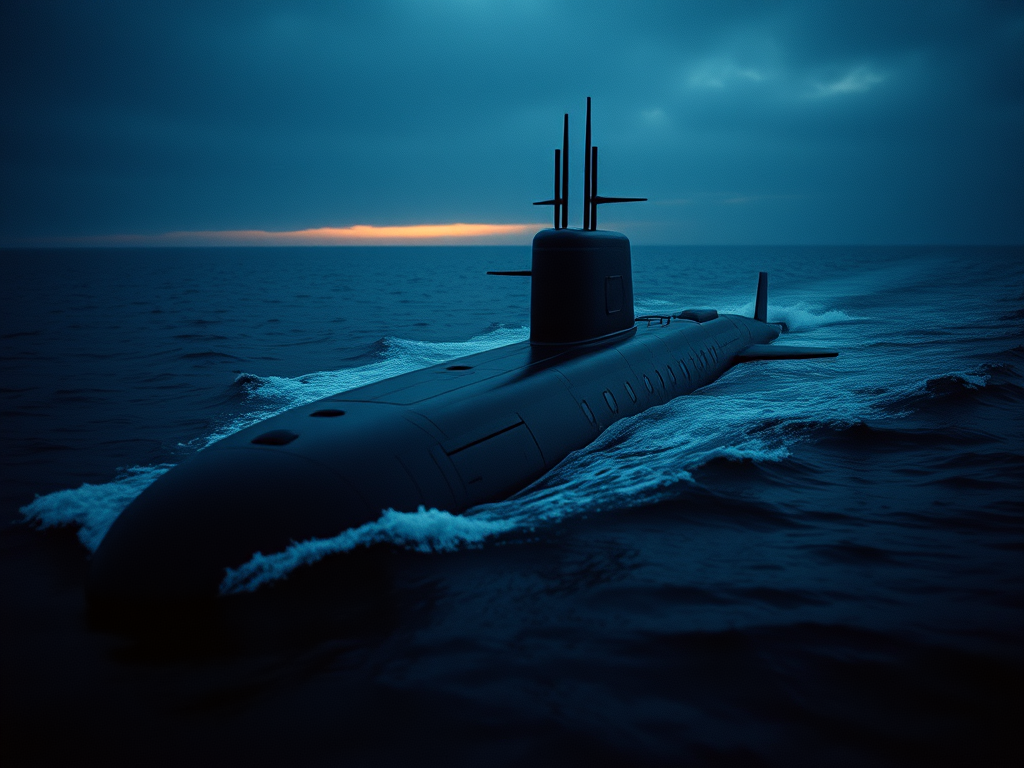
A top U.S. Navy intelligence official is sounding the alarm over China’s rapidly expanding submarine fleet — and warning that parts of the American homeland could soon fall within range of Beijing’s newest nuclear weapons platforms.
Rear Admiral Mike Brookes delivered the stark assessment in testimony to the U.S.-China Economic and Security Review Commission on Monday. His message was direct: China is no longer simply building more submarines. It is building better ones.
“These submarines will incorporate substantial advancements in nuclear reactor design, sensor performance, weapons integration, and noise quieting technologies,” Brookes said, referring to China’s upcoming Type 095 attack submarine and Type 096 ballistic missile submarine.
The Type 096, he warned, “will be able to target large portions of the U.S. from protected waters” close to China’s coastline.
The warning comes amid heightened global tensions following U.S.-Israel military operations in Iran and retaliatory strikes across the Middle East. Nuclear deterrence is once again front and center in global security discussions — and China’s sea-based arsenal is emerging as a pivotal factor.
China’s submarine force is a core leg of its nuclear triad, alongside land-based missiles and air-delivered weapons. U.S. officials are increasingly focused not just on how many platforms Beijing has, but how capable they are.
Brookes said long-term investments at China’s three major shipyards — some dating back to 2010 — have more than doubled submarine production capacity. What was once fewer than one nuclear submarine per year has grown into a sustained expansion pipeline that could stretch well into the 2030s.
“These investments… position the PLA Navy for sustained force expansion through the 2030s and beyond,” Brookes told the commission.
China’s navy currently operates more than 60 submarines. Roughly 50 are diesel-electric boats. The rest are nuclear-powered — and that nuclear segment is growing.
Projections suggest the fleet could reach around 70 submarines by next year and as many as 80 by 2035. About half are expected to be nuclear-powered, marking a significant shift in China’s force composition.
Among the most advanced platforms already entering service is the Shang III-class attack submarine. At least six of the expected eight boats have launched since 2022. These vessels are designed for anti-ship warfare and land-attack cruise missile strikes while operating with reduced acoustic signatures.
China also fields six Jin-class ballistic missile submarines capable of launching intercontinental ballistic missiles that can reach the United States from deeper Pacific patrol zones.
Meanwhile, the U.S. Navy maintains 71 submarines, including 12 Ohio-class ballistic missile submarines, attack submarines armed with torpedoes and Tomahawk cruise missiles, and four guided-missile submarines configured for heavy payloads and special operations missions.
Randall Shriver, chairman of the commission, cautioned that America’s long-standing underwater dominance cannot be taken for granted.
“China is advancing a growing fleet of increasingly capable submarines, unmanned underwater vehicles, seabed sensors and sophisticated oceanographic mapping programs,” Shriver said in opening remarks.
He acknowledged that the United States retains “significant advantages in the underwater domain,” but warned those advantages could erode without sustained investment.
That concern is not theoretical. The U.S. submarine industrial base has faced persistent workforce shortages and delivery delays affecting both the Virginia-class attack submarine and Columbia-class ballistic missile submarine programs.
While China accelerates production, the United States is battling bottlenecks.
The Type 095 and Type 096 submarines are expected to enter service in the late 2020s and early 2030s. If development timelines hold, Beijing will possess a quieter, longer-range sea-based nuclear force capable of operating closer to home while still threatening U.S. territory.
The strategic implication is clear: China may soon be able to hold American cities at risk without sending submarines deep into the Pacific.
For decades, the United States dominated the underwater battlespace. Now, Navy officials are signaling that the gap is narrowing — and faster than many expected.
The question facing Washington is no longer whether China is modernizing its nuclear fleet.
It’s whether America can keep pace.
Discover more from Next Gen News
Subscribe to get the latest posts sent to your email.
USA should be partnering with China and Russia against the always warmongering theocracies…
China and Russia become more similar to USA every day…